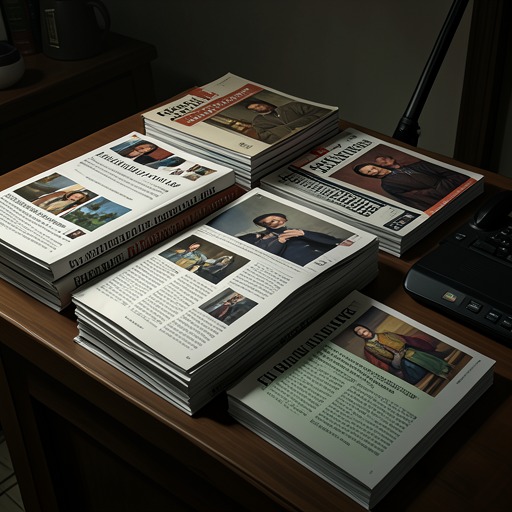
Andromeda Spaceways Inflight Magazine
Science Fiction, Fantasy and Horror Genre and Rating GuideAndromeda Spaceways Inflight Magazine is a recurring science-fiction magazine title that functions in the catalog as more than a single isolated publication. Its repeated issue entries, contributors, and links to podcasts, stories, criticism, and genre history establish it as a platform within a wider speculative-fiction culture: a place where individual works become part of an ongoing, distributed conversation.
Identity and Catalog Presence
Andromeda Spaceways Inflight Magazine appears repeatedly as a magazine-level entry rather than as one self-contained novel or story. The catalog identifies issue 20 through Stuart Barrow, issue 11 through Lyn Battersby, and issue 23 through Stuart Barrow, Zara Baxter, and Terri Sellen. Other dedicated entries identify issues 14 and 28 through Zara Baxter, issue 8 through Sally Beasley, issue 17 through Sally Beasley, and issues 13 and 26 through Andrew Finch. This pattern gives the title a serial identity: its meaning is accumulated across numbered installments and changing contributors rather than fixed by a single authorial voice.
The entries also show that the magazine is classified within science fiction and magazine publication codes, with ratings ranging from 3.0 to 4.5. The strongest listed issue rating is 4.5 for issue 17, while issues 20, 11, 23, 14, 28, and 26 receive ratings of 4.0 or higher, and issue 8 receives a 3.0. These scores do not define the magazine's entire value, but they document a sustained presence in the catalog and distinguish its issues as individually assessed works.
Serial Structure and Contributors
The magazine's serial structure creates a productive tension between continuity and variation. The same title recurs across at least eight numbered issues, but the credited names change: Stuart Barrow appears on issues 20 and 23, Zara Baxter on issues 23, 14, and 28, Sally Beasley on issues 8 and 17, Lyn Battersby on issue 11, and Andrew Finch on issues 13 and 26. Issue 23 is especially revealing because its credit joins Stuart Barrow, Zara Baxter, and Terri Sellen, presenting the magazine as a collaborative venue rather than a sequence controlled by one recurring writer.
The catalog therefore records two kinds of authorship at once. Individual contributors remain visible through their issue credits, while the magazine title supplies the larger continuity that connects otherwise different texts. The result is an organization-like literary presence built from recurrence, editorial aggregation, and shared genre address. Each issue can be evaluated separately, yet the repeated title invites readers to understand them as parts of a continuing publication history.
Media Network and Associated Publications
Andromeda Spaceways Inflight Magazine sits within a broader media network represented by the surrounding catalog. The same evidence set includes a joint entry for Stuart Barrow and Barbara Robson, Welcome To Andromeda Spaceways In-flight Duty Free, as well as Stuart Barrow's Letter From the President Earth Edition. These titles extend the magazine's identity beyond numbered issues into ancillary or adjacent forms: a named feature associated with the publication and an explicitly editorial or institutional address to its readership.
The title also appears beside The Geek's Guide to the Galaxy Podcast Episode 03: Robots! War Machines! Robolobsters!, Beneath Ceaseless Skies 10, The History Of the Science Fiction Magazine 1926-1935, Ender's Game, A Merit For Fantasy, Subterranean 4, The Full Story Of the Firstborn Assault On Mars, Diaspora, The Ascent of Wonder The Evolution of Hard SF, Bloom, The Android's Dream, and Science Fiction in China 2008. These neighboring records do not prove that every work is published by the magazine or belongs to its internal contents. They do, however, situate the magazine within a catalog ecosystem where print periodicals, podcasts, literary criticism, hard science fiction, international science fiction, and commercial or freely available genre texts are read together.
That ecosystem matters because the magazine's identity is partly bibliographic and mediating. It is not only a container for stories; it is a recurring node through which speculative fiction is organized, encountered, and compared with other media. The catalog's simultaneous attention to issue numbers, authors, ratings, and publication forms makes the magazine legible as an instrument of circulation as much as a literary object.
Genre and Editorial Significance
The issue entries are consistently marked as science fiction and magazine material, while the surrounding records include both narrative fiction and critical or historical studies of the genre. In that setting, Andromeda Spaceways Inflight Magazine represents the periodical side of science-fiction culture: a form capable of bringing multiple authors, subjects, and modes of engagement into one recurring structure.
Its significance lies in this collective arrangement. A single story can present a novum, a technological speculation, or a transformed social order, but a magazine places many such possibilities into comparison. The catalog's association of Andromeda Spaceways Inflight Magazine with work about robots, war machines, hard science fiction, the history of science-fiction magazines, and science fiction in China suggests a field in which invention is also sorted by medium, history, and cultural location. The magazine's repeated issues preserve that breadth without reducing it to one plot or one representative text.
Development Across the Catalog
The surviving issue references trace a publication that remains recognizable while its documented contributors and issue numbers change. Issue 8, issue 11, issues 13 and 14, issues 17 and 20, issue 23, and issues 26 and 28 form a scattered but substantial sequence. The catalog does not provide a complete chronology or an account of editorial changes, so the entries cannot establish how the magazine began, how its staff developed, or whether its format altered over time. They do establish persistence: the title returns across multiple points in the catalog and through several contributor groupings.
That persistence gives Andromeda Spaceways Inflight Magazine a distinctive narrative role within the book's knowledge system. It is a recurring institution against which one-off stories, books, podcasts, and histories can be placed. Its numbered issues turn publication into an observable process, while the changing author credits show how continuity can be produced without sameness. The magazine's lasting identity is therefore carried by the platform itself: an ongoing meeting point for contributors, readers, and the evolving forms of science fiction.