faeries
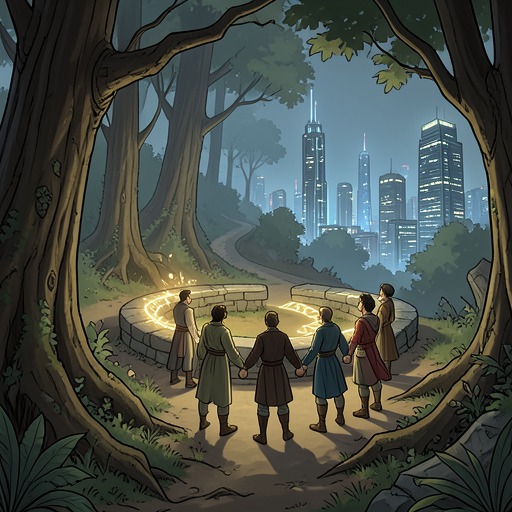
Science Fiction, Fantasy and Horror Genre and Rating GuideFaeries form a recurring supernatural category across the collection, appearing in stories, interviews, reference material, and major works of fantasy and speculative fiction. The evidence does not define one fixed biology, society, or appearance for them; instead, it shows faeries as a flexible literary and folkloric figure whose meaning changes with genre. They may be treated as beings to be framed and mounted, celebrated in communal performance, encountered alongside goblins, or placed within the older imaginative traditions of fairy tales and wonder. Their decisive significance lies in this range: faeries mark the point where ordinary social reality meets older, less controllable forms of enchantment.
A Recurring Folkloric Presence
Faeries occur in material explicitly concerned with fantasy and horror, including a collection titled Black Thorn White Rose, a work about Clapping For the Faeries, and a story titled Pip and the Fairies. These appearances place them within traditions that join wonder to danger. The vocabulary shifts between “faeries” and “fairies,” but the recurrence of the figure is more important than the spelling: faeries belong to a shared imaginative field of folk narrative, fairy tale, ghost story, and modern fantasy. Their presence suggests beings inherited from oral and literary traditions yet continually reshaped by contemporary writers.
The surrounding works also establish that faeries are not confined to children’s literature or to uncomplicated benevolence. They appear beside fantasy and horror, where the beautiful and the threatening can occupy the same scene. A faerie can therefore represent attraction without safety, mystery without explanation, or an encounter whose consequences exceed the human characters’ understanding. The category’s power comes from this unresolved doubleness rather than from a single repeated plot function.
Representation and Containment
The title Framing and Mounting Fairies gives the creature an especially revealing material context. To frame or mount a faerie implies an attempt to turn a potentially elusive being into something visible, bounded, and displayable. The wording sets mobility and containment against one another: the faerie belongs to an imaginative world associated with escape, transformation, or hidden life, while framing and mounting impose the logic of the specimen, picture, or artifact. Even without a supplied scene, the title identifies a central tension in the faerie image—the desire to preserve enchantment by fixing it in place, and the possibility that such preservation changes what is being preserved.
This tension connects the faerie to the broader history of collecting and classification. A creature that can be named, displayed, or made into an object may seem to surrender its otherness, but the very act of containment can emphasize how difficult that otherness is to master. Faeries thus occupy an unstable boundary between living presence and representation. They are not merely decorative symbols of prettiness; they expose the human wish to possess, interpret, and stabilize what remains culturally or physically elusive.
Community, Performance, and Relation
Clapping For the Faeries places faeries in a social and performative setting. Clapping is a collective gesture, and the title associates the beings with an audience’s response rather than with a solitary encounter alone. This framing allows faeries to function as participants in a shared imaginative practice: a community acknowledges them, stages attention toward them, or makes belief visible through repeated action. The title also preserves ambiguity about whether the applause is affectionate, playful, ceremonial, or ironic. What matters is that the faerie is connected to social behavior and performance, not only to private fantasy.
The collection’s other evidence broadens this relational field. The Faery Reel invokes a specifically traditional and communal image, while Pip and the Fairies places the beings in relation to a named human figure. Goblin Hunter supplies a neighboring supernatural category, showing that faeries belong to a wider ecology of nonhuman beings rather than standing alone as the sole form of the marvelous. Such adjacency matters: the faerie is defined partly through contrast with goblins, ghosts, vampires, and other figures of the uncanny, even when the supplied titles do not establish direct interaction among them.
From Fairy Tale to Modern Speculation
Faeries appear alongside classic works such as Aesop’s Fables, The Wonderful Wizard of Oz, and Alice in Wonderland. These works represent different modes of wonder—moral fable, portal fantasy, and dreamlike transformation—but together they locate faeries within a long literary continuum in which ordinary rules are suspended and human assumptions are tested. The faerie figure belongs to that continuum without being reducible to any one of its forms. It can carry the oral residue of folk belief, the structured marvel of a fairy tale, or the disorienting logic of a modern fantastic narrative.
The category also appears in proximity to works by Isaac Asimov, H. P. Lovecraft, Tim Powers, Cordwainer Smith, and J. R. R. Tolkien. The evidence does not claim that faeries directly occur in each of those works; rather, their inclusion in the same curated field demonstrates the breadth of the surrounding speculative tradition. In that field, faeries can be read against radically different treatments of the supernatural: rationalized cosmic speculation, ancient horror, historical fantasy, strange futurism, and epic myth. Their persistence across these contexts indicates that they remain adaptable carriers of questions about the limits of knowledge and the survival of older mythic forms.
Narrative and Cultural Significance
Faeries are most effective when they resist complete translation into ordinary human categories. They can be welcomed, displayed, applauded, narrated, or hunted, but each of those actions risks reducing an independent presence to a human use. The evidence repeatedly returns to that pressure between encounter and control. In a fairy tale, the faerie may open a path into wonder; in horror, the same openness can become vulnerability; in speculative fiction, it can expose the instability of the boundary between the natural and the supernatural.
As a recurring creature category, faeries therefore connect genre history with folk narrative. They preserve older structures of taboo, exchange, transformation, and uncertain reward while remaining available for revision in modern stories. Their appearances across free fantasy texts, literary classics, horror materials, and speculative works show not a single canonized image but a durable narrative instrument: faeries make visible the cultural desire for enchantment and the corresponding fear that enchantment cannot be safely owned, explained, or kept.