Andy Carlyle
Secret InvasionAndy Carlyle is a field partner in the response to the Sligger crisis, first drawn into the investigation by Ron Tully and later helping recruit specialists for work at another attack site. The scenes that introduce him define him through collaboration: he is Ron’s trusted colleague, an eager participant in the investigation, and a practical member of a team preparing to face dangerous creatures whose behavior and physical toughness are still uncertain.
Introduction and Recruitment
When a federal liaison, Gina Taylor, asks Ron to bring Andy into an investigation alongside Leslie Bickers, Andy is not presented as a remote consultant or an unknown name on a roster. Ron closes the call, shuts up his house, heads for his SUV, and phones his partner directly. Andy answers from home, where he has been relaxing, and Ron tells him they have a major job and asks him to meet at the Bio+Tech Park.
The urgency of the recruitment comes from the possibility that the specimens under investigation are alive. Leslie says they match footage of body parts and descriptions from people who had dealt with them. Ron responds with anticipation at the prospect of seeing living Sliggers; Andy’s part in the exchange is conveyed through his prompt arrival rather than through a separate account of his reaction to the discovery. The sequence places him inside the investigation at the moment it is shifting from interpreting reports and remains toward confronting a possible live specimen.
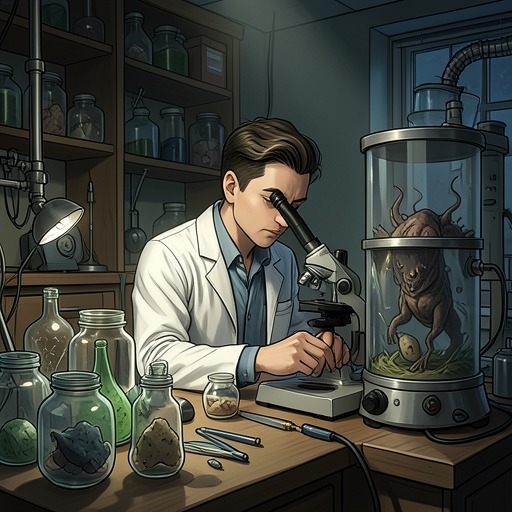
Andy reaches the VA Bio+Tech Park five minutes after Ron has arrived. His introduction gives a few distinctive physical details: his long brown hair is combed back into his usual ponytail, and a matching beard frames what is described as a boyish smile. His excitement is apparent. He and Ron greet one another as partners, and Ron locks his SUV before the two go to see what they expect may be a sea monster. The combination of familiar greeting and investigative anticipation establishes both their established rapport and Andy’s willingness to enter an unknown situation with Ron.
Partnership with Ron Tully
The repeated designation of Andy as Ron’s partner is central to his characterization. Ron calls him as soon as he receives the assignment, expects him to join the work, and makes plans with him before contacting Leslie. Andy, in turn, arrives at the meeting place and joins Ron without the scenes suggesting hesitation or a need to be persuaded. Their partnership is shown as an operating relationship: information and plans pass between them, and they travel and prepare for the investigation together.
That working bond remains visible when the investigators meet Mason Parker, Denise Baddington, and Josh Moody. Ron introduces himself as being from Richmond and identifies Andy as his partner; Andy greets the others with a nod before looking toward Josh. The moment situates him within a wider team but preserves the distinction between his established relationship with Ron and the new connections being made around the case. Andy is not introduced there with an independent specialty or separate authority. Instead, his place in the group is legible through his partnership and his participation in the shared investigation.
Expanding the Investigation
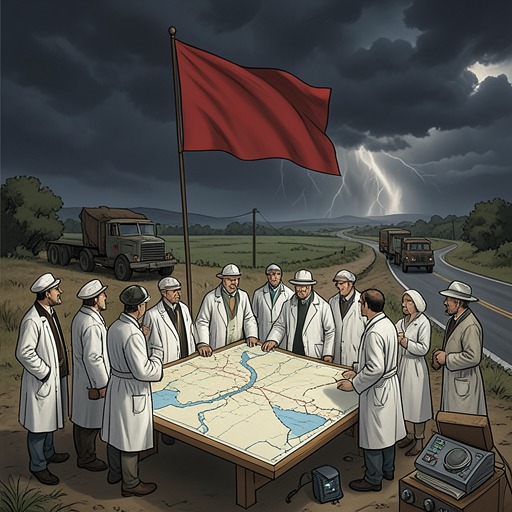
Andy also takes an active part in bringing the response beyond the Richmond laboratory. In a briefing with Josh and Denise, he describes a new attack in North Carolina: a family has run over a Sligger with their car, the body is at a nearby military base, and the investigators are driving there that day. The information is concrete and operational. The creature has been recovered, its location is known, and the team has a destination. Andy’s account helps turn a new report into the next stage of the investigation.
Ron then explains that the federal government wants Josh and Denise on the study team. The sheriff will stay behind, while the two specialists are invited to work with Ron and Andy. Denise agrees, noting that she is already employed by the same federal organization. In this exchange, Andy is one of the people carrying the investigation forward: he reports the North Carolina attack, while Ron states the recruitment proposal. Together their actions show the team growing in response to further incidents rather than remaining confined to a single laboratory or locality.
The preparations for fieldwork make the danger more explicit. The team is told to bring guns, and each member takes a Remington .45 handgun loaded with hollow-point ammunition, selected because the Sliggers may be developing tougher skin. Ron also gives Andy the second of his two flashlights. Andy asks how long they expect to be out, an apprehension prompted by the prospect of needing that equipment and spending an uncertain amount of time in the field. Ron cannot give him a duration and answers that the flashlight is for just in case. Andy’s question registers uncertainty without turning it into refusal: he remains part of the party as it prepares to go.
Characterization and Narrative Role
Andy’s characterization is deliberately relational and practical in these scenes. The text supplies a recognizable appearance and an evident enthusiasm at the Richmond meeting, then defines his place in the crisis through his coordination with Ron, his report of the North Carolina attack, and his participation in preparations. It does not establish a separate personal history, a specialized scientific role, or an independent objective. The limits of what is shown keep his function clear: he is a working member of the response whose identity within the investigation is closely tied to his partnership with Ron.
That partnership also gives the expanding crisis a human scale. Federal coordination and the spread of attacks could remain abstract, but Andy and Ron’s phone call, meeting at the Bio+Tech Park, and shared preparations render the response as work undertaken by people who rely on one another. Andy’s excitement at the possibility of encountering a living specimen sits beside his later question about how long the expedition might last. Together, those details present neither unqualified bravado nor withdrawal, but a committed investigator registering the practical uncertainty of entering the field. The scenes establish him as part of the team’s movement from evidence and reports toward direct investigation, without resolving what that work will ultimately cost him.