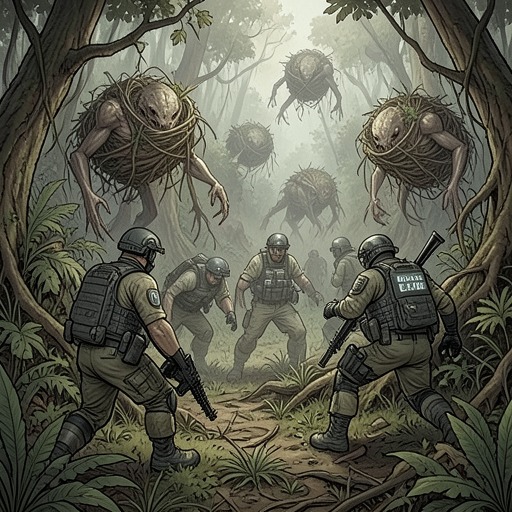
Battle at the New Orleans Riverbank Nest
Secret InvasionThe Battle at the New Orleans Riverbank Nest turns a search for hidden eggs into a close-quarters fight beneath a ruined dock. The discovery confirms that the sliggers have reached the Mississippi’s tangled shoreline, while the soldiers’ losses show how quickly a nest search can become a lethal ambush.
Background and Search
The danger had been building across a widening area. Reports from distant coastal locations led Denise to conclude that the attacks could not be traced to a single nest: multiple nests, eggs, and creatures might already be scattered along the coast. The prospect made finding the nests as urgent as responding to individual attacks. Mason’s advice was to search dark, damp places near water, then destroy both the nests and the creatures associated with them.
The origin of the infestation remained a theory rather than a settled finding. Tissue analysis had not identified what the creatures were, and laboratory results from residue recovered from a Nazi U-boat beneath Wrecker Island were still pending. Denise suspected that the residue might be a substance engineered to induce genetic mutation, accounting for the sliggers’ mixture of marine-animal characteristics and their apparent acquisition of traits through feeding. She warned that killing them carelessly could also spread mutated tissue into the food chain; carcasses needed to be collected and burned so scavengers could not carry the contamination onward.
By the time Ron’s team was operating in Louisiana, investigators had concluded that coastal currents had brought the creatures east along the Gulf of Mexico. Port Arthur, Texas, was the westernmost reported point, but Ron was more concerned about the Mississippi River and the possibility of the creatures moving inland. Troops were divided among Port Arthur, Florida, and the river route. In New Orleans, the searchers worked the river’s edge for suitable nesting places, where darkness, water, and shelter could conceal eggs and waiting adults.
The Nest and First Attack
By nightfall, the search had reached the New Orleans Irish Channel and the remains of a large wooden dock, battered by decades of hurricanes and floodwaters. Its missing upper planks left a grid of rotting beams above the water. Trees had taken root among the old joists, their roots descending into the depths, making the shoreline a promising place to find a nest. Sgt. Billingsly’s squad ventured out along the narrow sides of the beams, while Ron and his team stayed on shore with the other searchers. Flashlights picked out murky, silt-brown water beneath the structure as the squad followed the line of trees upriver.
On a shallow patch where the water gave way to mounds of exposed land, a soldier spotted a crater of mud at the base of a tree. Inside it lay ten large eggs, greenish in the beams of the squad’s LED lights. The soldier signaled the others to stop, and Billingsly warned the squad to stay alert: they had found a nest. The discovery turned the search into an immediate confrontation. The water erupted beneath them, and a tentacle lashed up against the old wood.
The soldier narrowly missed the first strike and fired at the tentacle, but the creature thrashed rather than dying. A second appendage wrapped around his ankle and dragged him out of sight. Another clawed tentacle swiped at Billingsly; he dodged, lost his balance, and fell between the beams into a few inches of water. From below, he saw multiple creatures converging and called the squad to engage. At least seven Sliggers advanced, their broad jaws, teeth, and glossy black eyes visible as the troops fired.
The squad suffered another loss when a creature seized a soldier and dragged her away; her screams continued as she was torn apart. The remaining troops tightened their formation and kept firing. Several Sliggers fell under the concentrated gunfire, but the final one kept splashing toward them. It took half a dozen shots, including two to the head, to bring it down. Ron and his team rushed from shore when the shooting began and arrived to find the dead creatures piled beneath the beams. The nest had been found and its defenders killed, but the encounter made the cost of searching such confined, waterlogged ground unmistakable: the creatures could strike from below, pull people out of sight, and withstand repeated gunfire.
Campaign Assessment and Aftermath
Four days after the creatures broke into the hotel room in Baton Rouge, Army Reserve troops sweeping the area found and destroyed a nest near the Mississippi River. Ron’s team continued north with them as the searchers followed the waterways to St. Francisville; no further nests appeared. The New Orleans fight therefore belonged to a wider effort to trace and halt movement along the river, not an isolated encounter. After the Baton Rouge nest, searchers covered another forty miles of waterways without finding a single monster.
In his assessment to the U.S. Department of the Interior, Ron summarized what the campaign had established about the Sliggers: they could reproduce asexually and evolve rapidly enough to adapt to different environments. He also reported that the creatures found during the extermination had been disposed of cleanly, with no remains left to contaminate the ecosystem. Reports from the Gulf of Mexico were improving too: federal and local authorities were encountering the creatures less often and considered the situation under control. Based on the manpower deployed, Ron estimated that eliminating the last of them would take comparatively little time, making eradication appear close.
From Local Search to Regional Mobilization
The riverbank encounter belonged to a crisis already demanding coordination beyond any one town or agency. Denise warned that the creatures could reproduce almost as quickly as they grew, allowing their numbers to outrun the response; Mason urged a public warning and notice to every police department along the coast. Ron agreed to have his superiors alert the media and contact law-enforcement agencies, while Denise insisted that responders collect and burn the creatures’ remains to keep mutated tissue out of the food chain. The fight beneath the dock gave those warnings immediate, physical stakes: a nest held ten eggs, at least seven Sliggers attacked, and repeated gunfire was needed to bring them down. The response widened to match the threat. The governors of Virginia, New York, South Carolina, Georgia, and Florida called in the National Guard, and the president ordered the United States Coast Guard to assist. Against that backdrop, the New Orleans search was one part of a broader effort to find nests across connected waterways and prevent further spread. Its outcome was not simply the destruction of creatures at one site: the encounter exposed the danger of searching submerged, obstructed terrain, while the later clean-disposal reports and the absence of further nests along the searched Mississippi waterways offered evidence that coordinated eradication could contain the expansion.