David Mittenfeld
Secret InvasionDavid Mittenfeld is the sheriff of St. Johns County, Florida, and a local law-enforcement leader confronting the sligger outbreak around St. Augustine. His two calls with Mason Parker trace a shift from confirming the first attacks and asking how to respond to managing an extended operation with civilian losses, limited manpower, and the possibility that nests have been missed. Mittenfeld’s role is practical: he supplies local reports, seeks guidance from someone with prior experience, and relays how Florida’s response develops.
Identity and First Contact
Mittenfeld first contacts Mason after Mason has sent him an email. Though the call opens with a deep, brooding voice, Mittenfeld quickly makes clear that he does not dismiss Mason’s warning as irrational. He has seen television reports about Mason’s sea-monster incidents and believes that the creatures appearing in Florida are sliggers. His recognition matters: the danger is no longer a report from a distant town that can be explained away, but a threat Mittenfeld’s own jurisdiction is encountering.
The first call establishes him as both a source of information and a recipient of hard-won advice. Mittenfeld confirms that Florida has experienced two attacks the previous night: one near the eggs found on a beach in St. Augustine, and another about twenty miles north, near Sawgrass. The geographic separation already complicates the response. The attacks cannot be treated as a single incident at one beach, and Mason immediately connects adult creatures in the area with the likelihood of another nest.
Florida Attacks and Emerging Evidence
Mittenfeld recounts the St. Augustine Beach motel attack as a sequence in which the threat becomes visible too late. A domestic-disturbance call came in at around 10 p.m.; by the time an officer arrived, the motel had called again to report animals attacking its guests. Officer Mullins contacted animal control and initially waited for help, but screams drew her into the danger. In the darkness, she saw what she described as a man-sized sea creature disappear over a railing with a dead body. She believed it returned to the ocean before she could find or stop it.
The second report, from a homeowner near Mickler’s Landing, points to another likely nest rather than a continuation of the motel scene. The caller reported someone breaking patio items and trying to get inside. Responding officers found what appeared to be a murder scene: the house smelled of rotten eggs and seawater, and slimy residue covered the windows they had broken through. Mittenfeld reckons that there are at least two nests in the area. His reports combine witness testimony and physical traces; they indicate danger and likely creature activity, but do not establish the full extent of the infestation.
Mittenfeld also admits that the eggs found earlier have not yet been treated as a danger. On reconsidering their significance, he realizes he should warn those responsible for them that they contain dangerous animals. Mason confirms the urgency, explaining that sliggers are lethal and aggressive immediately after hatching. The exchange makes the eggs more than evidence left behind by an attack: they are a potential source of another one.
Advice and Operational Response
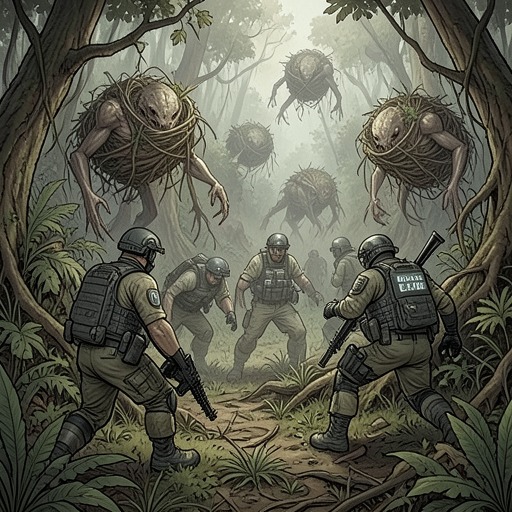
Mittenfeld asks Mason how best to pursue the creatures. Mason’s answer gives the Florida sheriff a practical sequence: search for nests in dark, wet, sheltered locations, including shaded thickets and seaside caves where currents are unlikely to disturb them; destroy both the nests and the sliggers associated with them. He warns against simply blowing creatures apart, because scattering mutated tissue into water could allow other animals to consume it and continue the cycle of contamination.
The disposal instructions are specific. Mason recommends burning the eggs, citing gasoline as a method that had worked, and using gunfire against adult creatures. He cautions that they may require several rounds, move quickly while attacking, and should be engaged from a distance. The carcasses should then be collected and disposed of cleanly, with burning again recommended. Mittenfeld says he feels somewhat overwhelmed, but that he now has the beginnings of a strategy. The call ends without suggesting that the problem is solved; it leaves him with procedures to put into practice.
Renewed Consultation and Manpower
When Mittenfeld calls again, he reports that Florida has suffered several civilian casualties, while encounters with the sliggers have, for the most part, been successful. His officers have become familiar with finding egg-laying sites, destroying nests, killing the creatures, and burning their bodies. The account marks an operational change from the first conversation: the response has acquired repeatable field practices, even as the human cost remains serious.
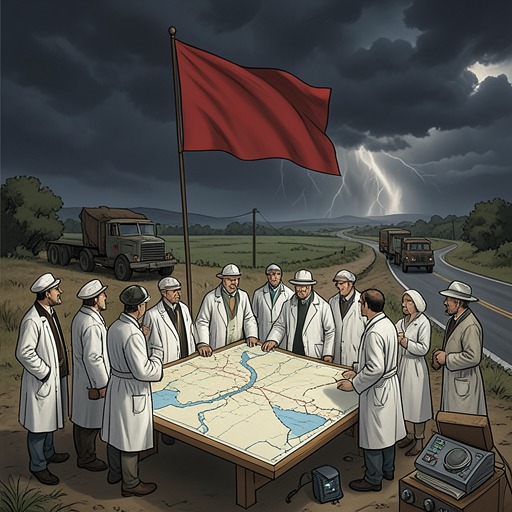
The scale of the work is still a constraint. Mittenfeld says roughly fifty officers from his department and the St. Augustine Police Department are taking shifts in the field when they are not answering other calls. The governor has called in National Guard troops to assist, but the available personnel must cover many areas and are already spread thin. Mittenfeld’s description presents the response as a problem of capacity as well as tactics: a method can be sound and still fail to cover enough ground if teams are dispersed across too wide an area.
Mason raises a further danger: the creatures are born with developing eggs already inside them, making any missed sligger a possible source of continued spread. Mittenfeld recognizes the implication and worries that the search cannot afford to miss a nest. He hesitates at Mason’s proposal to keep personnel together and clear the territory area by area, since a concentrated sweep would take longer and could leave other sites undiscovered while the outbreak worsens. Mason argues that a methodical, advancing sweep may be more thorough. The call records this disagreement as a strategic trade-off, not a settled decision; the evidence does not establish whether Mittenfeld adopts the proposed approach.
Narrative Role
Mittenfeld’s two conversations make the spread legible through local reporting: attacks near St. Augustine Beach and Sawgrass, a separate scene near Mickler’s Landing, casualties, staffing levels, and the arrival of National Guard support. The details also distinguish confirmed reports from inference. Officers find residue and a disturbing scene; Mittenfeld and Mason infer nests and discuss the risk of missed eggs, but the calls do not provide a complete map of Florida’s outbreak.
His role is therefore less that of a solitary monster hunter than of a sheriff coordinating a response under uncertainty. He takes Mason’s experience seriously, asks for advice, and describes both the procedures his officers are learning and the limits on their reach. The progression from a first, unsettling pair of attacks to casualties and a field operation shows how quickly local incidents become a sustained public-safety problem—and how even growing competence cannot remove the difficulty of finding every nest in time.