Delacroix
Secret InvasionDelacroix is a Louisiana community where the book’s Gulf Coast crisis becomes a close, local encounter: airboat operator Paul Fontenot finishes a routine day of work, takes a party of visitors into the waterways, and is seized by a creature in the bayou. The episode makes the landscape more than a backdrop. Its marshes, wooded banks, and rivers connected to the ocean provide both a setting for recreation and a network along which danger can travel.
Waterways and Everyday Life
The chapter introduces Delacroix through Paul’s ordinary evening. After tying his airboat to the pier, he sends the tourists ashore row by row, accepts their tips, and wishes them a good day. It is his last tour; he returns the key, clocks out, and drives home. The commute takes about half an hour, and he casually cruises in his pickup while singing along to the radio before arriving a little after five-thirty.
At home, Paul heats gumbo from the refrigerator, opens a beer, eats, and settles toward an evening in front of the television. The routine is specific and unhurried: a familiar meal, a drive, a shift ending at the pier. Yet he cannot simply stay in for the night. His work as an airboat operator continues after the tourist day is done, and he leaves home again to take another group out.
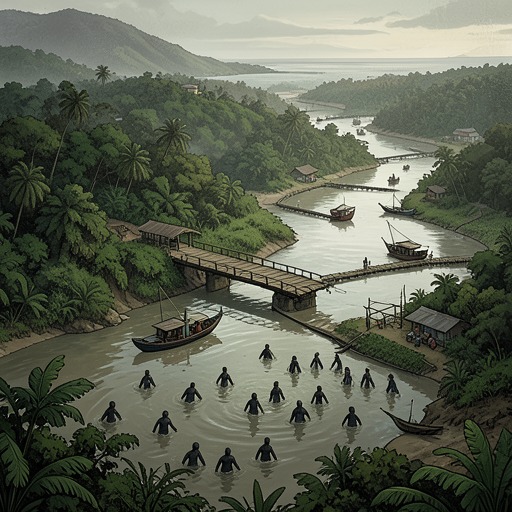
The route beyond the dock passes through woodlands and marshes threaded by rivers connected to the ocean. The party travels by flashlight beneath oak and cypress branches, with Spanish moss hanging down over the narrow waterways. These details establish a landscape in which land and water continually meet, and in which visibility is limited once the boat leaves inhabited areas. The trip begins as an excursion, but its setting makes the boundary between spectacle and peril precarious.
Paul Fontenot’s Night Tour
Paul starts the motor and steers away from the dock, controlling the rudder with one hand. Once the boat is far enough from inhabited areas, he presses the throttle further and the propeller drives the airboat faster. The guests enjoy the sudden speed. The excursion’s pleasures—movement, open water, and a close view of the wooded waterways—are still intact when the group encounters an adolescent alligator.
Paul stands waist-deep in the water with the gator held against his chest, posing while four friends in the boat take pictures. The moment turns abruptly. Something dark and ropelike wraps around the reptile and rips it from his grasp, nearly pitching Paul forward as the animal vanishes into the bayou. A monster then erupts in the water in front of him. In the flashlight beam, Paul briefly sees olive-green, glistening skin, huge eyes, and a long-toothed snout. Something grips him around the waist and pulls him under the surface.
The attack transforms Delacroix’s familiar working landscape into a site of sudden disappearance. The episode does not establish what happens to Paul after he is taken beneath the water; it leaves his fate at the moment of seizure. The contrast is sharp: the same waterways that carry a paid evening tour also conceal a creature powerful enough to take both the alligator and its handler.
Place in the Gulf Coast Outbreak
Delacroix’s significance widens after the attack as investigators piece together reports from the Gulf region. Ron’s group finds accounts of incidents in Alabama and Mississippi, with missing people but no confirmed victims in those reports. Andy also reports that people have gone missing on the bayou south of New Orleans, including a group of lawyers from Houston on a bachelor party. Ron judges these disappearances likely to be part of the migration that has moved up the Mississippi River. The report links the bayou region to the wider pattern, but it does not by itself confirm the fate of Paul or identify every missing person as a victim of the same attack.
The investigation also identifies Port Arthur, on the Texas-Louisiana border, as the furthest west point where the creatures have been reported. The team reasons that coastal currents have brought them along the Gulf of Mexico, moving east from somewhere farther west. These conclusions are presented as an evolving account of spread: reported incidents establish a widening geography, while the current-based explanation and the proposed migration route remain investigative interpretations.
The response plan reflects the scale of that geography. Ron recommends sending a third of the troops to Port Arthur, another third westward from their existing position in Florida, and the final third to the Mississippi immediately to follow the creatures’ trail upriver. Delacroix sits within this network of coastal currents, bayous, and river routes—not as a proven point of origin, but as a place where the threat becomes visible in a personal encounter and where later reports contribute to the effort to understand its movement. Its ordinary pier, tourist traffic, and connected waterways give the crisis a local face while showing why tracking it requires attention to the larger Gulf and river system.