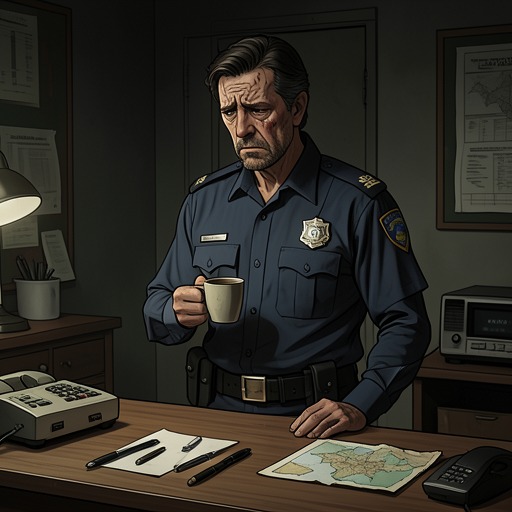
Demarcus Johnson
Secret InvasionDemarcus Johnson is a deputy in Mason Parker’s sheriff’s office whose brief appearances establish him as both a familiar presence at the station and a field partner in the search for Sligger nests. His scenes move from ordinary workplace banter to an increasingly tense patrol along the coast: he greets Mason with easy respect, takes the threat seriously enough to arm himself, and stays beside the sheriff as they search into the fading daylight.
Identity and Introduction
Demarcus is introduced at the police station, where he is working at the desk when Mason arrives with a coffee tumbler. Their morning greeting is informal but clearly shaped by their roles: Demarcus addresses Mason as sheriff, while Mason calls him by his first name. The exchange presents a workplace in which authority and familiarity coexist without ceremony.
A small joke about Mason’s wind-mussed red hair gives the introduction its everyday texture. Demarcus notices the sheriff’s hair sticking up and points it out; Mason checks his reflection in the glass door, pats it back into place, and jokes about adopting the look. Demarcus answers with a smile. The moment does not advance the investigation, but it establishes that the two can share a light exchange before the story turns toward the danger outside town.
Demarcus is also attentive to the condition of his colleagues. When Mason asks how Lewis Simkins looked after the overnight shift, Demarcus reports that Lewis seemed tired and adds that this has been happening more often. His observation is brief and matter-of-fact, but it shows him noticing the pressures of station life rather than treating the desk as a place detached from the people working there.
A Familiar Partner at the Station
Later, when Mason returns to the station after lunch, Demarcus is still manning the desk and gives his boss a friendly salute. Mason asks him to join a wildlife patrol along the coastline to look for Sligger nests, and Demarcus agrees. His response is practical: he asks where they are going, then accepts the assignment once Mason identifies the coast as their search area.
The exchange positions Demarcus as a deputy who can be called from routine station duty into a hazardous field task. He does not need to be persuaded at length, and his willingness to go is followed by a concrete decision to prepare for danger. When Mason explains that the patrol is a duty to protect the town, Demarcus says he will bring firepower just in case. His concern is not abstract: the search may put them in the path of the creatures they are trying to locate.
Mason shares that caution. He arranges for Deputy Henner to watch the station, then the two men arm themselves with shotguns and plenty of shells, check their sidearms, and take extra 9mm hollow-point magazines. Mason also places two full cans of gasoline in the cruiser’s trunk. The preparations show the scale of the risk surrounding what might otherwise sound like a routine wildlife patrol; Demarcus’s choice to bring weapons is part of a coordinated effort rather than an impulsive departure.
The Coastal Search
Mason drives north to Pirate’s Bend, where the first Sligger lair had been discovered a year earlier. The rocky cove gives them a starting point for a methodical search. They begin at its southern end and work their way along the shoreline, checking gaps between rocks for Sligger eggs. Mason has seen enough eggs to recognize them and describes them again so Demarcus knows what to look for. The search takes more than two hours to cover the cove.
Finding nothing there, they continue north. They look not only for eggs but also for possible signs of a nest: piles of nesting material, craters in the sand, or tracks left by a Sligger’s legs and tail. When the coastline reaches an inlet, a wide river prevents them from crossing on foot. They therefore continue searching the accessible southern side, moving among the rocks and nearby vegetation before following the river inland.
The terrain makes the work slow. Sweetgrass and long cordgrass could conceal eggs, so the men take care to inspect the ground beneath the thick growth. Oaks and pines provide shade as they proceed along the river. Demarcus is not portrayed as independently identifying a nest; instead, he participates in the careful sweep and follows the search method Mason has explained. The threat remains unseen, but the need to inspect each patch of cover keeps the possibility of an encounter present.
Apprehension, Persistence, and Significance
That possibility briefly becomes immediate when grass rustles. Both men freeze. Demarcus whispers a question, and Mason raises his shotgun and tells him to stay still. As something darts through the grass, Demarcus points his own shotgun toward the movement, though his hands are shaking. The animal that emerges is only a large river otter, which jumps into the water. The men lower their weapons in relief, and Demarcus admits how badly the surprise frightened him, turning the moment’s tension into rueful humor.
The relief does not end the patrol. Mason moves forward, and Demarcus stays beside him as they cover roughly another quarter mile along the river without finding eggs or a nest. By then the sun is sinking, and both men recognize that daylight is running out. Demarcus asks whether they should stop. Mason decides to use the remaining light to cover more ground, explaining that darkness would make it harder to see the enemy and that the pair are not equipped to face a group of Sliggers at night. A larger company of armed hunters would be safer, but the patrol continues for the time they have.
Demarcus accepts Mason’s decision and continues searching at his side. The chapter leaves the outcome open: no nest has been found in the areas they have covered, and their patrol has not yet ended. His role in these scenes is therefore not that of a discoverer or a lone hero, but of a deputy who shares the work of protecting the town—observing, preparing, reacting honestly to danger, and remaining with his partner as the search presses against the limits of daylight.