Denise Baddington
Secret InvasionDenise Baddington is a marine biologist employed by the U.S. Fish and Wildlife Service and stationed in Sweetboro to investigate the Sliggers that attacked the town. Her importance to the crisis lies in the questions she pursues: what made the creatures, how they reproduce, and how their remains might spread the danger beyond the original attacks. Her investigation links biological uncertainty to a practical warning—killing a creature is not enough if its altered tissue enters the food chain or its eggs remain undiscovered.
Identity and Investigation
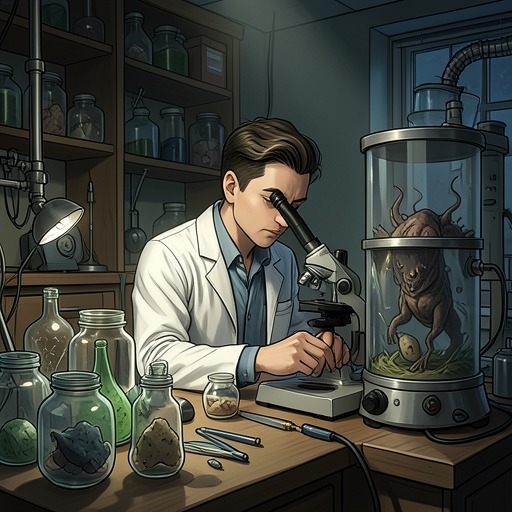
Denise is introduced as the federal service’s marine biologist assigned to study the specimens from the previous year’s attack on Sweetboro. By then she has several dead specimens to examine, along with samples of the tainted water in which the creatures lived. She hopes laboratory work will identify what leaked from the Wrecker Island Nazi U-boat and explain how the Sliggers acquired their combination of marine-animal characteristics. The evidence has not yet yielded a definitive answer: when later asked to brief visiting scientists, she reports that her tissue analysis has been inconclusive and that test results from the residue samples are still pending.
The gap between what Denise knows and what she suspects remains important. She proposes that scientists associated with the Nazi U-boat, including German and Japanese researchers, may have created a substance intended to induce genetic mutation when introduced into an organism’s DNA. In her account, successive generations could acquire traits from other species by eating them and then mutating with the DNA of their prey. Ron Tully considers the hypothesis viable in light of the possibility of World War II biological-warfare research, but neither his agreement nor Denise’s theory amounts to a completed laboratory finding. Her work gives the crisis a plausible biological explanation while preserving the uncertainty of the investigation.
Recognizing the Scale of the Threat
Denise’s understanding of the outbreak changes as reports arrive from distant locations. At a bar in Sweetboro, Mason Parker tells her and Josh Moody about an attack at a campground in Georgia and video of Sligger eggs on a Florida beach, at St. Augustine. Denise reasons that the locations are too far apart for the incidents to belong to a single nearby nest. Instead, there must be multiple nests, eggs, and creatures along the coast. Their whereabouts cannot be known in advance, she warns, and people may be killed before each nest is discovered. The threat is no longer a local aftermath that can be studied at leisure; it is a spreading emergency.
She helps turn that recognition into a call for wider action. When Eaver Robinson asks whether someone in government can issue a national warning, Denise remembers Gina Taylor, her contact at the U.S. Fish and Wildlife Service, and says she can notify the agency. Later, when Ron asks her to explain everything she knows, she shares both the limits of her tissue analysis and her theory about the residue and the creatures’ mixed traits. Her scientific briefing helps the visiting team understand why the sightings may represent a coastwide pattern, not isolated incidents.
Biology, Field Guidance, and Biosecurity
Denise also identifies reproduction as a crucial part of the danger. After Ron reports that a Richmond biologist found developing eggs inside young specimens, Denise recognizes the process as asexual reproduction. When Mason asks whether one creature could therefore produce a colony, she explains parthenogenesis: offspring developing from an unfertilized egg. The finding changes the practical meaning of any surviving individual. A Sligger need not find a mate to continue the population, so a search that misses even one creature or its eggs may fail to end an infestation.
The response must therefore account for habitat as well as reproduction. Mason gives the search team guidance based on the creatures’ preference for dark, cool places near water, including shaded thickets and seaside caves; he also warns against destroying them in a way that scatters mutated tissue into the water. Denise supplies the related biosecurity imperative: teams must recover the tissue of animals they kill and collect and burn the carcasses cleanly, so scavengers cannot eat remains carrying mutated DNA. The procedure connects the immediate act of extermination to a larger ecological risk: contaminated remains might transmit the problem onward through animals that consume them.
The concern is borne out in the later assessment Ron prepares. He records the creatures’ ability to reproduce asexually, their rapid evolution in response to different environments, and the clean disposal of the exterminated animals so that no remains are left to contaminate the ecosystem. Denise’s warnings thus belong to a response built around more than locating and killing visible monsters: it also has to prevent reproduction and interrupt the movement of mutated material through the environment.
Relationships and Role in the Federal Response
Denise’s professional work is closely connected to her relationship with Josh Moody, a state patrol captain. When Mason and Eaver find her on a weekend, she is seated at a bar beside Josh, with whom she is romantically involved. After the earlier battle, Josh remains in Sweetboro even though his post is in Blythewood; he is reluctant to leave Denise. Their relationship also shapes the practical organization of the response. When Mason later asks them to come to the police station to meet the visiting scientists, Denise explains that Josh had been preparing to return to his post and that she had to call him about the request.
The federal team seeks both of them for different reasons. Denise accepts an invitation to join the study team traveling to investigate an attack at Emerald Isle, North Carolina, where a family has run over a Sligger and its body is being held at a military base. She notes that she is already employed by the same federal service and will go where it sends her. Josh is less certain because he is not a scientist, but Denise’s acceptance makes clear that her work will take her beyond the Sweetboro laboratory and into the broader response.
Denise’s role is not to claim certainty where the evidence is incomplete. Instead, she repeatedly translates partial findings into consequences that others must act on: distant attacks imply multiple nests; developing eggs imply reproduction without a mate; contaminated tissue demands careful carcass disposal. In this way, her character links laboratory inquiry to field operations and public protection. The unresolved samples keep the origin of the Sliggers uncertain, while her increasingly specific warnings show how much can be understood—and how urgently it must be used—even before the mystery is fully solved.