East Coast sligger infestation
Secret InvasionEast Coast sligger infestation is the resurgence and spread of Sliggers across widely separated coastal locations, transforming what had seemed a containable danger into a regional crisis. Football-sized eggs on a Florida beach, a lethal attack at a Georgia campground, and later reports of nests and attacks elsewhere show that the creatures are appearing in multiple places at once. The resulting threat is not confined to the scenes of individual attacks: it unsettles coastal communities, draws civilians into the search, and forces investigators to reconsider how far the infestation may extend.
A dispersed coastal threat
The infestation first becomes visible to Mason Parker through a news report from St. Augustine, Florida. On white sand, the camera shows half a dozen oblong, greenish-yellow objects resembling reptile eggs, each about the size of a football. Mason recognizes them immediately and drops his fork. The discovery gives public form to a danger that had previously seemed possible to contain: the Sliggers have left evidence of reproduction far from the places where people thought they had encountered them.
Reports from Georgia sharpen the implications. A campground attack leaves campers exposed to creatures that emerge from the woods after Wes and Aliyah run ahead to warn them. The Sliggers redirect their charge toward the people gathered around the campfires. One creature tightens a tentacle around a woman’s neck, while the others seize, slash, and bite victims before tearing through tents and moving on. The attack is not simply an isolated encounter with a dangerous animal; set beside the eggs in Florida, it suggests a threat emerging at widely separated points.
Mason makes that geographic contrast explicit when he tells Denise that attacks have occurred in more than one place and that the St. Augustine report showed eggs on a beach. Denise reasons that the Georgia and Florida locations are too far apart to be explained by a single nearby nest. She expects multiple nests, eggs, and creatures along the coast, and fears that people may not know where the next danger lies until an attack occurs. Her conclusion marks the infestation as a distributed problem rather than a localized outbreak.
Signs, habitats, and possible origins
The Sliggers’ arrival is announced through clues that make ordinary waterfront settings feel unsafe. At a pier, Dennis first notices a sulfur-like odor and what appears to be a black snake attached to a piling. A second appendage fixes itself to the pier with a sharp tip; then the head of a large, dark creature appears among them. When another Sligger climbs onto the pier behind him, the first strikes a wooden plank near his foot, and Dennis abandons his fishing gear to run toward the beach. At another waterfront scene, Brian’s light reveals a smooth, shiny creature with enormous black eyes ambling over a dead body; more emerge and pursue him. These encounters show the danger taking shape at the boundary between land and water, where people may mistake the creatures’ appendages for something familiar before seeing the animal itself.
The creatures’ biology remains partly unexplained. Denise tells investigators that her tissue analysis has yielded no conclusive identification. She has also collected residue from the Wrecker Island Nazi U-boat and is awaiting test results. Her hypothesis is that the residue may reveal a substance created to induce genetic mutation when introduced into an organism’s DNA. She proposes that the Sliggers’ mixture of marine-animal characteristics could result from generations feeding on other species and mutating with traits from their prey. Ron considers the theory viable in light of the possibility that German and Japanese scientists conducted genetic experiments for biological warfare during World War II. The proposed origin is not presented as a confirmed finding: the test results are still pending, and the explanation remains a working theory.
Community fear and civilian searches
As news spreads, the infestation reshapes daily life in Sweetboro, South Carolina, where memories of the town’s earlier attack remain fresh. Some residents lock their houses and drive inland to stay with family or friends; others board their windows, fortify their doors, and stock up on ammunition. Mason Parker walks through town to reassure residents, asks them to watch for eggs or nesting signs near the water, and directs them to report discoveries to him so that he and his deputies can respond. His appeal for vigilance comes with a boundary: residents should leave the risk of confronting the creatures to the Sheriff’s Department.
National broadcasts widen public awareness beyond the towns directly affected. People are advised to remain inside at night and stay away from the water until authorities declare areas safe. The warning coexists with a less controlled response: social media circulates humorous memes made from sea-monster film stills, while groups of would-be hunters organize searches of their own. In Savannah, police concentrate their search along the Savannah River after the campground attack on Jekyll Island, yet River Street remains open and busy with diners, shoppers, gallery visitors, and people watching ships or riding historic riverboats. The ordinary life of the city continues beside a conspicuous search for signs that it may no longer be safe.
Molly Foster’s group illustrates both the appeal and the cost of civilian participation. Raised in a military family and taught to hunt, Molly is comfortable with firearms and carries her best shotgun when six friends gather near Old Fort Jackson after dark to search the waterside. Their activity belongs to a broader movement of citizens helping to find nests, but it does not make the danger abstract or manageable. A later broadcast reports that nests have been found and destroyed in St. Augustine, Savannah, and Emerald Isle, North Carolina, while also reporting five additional deaths after encounters with the animals around those nests. The same public involvement that expands the search therefore places volunteers in reach of the threat.
Expansion, mobilization, and containment
The infestation’s geography later becomes a moving investigative question. After finding reports of attacks west of their position, investigators discuss a route along the Gulf of Mexico: coastal currents, they conclude, have carried the creatures eastward from somewhere farther west. Texas is the westernmost reported point, with a small city, Port Arthur, on the Texas-Louisiana border identified as the furthest-west location known to them. These reports extend the crisis beyond its initial East Coast frame and give investigators a waterway-based explanation to pursue, without establishing a complete account of the creatures’ origin or distribution.
The government response escalates when a second wave of Sligger migration prompts the president to declare a National State of Emergency and deploy Army Reserve troops to assist the National Guard in exterminating the creatures. The announcement renews Molly’s sense that she might be able to contribute. She calls Deputy Norman Linneman, an officer who had responded three times to clean up after her group’s nest destructions along the Savannah River. Her call connects the improvised civilian hunts to the expanding official response: the volunteers’ past actions are known to local police, and Molly seeks information as the emergency grows.
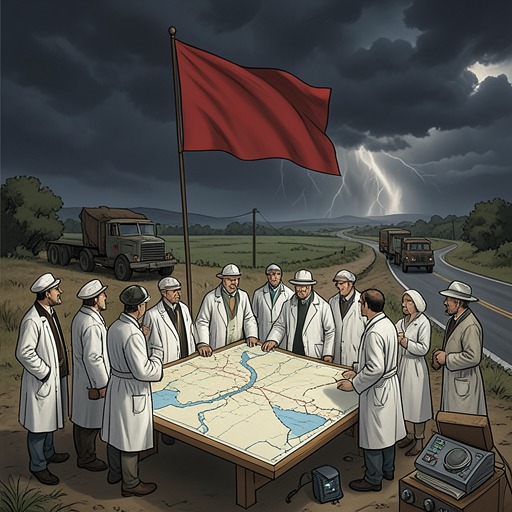
A later phase of the search focuses on the Mississippi River. Four days after Sliggers break into a hotel room in Baton Rouge, sweeping Army Reserve troops locate and destroy a nest near the river’s edge. Ron’s team continues north with the troops as far as St. Francisville. There they become convinced that the spread up the Mississippi has been stopped: since the Baton Rouge nest was found, searchers have covered forty more miles of waterways without finding another creature or nest. Ron records not only the apparent success of the sweep but also the risk of leaving contaminated remains: the creatures’ capacity for asexual reproduction and rapid adaptation makes thorough eradication important, and the searchers have left no remains that could contaminate the ecosystem and mutate its animals. This is a bounded success along the Mississippi, not proof that every infestation everywhere has ended; its significance lies in showing how discovery, concentrated searching, and clean disposal can interrupt one reported route of expansion.