Gina Taylor
Secret InvasionGina Taylor serves as a federal liaison for the U.S. Fish and Wildlife Service during the sligger crisis. Her importance lies less in direct encounters with the creatures than in the practical work of connecting people and information: she recruits researchers, relays new reports, and helps turn scattered sightings into questions of coordinated response. Through her calls, the widening threat becomes a problem that agencies and field teams must address across multiple jurisdictions.
Identity and Introduction
Gina is already a known contact to Ron Tully when she calls him on a Saturday afternoon. The incoming display identifies the call as coming from the U.S. Department of the Interior, and she introduces herself as being with Fish and Wildlife. Ron has spoken with her on previous occasions, giving their conversation the familiarity of an existing professional connection, even as the urgency of this call changes its character.
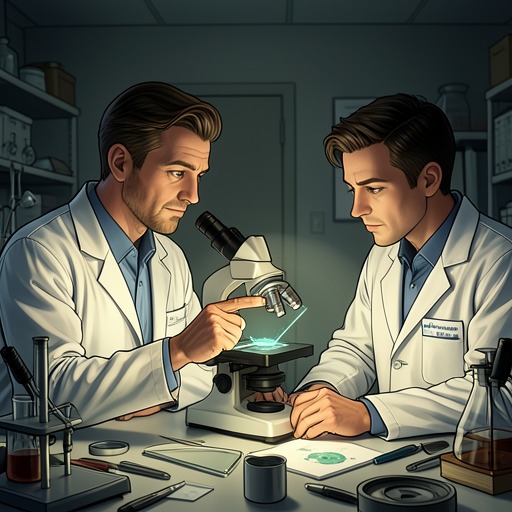
She asks Ron and his partner, Andy Carlyle, to join the response at the VA Bio+Tech Park in Richmond and work with Leslie Bickers, one of the resident biologists. The immediate subject is an unidentified animal found near Virginia Beach. Gina links that discovery to the sea-monster reports from South Carolina; when Ron recognizes the creatures as sliggers, she confirms that Leslie’s call makes the identification seem likely. The exchange quickly moves from an alarming possibility to a request for qualified help.
Recruiting Expertise and Relaying New Evidence
Gina’s recruitment of Ron and Andy shows her role as a connector between federal agencies and specialized investigators. Ron agrees to leave for the laboratory, and Gina promises to text Leslie’s number so the two scientists can coordinate directly. She also specifically asks him to bring Andy, widening the expertise available to the Richmond investigation rather than treating it as a matter for one biologist alone.
The initial Virginia Beach case soon becomes harder to isolate. While Ron and Leslie are examining the creatures, Gina calls again with information from another Fish and Wildlife biologist: more eggs have been found in St. Augustine, Florida. She adds that a campground on Jekyll Island in Georgia was attacked the previous night, with casualties, and that survivors’ descriptions resemble the animals under examination in Richmond. Her update places an egg discovery and a deadly attack alongside the Virginia Beach investigation. The threat is no longer conveyed as a single unidentified animal; reports from separate coastal locations suggest a broader emergency.
That widening pattern also gives significance to Gina’s place in the information network. Denise Baddington identifies Gina as her contact at Fish and Wildlife when the group asks whom it can notify about a national warning. Gina is therefore a route by which local knowledge can reach a federal agency, although the evidence does not make her the sole decision-maker or credit her personally with issuing the warning. At the same time, the characters’ concern is specific: reports from distant sites imply multiple nests and eggs, while the location of the next attack remains unknown.
From Coastal Reports to a Wider Response
As the crisis expands, public communication and government mobilization proceed on several levels. Ron argues that the public and coastal law-enforcement agencies need to be warned, despite the risk of panic. News broadcasts later tell people across the country to remain indoors at night and stay away from the water, while civilian hunters organize searches and police concentrate on vulnerable areas. These developments establish the scale of the response surrounding Gina’s work, but the account distinguishes them from her direct actions: her documented contribution is principally liaison, recruitment, and the relay of information.
The governmental response grows to include state National Guard deployments and an order for the United States Coast Guard to become involved. Gina’s part in the story is not presented as command of those forces. Rather, her earlier calls help establish the channels through which biological findings and geographically dispersed reports can be brought to the attention of people able to investigate and respond. The distinction matters: the crisis requires both knowledge of the animals and coordination among organizations with different responsibilities.
Tracking the Gulf Coast Spread
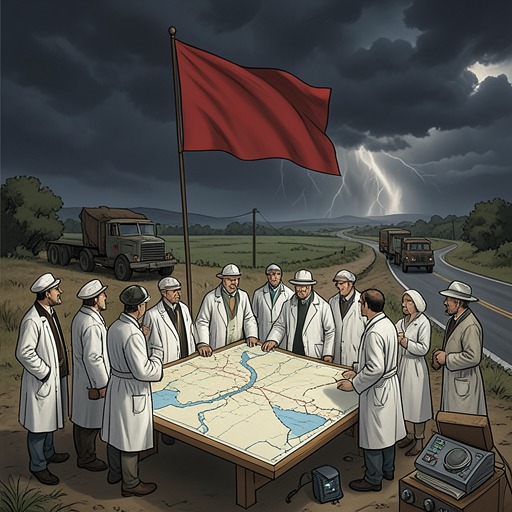
Later, Gina and Ron discuss reports of sliggers farther inland. The working assessment is that coastal currents have carried them along the Gulf of Mexico, moving east from somewhere to the west. Texas, with Port Arthur near the Texas–Louisiana border, is at that point the furthest west location where the creatures have been reported. Gina asks what should be done about Texas, turning a developing account of movement into a practical allocation problem.
Ron prefers to take his team to Louisiana and investigate the Mississippi River, which he sees as the more pressing route of expansion. He proposes dividing the troops into three groups: one to Port Arthur, one to continue west from the creatures’ known presence in Florida, and one to reach the Mississippi immediately and follow the trail upriver. The subsequent briefing places the deployment along those lines: troops search from New Orleans up the Mississippi while other divisions approach from Florida and Texas. Gina’s question helps open the planning exchange, while Ron supplies the proposed distribution and the military carries out the deployment.
The search eventually reaches St. Francisville. Four days after the hotel-room attack in Baton Rouge, troops destroy a nearby nest and continue north; after searching another forty miles of waterways without finding a further nest, Ron concludes that the spread up the Mississippi has been stopped. His final report goes to the Department of the Interior. Gina is not shown receiving that report or participating in the final confirmation, so the narrative does not specify her personal role in the campaign’s conclusion. Her arc instead traces the crisis as a chain of communication: an urgent request for expertise, reports that redraw the threat’s geography, and questions that help convert those reports into a coordinated search.