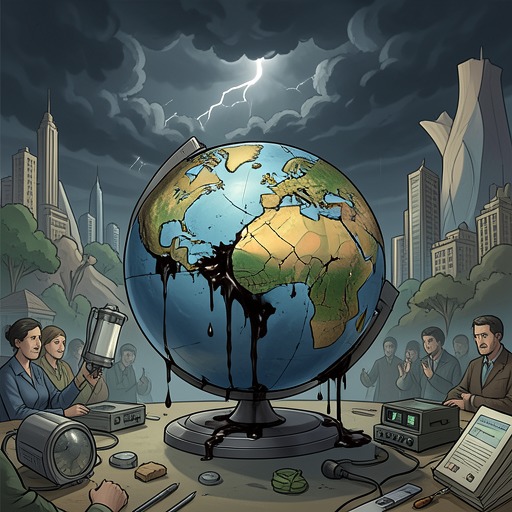
Global Monster Catastrophe
Secret InvasionGlobal Monster Catastrophe is the widening calamity that overtakes the coastal Sligger emergency and then breaks beyond its known boundaries: first, separated attacks suggest an extensive, difficult-to-map infestation; later, news reports describe destruction in cities around the world, and a Tyrannosaurus attacks people outside a store. The shift enlarges the story’s threat from creatures multiplying along waterways to a world in which ordinary explanations and ordinary protections no longer hold. The narrative places these crises in the same broad arc, but does not confirm that the Sliggers caused the global catastrophe.
From coastal outbreaks to a dispersed threat
The first alarm is geographic as much as biological. Mason reports an attack at a campground in Georgia and clear video of Sligger eggs on a Florida beach, identified as St. Augustine. Denise recognizes that the distance between the two locations makes a single local nest an inadequate explanation: there must be multiple nests, eggs, and creatures along the coast. The danger is not simply that an attack has happened, but that authorities cannot know where the next one will occur until it does. She expects many people to be killed and urges action beyond local response; Eaver asks about a national warning, and Denise identifies Gina Taylor at the U.S. Fish and Wildlife Service as a contact she can call.
The warning changes life even in Sweetboro, where the previous year’s attack remains fresh in residents’ minds. Some people lock their homes and drive inland to stay with distant family or friends; others board up windows, reinforce doors, and stock ammunition. Mason walks through town to reassure residents that he will not let the creatures gain a foothold on its shores. He asks them to watch for eggs or nesting near water, but directs them to bring any discoveries to him and leave intervention to the Sheriff’s Department. The response thus mixes private flight and preparation with an effort to keep observation and armed action under official control.
Public alarm and improvised response
National broadcasts tell people to remain indoors at night and avoid the water until authorities declare areas safe. Social media spreads the warnings, but also turns Sliggers into material for jokes and movie-image memes. At the same time, civilian hunting groups organize across the East Coast. The blend of warning, humor, and volunteer mobilization shows a crisis entering public life: danger is no longer confined to the people at the original attack sites, even as its extent remains uncertain.
In Savannah, police concentrate along the Savannah River after the campground attack on Jekyll Island. The city searches the riverside, while River Street remains open, with restaurants, pubs, galleries, confectionery businesses, ship watchers, and historic riverboats still drawing visitors. Outside the populated area, Molly Foster assembles friends willing to search for nests. Her military-family upbringing and her father’s instruction in hunting have made her comfortable with guns; she brings her best shotgun. Her group’s willingness to act is not presented as a substitute for official operations so much as a parallel, locally organized response to a threat that official searches have not yet eliminated.
Investigation, uncertainty, and containment
The origin of the creatures remains a theory rather than a settled finding. Denise says her tissue analysis has yielded no conclusive identification. Residue recovered from the Nazi U-boat beneath Wrecker Island is still awaiting test results, but she suspects it may reveal a substance engineered to induce genetic mutation. In her account, generations of creatures could have acquired traits from the marine animals they ate. Ron considers the idea plausible in light of Nazi experimentation during World War II; agreement, however, does not make the proposed cause proven.
Operational knowledge is similarly specific but incomplete. Mason describes likely nesting places as dark, cool sites near water, while he and Josh warn that the creatures move quickly, carry deadly toxin in their claws, and take many bullets to kill. Later, reports give the response a larger geographical frame: investigators conclude that coastal currents have carried Sliggers east along the Gulf of Mexico from somewhere farther west. Texas is, so far, the westernmost reported point, at Port Arthur near the Texas-Louisiana border. Ron proposes dividing troops among three tasks: a third to Port Arthur, a third to continue west from their existing position in Florida, and the rest to reach the Mississippi and trace the creatures upstream. The plan treats waterways as both routes of spread and guides for investigation, while the phrase so far preserves the limits of what has been reported.
Emergency mobilization and continuing civilian involvement
After the discovery of a second wave of Sligger migration, the president declares a National State of Emergency and deploys Army Reserve troops to assist the National Guard in exterminating the creatures. Molly fears that they could spread across the country if not stopped quickly, but the bulletin also renews her sense that she might help. She calls Deputy Norman Linneman, whom she knows from three occasions when he was among the officers sent to clean up after her group destroyed nests along the Savannah River. Their history gives the call a practical basis: she is contacting an officer who has already encountered the consequences of her searches, not an unknown authority. The emergency therefore scales up formal intervention without erasing the local knowledge and involvement built during earlier operations.
The catastrophe becomes global
The book then shifts into Age of Monsters, opening with Jonah fishing and remembering the moment the world ended. In a store, a small group watches a black-and-white television after the Internet has gone down. The New York City skyline is burning and collapsing; the clerk says the destruction happened within the last hour and that reports had begun to describe events elsewhere. The list expands from New York to Los Angeles, Chicago, London, Paris, and Beijing. A failing connection and an old television become the group’s narrow window onto a disaster whose scale outruns any one city.
The global report turns into immediate physical danger outside the store. A Tyrannosaurus stands in the parking lot between the building and a gas pump, eating the burly man who had walked out ahead of the others. Shots startle it; it snaps at empty air, then appears to associate the attack with the people nearby. With its jaws open, it charges. The ending does not explain the creature’s origin or resolve the group’s fate. Instead, it closes on the gap between mediated catastrophe and direct encounter: the world’s destruction has been visible on a screen, but the monster is now in the parking lot. That final escalation broadens the narrative beyond a coastal infestation without supplying a causal link between the Sligger crisis and the wider monster disaster.