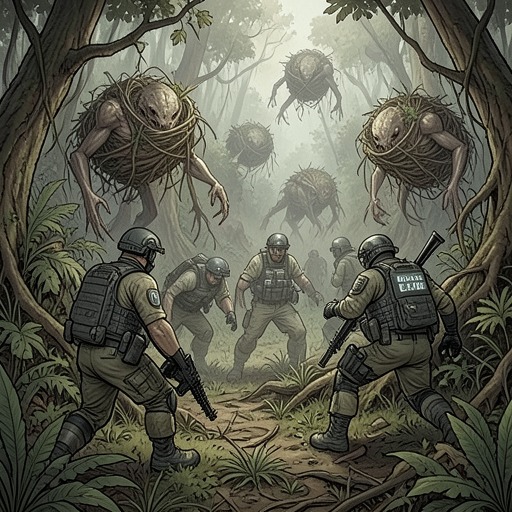
Irish Channel
Secret InvasionIrish Channel is the setting for one of the clearest demonstrations of how the Sliggers exploit connected waterways and concealed wetland habitat. During a night search, troops found a nest beneath trees growing through the remains of an old dock; the discovery prompted an ambush that cost a soldier his life before the searchers killed the attacking creatures. The area’s ruined timber, shallow water, and submerged roots make it both a distinctive physical setting and a concentrated expression of the crisis’s ecological danger.
Setting and Physical Character
By the time the search party reached the Irish Channel area, night had fallen. Ahead lay the ruins of what had once been a large wooden dock. Hurricanes and floodwaters had battered it over decades, leaving a skeletal structure spread across the water: a broken grid of rotting timber with its upper planks long gone. The dock was no longer a usable platform, but its beams still formed a precarious route out over the water.
Trees had grown up from beneath the weathered joists near the shore. Their roots reached down into the water, and the trees created precisely the kind of sheltered, damp environment that made the site a plausible nesting place. The ruined dock thus joined human-made wreckage and living growth in a single search landscape: old wood gave the troops a narrow path, while the submerged terrain around it concealed what they were looking for.
The approach exposed the searchers to the setting rather than giving them a clear view of it. The soldiers had to walk along the narrow sides of the beams to reach the trees, balancing above water. Their flashlights picked out the spaces between the joists and the brown, silty waves about two feet below. Once the squad reached the trees, it followed the line of roots upriver, searching the ground and the shallow spaces around them.
The Nest and the Ambush
The nest lay in a shallow area where the water gave way to visible mounds of land. At the base of one tree, ten large eggs were bunched together in a crater in the mud. Under the soldiers’ LED lights, the eggs looked greenish. A soldier spotted them and signaled the rest of the squad to stop; the sergeant warned the group that they were at a nest and should remain alert.
The warning was followed almost immediately by an attack from below. Water erupted beneath the squad, and a tentacle whipped out of the darkness, striking the old timber. The soldier it nearly hit opened fire, but the creature thrashed rather than dying. Another appendage wrapped around his ankle and pulled him out of sight. The dock’s narrow beams, already difficult to cross, became a dangerous place to fight: the troops had little room to retreat, and the water concealed the attackers until they struck.
A clawed tentacle also swiped at the sergeant. He jumped back to avoid it, lost his balance, and fell between the beams into a few inches of water. The moment brought the threat directly onto the unstable structure, forcing the squad to respond while one of its members had already been dragged away and its leader had fallen from the path.
Searchers, Fighting, and Aftermath
The squad tightened its formation and kept firing at the creatures. Several fell only after repeated shots: two went down, followed by another and then two more. The last Sligger continued splashing toward the soldiers, and concentrated fire—including two shots to its head—was needed to kill it. The exchange makes the nest more than a discovery site: it is where the searchers’ expectation of finding eggs becomes an immediate fight against creatures concealed in the same water and vegetation.
Ron Tully and his team rushed out from shore when they heard the gunfire and joined the squad on the beams. They looked down at the dead creatures below. Ron noted how much ammunition the fight had consumed, while a soldier, still charged with adrenaline, suggested that flamethrowers might be needed. Their reaction underscores the practical consequence of the encounter: locating a nest did not make its destruction straightforward, even for an armed group that knew the Sliggers were difficult to kill.
Ecological and Narrative Significance
The Irish Channel nest fits the wider pattern of the infestation. Denise had warned that widely separated attacks meant multiple nests, eggs, and creatures along the coast, while Mason described dark, wet sites near water as likely nesting places. Here, the combination of a sheltered tree line, exposed mud, and nearby water gives those warnings a concrete location. The searchers’ discovery also shows why following waterways mattered: the creatures were not simply appearing at isolated points but were being sought in connected aquatic environments.
The danger extends beyond the immediate attack. The investigation linked the creatures’ mutations to a suspected substance from the old Nazi U-boat beneath Wrecker Island, while Denise cautioned that killed creatures had to be collected and burned so their tissue could not re-enter the food chain. The Irish Channel scene supplies a local instance of that larger problem: killing the attackers was only one part of clearing a nest whose eggs and remains could sustain further ecological harm. In this way, the ruined dock is not merely atmospheric scenery. Its submerged, overgrown structure hides the reproductive source of an attack and makes the work of finding, fighting, and safely disposing of the creatures inseparable.