Louisiana
Secret InvasionLouisiana is where the Sligger crisis’s eastward advance along the Gulf meets the Mississippi River, turning a coastal outbreak investigation into a campaign to trace and contain creatures moving inland by water. The state’s narrative settings—Delacroix, New Orleans, Baton Rouge, and St. Francisville—show the crisis entering ordinary work and travel before becoming the focus of a coordinated military search and a federal report.
Geographic Role in the Crisis
The investigation’s map changes as new reports emerge west of the earlier Florida search area. Andy finds several attack sites west of the team’s position, prompting Ron to consider whether the spread has a western origin and whether the search may have to begin again farther west. The reports do not yet settle where the creatures came from, but they make the existing east-coast picture incomplete.
The working theory is that coastal currents carried the Sliggers east along the Gulf of Mexico from somewhere farther west. Texas is identified as the furthest-west point where attacks have been reported, with Port Arthur, on the Texas-Louisiana border, named as a starting point for the investigation. This is a reported limit, not proof of an original source: the team is tracing the outbreak with incomplete information and recognizes that its account may need revision as new locations are found.
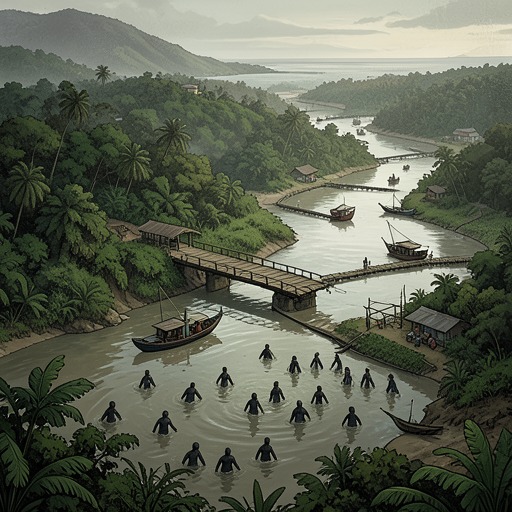
Louisiana matters not simply as another place on the route but because the Mississippi River raises a distinct strategic concern. Gina suggests that the team go to Port Arthur instead; Ron prefers Louisiana, where he is more worried about the creatures’ expansion along the river. The choice shifts attention from the westernmost reported site to a waterway that could carry the threat northward.
From Public Alarm to Coordinated Search
The movement toward Louisiana follows warnings that the crisis may involve multiple nests and that the Sliggers could reproduce almost as quickly as they grow. Eaver asks whether someone in government can issue a national warning, and Denise identifies her U.S. Fish and Wildlife Service contact as someone she can notify. Later, national broadcasts advise people to remain indoors at night and away from the water while authorities assess whether areas are safe. These measures establish the broader emergency in which Louisiana’s river corridors become a focus of response.
At the planning stage, the response is divided among three routes: one third of the troops are to go to Port Arthur, another third are to continue west from their existing position in Florida, and the final third are to reach the Mississippi immediately and follow the creatures’ trail upstream. The plan treats the outbreak as a connected but geographically uncertain problem. It distributes forces across the reported western limit, the existing Florida front, and the river route that most concerns Ron.
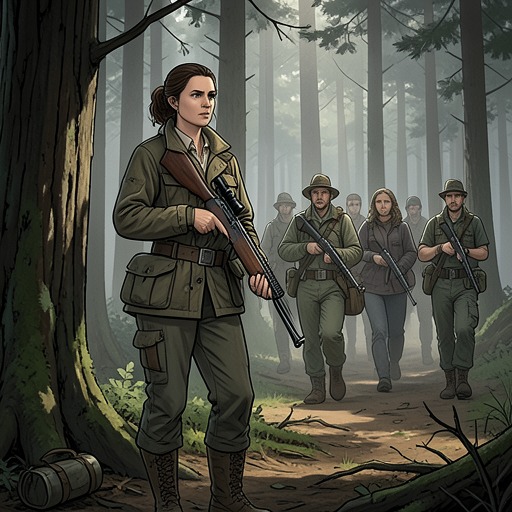
The arrangement is later reflected in the briefing for the operation. The National Guard unit is assigned to clear the area from New Orleans north along the Mississippi, while two other infantry divisions are to approach from Florida and Texas. Ron’s team accompanies the operation as additional observers, keeping close to the search line. The plan’s convergence of three directions gives Louisiana a central role in the campaign rather than treating it as a distant endpoint.
Louisiana Places and Ordinary Routines
In Delacroix, the crisis enters through a day’s work that initially appears routine. Paul Fontenot finishes his last airboat tour, ties the boat to the pier, helps the tourists disembark, accepts their tips, and sends them on their way. He returns the key, clocks out, and drives home in his pickup, reaching his one-story house a little after five-thirty. The sequence places a working waterfront and tourist activity immediately before the story turns toward danger; the supplied account establishes the ordinary setting and the tour’s end, without making that routine itself evidence of the outbreak’s source.
New Orleans appears through a different kind of seasonal movement. Four students from Florida State spend four days there during the last week of summer break, visiting for regional food, nightlife, and the city’s atmosphere before classes resume. Their hotel is in the French Quarter, the historic heart of the city, chosen in part because its shops, restaurants, and bars are within walking distance. This urban setting contrasts with the operation’s river-focused strategy: the same city that serves as a holiday destination also becomes the southern starting point for the planned upstream clearance.
Baton Rouge makes the military geography more immediate. Ron follows Highway 10 through shopping centers and residential neighborhoods into downtown, while Andy has booked two rooms at the Hilton Baton Rouge, close to the Mississippi River. The team is staying near the area it expects to search, and the Army Reserve is moving north along the river. The hotel’s proximity to the water is practical, binding the team’s temporary base to the route under investigation.
Search, Reporting, and Significance
In the operational briefing, Sergeant Billingsly warns the troops to avoid the creatures’ toxic appendages and orders them to kill the animals without explosives, following Denise’s warning. He marks their route on a large map: his unit will clear from New Orleans up the Mississippi, with the other divisions advancing from Florida and Texas. Ron considers the deployment consistent with his proposed strategy. After the briefing, the team follows the sergeant to the wharf, where he positions his men and begins the search.
St. Francisville provides the setting for the operation’s written record. There, Ron types a final report in a motel room, using Wi-Fi to email his federal employers. The laptop illuminates his face as he summarizes his team’s actions and findings over the previous four weeks. The report closes a sustained period of fieldwork without making the evidence of spread any less provisional: the inquiry began with scattered attack reports, advanced through a theory of Gulf-current movement, and organized its response around a river whose upstream reaches remained a concern.
Across these locations, Louisiana links three scales of the story: local life, the contested geography of the outbreak, and the government’s attempt to organize a response across state lines. Delacroix and New Orleans place everyday travel and leisure beside the expanding emergency; Baton Rouge and the Mississippi make the search’s route visible; St. Francisville frames the effort as something to be documented and sent back to federal authorities. The state’s importance lies in this convergence: it is both a setting for ordinary routines and a strategic corridor in the attempt to follow the Sliggers inland.