Mississippi River
Secret InvasionThe Mississippi River is where the Sligger crisis changes from a series of coastal reports into a suspected inland invasion. Its vast, inhabited waterside setting first draws unsuspecting visitors close to the river at night; later, investigators treat the waterway as a route by which the creatures may have spread north. The river is thus both a landscape people approach for pleasure and a corridor authorities must search, whose length and connected waters complicate the effort to locate and eliminate hidden nests.
A landmark turned danger zone
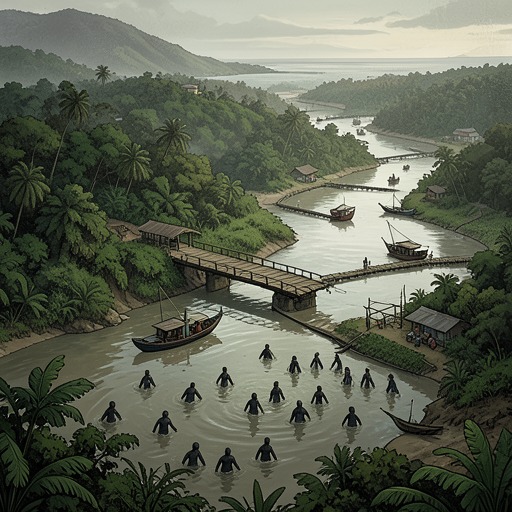
For Kimmy, the river is a new sight. After an evening in New Orleans, she persuades Daniel and Steve to leave their plans for music and walk down to the waterfront. From Washington Artillery Park, the view is not close enough for her, so she leads the group across three train tracks and down another flight of steps to the river sidewalk. Freighters moving upriver help her gauge the breadth of the water; she estimates it at half a mile. Daniel, who grew up in Memphis, regards the Mississippi as familiar and unremarkable. Their difference in perspective gives the scene its ordinary, almost touristic beginning: for Kimmy, the river is an immense spectacle, while Daniel expects nothing special.
That ease vanishes when Daniel disappears into the water. His friends initially see no explanation for his sudden absence. Then a hand breaks the surface, followed by Daniel’s head; he cries for help, and his companions can see that he is being pulled upriver. The scene makes the river’s scale newly threatening. Its width, which had been a measure of wonder, now separates the witnesses from someone in immediate peril, while the darkness leaves them watching the water without knowing what has taken hold of him.
From individual attack to a suspected route
The river attack becomes part of a broader pattern rather than an isolated mystery. After examining the aftermath of an attack in New Orleans, Andy reasons that the creatures’ presence there points to somewhere farther west as their likely point of arrival. Sheriff Cox confirms that the news has reported a possible Sligger attack in the city. When Andy searches for further reports, he finds several attack sites to the west, and the investigators connect the emerging geography to the Gulf of Mexico: they conclude that coastal currents have carried the creatures eastward from somewhere farther west.
Port Arthur, a small city on the Texas-Louisiana border, is the westernmost reported location at that point. The river consequently matters not just as the setting of an attack but as the next possible line of expansion inland. Gina Taylor suggests that the team go to Texas, while Ron Tully says he would rather take his group to Louisiana and investigate the Mississippi because its spread concerns him most. His preference turns the waterway into an investigative priority: the question is no longer only where the creatures have appeared, but how far they may have traveled along a connected route.
The response divides its forces according to that uncertainty. Ron proposes sending a third of the troops to Port Arthur, another third westward from their current position in Florida, and the final third to the Mississippi at once, to follow the creatures’ trail upriver. The allocation preserves several lines of inquiry rather than treating one suspected origin as proven. The river branch is both urgent and exploratory: it is meant to establish the extent of the spread, not merely to defend a known nest.
Searching the banks and backwaters
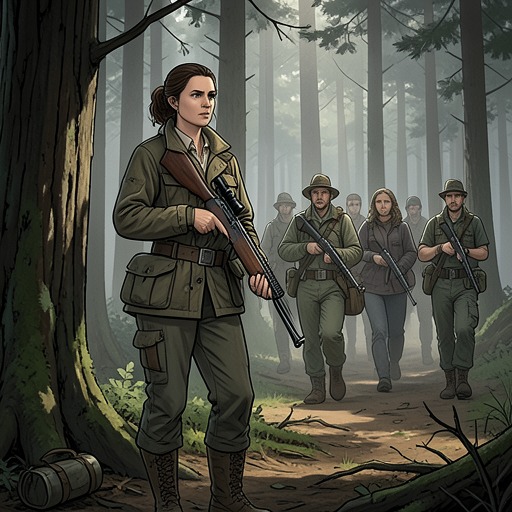
In New Orleans, the search brings together National Guard troops and city police, with different groups covering different terrain. The troops work at the water’s edge, while police officers search culverts and sheltered recesses farther from shore. Ron tells Sergeant Billingsly what he knows about the Sliggers, emphasizing their tenacity and explaining how to destroy their bodies and collect the remains. The guidance reflects the investigation’s dual task: finding the animals is not enough if the response leaves contaminated remains behind.
The searchers move past businesses and cafés, sometimes squeezing single file around outdoor patios, before reaching a stretch of shoreline with partially submerged trees. The trees appear to offer suitable nesting conditions, but the squad finds nothing there. By nightfall the group has reached the Irish Channel, where it encounters the remains of a wooden dock battered by decades of hurricanes and floodwaters. Its missing upper planks and rotting timber have left a broken framework over the water; trees have grown through the old joists near shore. The damaged structure offers another plausible place to search, and the hunters move closer, but the existence of promising cover does not itself establish that a nest is present.
The river as a test of containment
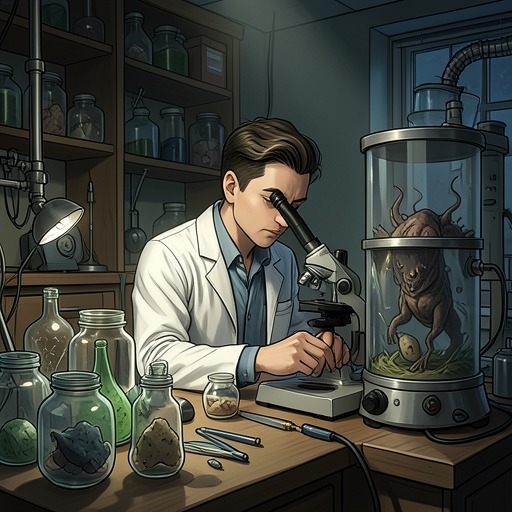
The search does not end with the New Orleans patrol. Ron and his team decide to keep moving along the Mississippi ahead of the creatures, trying to determine how far upriver they have spread. As the operation proceeds, the danger also appears to change: Denise observes that the creatures have changed a little, and Josh notes that they have become harder to kill. Their investigation has linked mutation to feeding on other species and absorbing prey DNA, while the possibility of rapid reproduction makes delay especially dangerous. The river search therefore follows a threat that may not remain biologically constant as it moves through different environments.
Four days after the creatures break into a hotel room in Baton Rouge, Army Reserve troops locate and destroy a nest near the river’s edge. Ron’s team searches alongside them as the troops continue north. They find no further nests, eventually reaching St. Francisville and concluding that the spread has been stopped. The searchers have covered forty more miles of waterways without finding another monster. Ron then prepares an assessment for the U.S. Department of the Interior, reporting the creatures’ asexual reproduction and rapid environmental adaptation, as well as the clean disposal of the exterminated animals so that their remains do not contaminate the ecosystem.
The Mississippi River’s narrative role rests on the difference between a route suspected and a route confirmed. The investigators infer movement from reports, geography, and currents, and divide their forces before they know how far inland the invasion extends. The nest near Baton Rouge gives the river search a concrete target; the empty miles beyond it provide the evidence that the advance may have been stopped. The same waterway that first conceals an attack in darkness becomes the scale against which containment is measured.