Molly Foster
Secret InvasionMolly Foster becomes one of the crisis’s determined civilian hunters, carrying her family’s hunting skills from local searches into the expanding campaign against the Sliggers. Her arc moves from finding and destroying eggs near Old Fort Jackson to seeking further work in New Orleans; along the way, the danger that first makes her expertise useful also becomes, by her own account, something she craves returning to.
Background and Preparation
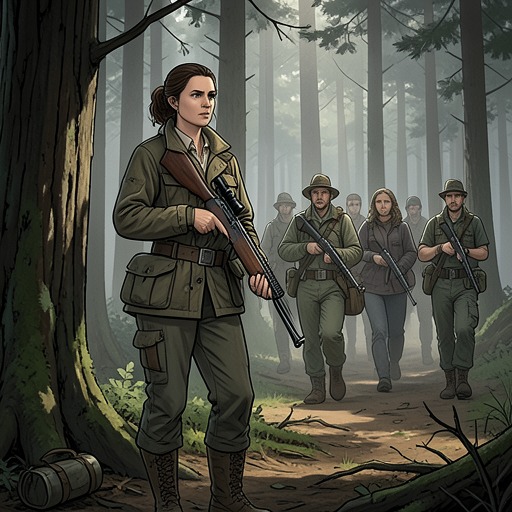
Raised in a military family, Molly is comfortable around guns, and her father taught the children to hunt. Duck hunting is her favorite winter pastime. When civilian search groups begin forming in response to the coastal attacks, she therefore brings more than willingness: she already knows the habits and equipment of a hunter, and she has a best shotgun ready for the work.
The emergency makes such volunteer action both risky and consequential. National broadcasts advise people to remain indoors at night and stay away from the water until authorities declare areas safe. At the same time, groups of East Coast hunters assemble to look for Sligger nests. Molly joins this uncertain effort not as a trained official but as someone whose practical familiarity with firearms and hunting can be put to immediate use.
The First Search at Old Fort Jackson
Well after dark, Molly and five others park near Old Fort Jackson, three miles from River Street. Her younger brother Ryan is with her. Molly leads the group to the closed entrance gate, then along the fence line to the river; once they round the fence, the lights of River Street remain behind them as the search proceeds east. The route places the hunters along the waterside vegetation where a nest might be concealed, away from their vehicles and from the safety of the road.
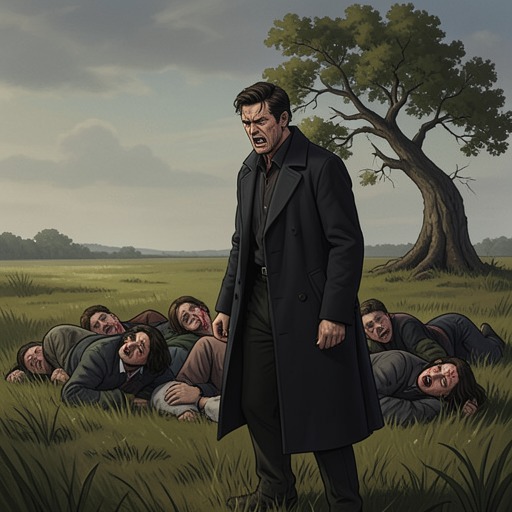
Molly’s flashlight picks out bright objects among tufts of cut grass. She recognizes them as large eggs, and the group treats the discovery as a nest that must be destroyed. Molly steps back, aims her shotgun, and fires. The eggs disintegrate, leaving sticky debris across the grass. The destruction is immediate, but it does not make the site safe: four creatures erupt from nearby foliage and converge on the hunters.
After the encounter, Molly calls the police, reports what happened, and gives the location of the bodies requiring disposal. An officer tells her group to wait for help. She considers continuing down the river, but it is late and the party is already two miles from its vehicles. She decides to end the night’s search and return after dealing with the authorities. Her choice balances the urge to keep hunting against the practical danger of pressing farther into the dark with the group already separated from its trucks.
A Returning Hunter
Molly later leads another search, this time with Ryan and a group that includes Gary Bracken and Oscar Brown, whom she recognizes and introduces to the others. She welcomes Oscar under the nickname Texas and asks whether he is ready to begin. The exchange presents her as an organizer within the group: she identifies its members, draws a newcomer into the party, and then sets the search in motion.
Again, Molly and her brother take the lead toward the river. The hunters search the nearby vegetation methodically with flashlights rather than simply moving through it. When one member spots a nest, the others hurry over. It contains four eggs, each about the size of a football. Molly recognizes them as Sligger eggs and prepares to destroy them with her shotgun, praising the person who found them. The passage establishes a repeated pattern in her work: she helps direct the search, confirms the target, and is ready to act against the nest. The available account does not state what follows this particular discovery, so the encounter does not establish that the eggs were destroyed or that the group was attacked.
From Local Searches to New Orleans
The wider crisis gives Molly’s hunting a larger frame. Denise concludes that attacks at locations too far apart to be connected point to multiple nests and creatures along the coast, making further attacks likely. The national response grows as well: governors in Virginia, New York, South Carolina, Georgia, and Florida call in the National Guard. News coverage spreads public warnings, while social media produces jokes about the creatures and helps bring volunteer hunting teams together. Molly’s work belongs to this improvised civilian response, but it is not presented as a substitute for the authorities or military forces mobilized around the threat.
Watching the crisis unfold, Molly fears that the creatures could spread throughout the country if they are not stopped quickly. The possibility that she might still help prompts her to call Deputy Linneman. She identifies herself by recalling that she is the person who leaves large messes for him to clean up by the river—a wry acknowledgment of the consequences attached to her searches, and of the familiarity her earlier work has established with local police. She plans to pack and travel east to New Orleans to join the growing group of hunters along the Mississippi River.
Molly does make her way into that wider effort. At a café in New Orleans, she is disappointed that the previous night’s hunt was uneventful. Her disappointment is not about sitting alone; it is the lack of Sliggers to find. Over chicory coffee, she recognizes that New Orleans has been largely cleared but reasons that other places may still need searching. She remains ready to contribute, alongside anyone else willing to walk the ground and keep looking.
Commitment and Narrative Role
The shift in Molly’s relationship to the hunt is made explicit when she thinks about returning to the field. Searching for the creatures and their nests has become an addiction. The word marks a change from the practical confidence established by her upbringing: hunting is no longer only a familiar skill applied to an emergency, but an activity she actively wants to resume. Her exhilaration at the prospect of helping is set against the mass danger that makes the work necessary, keeping her commitment both useful and unsettling.
Molly’s contribution remains grounded in specific, physical tasks: carrying a shotgun, leading a group along a river, recognizing eggs in grass, searching vegetation with a light, and alerting police when an encounter leaves bodies to be handled. She is neither shown commanding the official campaign nor given control over the crisis’s outcome. Instead, her significance lies in the bridge she forms between ordinary hunting knowledge and collective emergency action. When the Army Reserve continues its sweep north from a nest near the Mississippi River toward St. Francisville, with no further nests found, Molly’s account has already shown why clearing one area does not immediately end a volunteer’s sense of obligation. Even after New Orleans seems mostly clear, she expects that other places will still require searching.