National Guard
Secret InvasionThe National Guard is a principal ground force in the escalating campaign against the Sliggers, moving the response from local alarms to coordinated searches across the coast and inland waterways. Its role grows in stages: governors summon it to affected states, the president extends its deployment to states that have not yet acted, and a later declaration of a National State of Emergency brings the Army Reserve alongside it. The force helps turn a scattered infestation into an organized search-and-destruction effort, though its eventual withdrawal follows an exhaustive sweep rather than a single decisive encounter.
From local alarm to wider mobilization
The case for a broader response emerges as reports reveal that the creatures are appearing far apart. Denise warns that distant locations cannot be explained by one nearby nest: multiple nests, eggs, and creatures must be present along the coast, with further attacks likely before anyone can know where the threat lies. The prospect of a spreading crisis makes notification and coordination urgent. Josh argues that the creatures could reproduce nearly as fast as they grow, while Mason calls for warnings to the public and coastal police departments. The National Guard becomes part of the answer as the threat outgrows the reach of any one community.
By the time the response reaches national television, the governors of Virginia, New York, South Carolina, Georgia, and Florida have called the National Guard in to help manage the crisis. The president then orders the United States Coast Guard to work around the clock with local law enforcement to find nests and directs the rest of the National Guard to states that have not already summoned it. This sequence shows a layered mobilization: state-level calls precede a presidential order extending the Guard’s reach, while the search itself depends on cooperation with other agencies rather than on the Guard acting alone.
State and local cooperation
In South Carolina, Mason tells residents of Sweetboro that he will not let the creatures establish themselves on the town’s shores. Some residents leave for places farther inland; others reinforce their homes, stock ammunition, and clean their guns. Mason asks people to watch for eggs or nesting signs but directs them to report discoveries to him so that he and his deputies can respond. Against this local backdrop, he later tells Eaver that the governor has called in the National Guard and that the state should be cleared quickly. Searchers have found a couple of nests near Hilton Head and destroyed them. The report offers a concrete measure of progress, but Mason’s hope that other states will follow suit also makes clear that the local success does not settle the wider crisis.
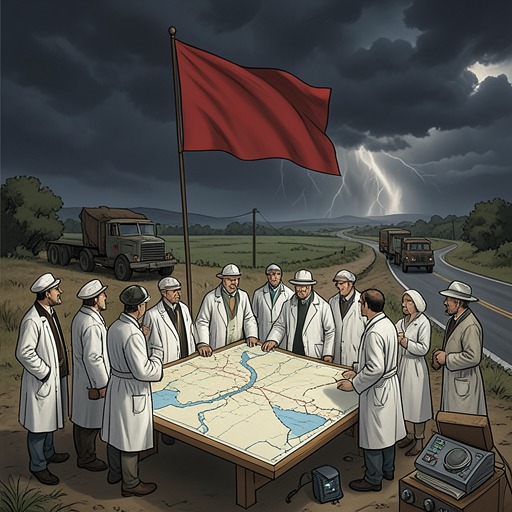
The wider effort draws on a mixture of personnel. Ron’s team is told that local police, volunteers, the Coast Guard, and the National Guard together provide enough people to cover the coast. In one jurisdiction, roughly fifty people from the sheriff’s deputies and city police divide their time on the ground, with another fifty National Guard troops on the way; police in neighboring areas are searching as well. These details give the mobilization a practical scale: the Guard supplies additional personnel to searches that remain geographically distributed and locally staffed.
Search operations and field precautions
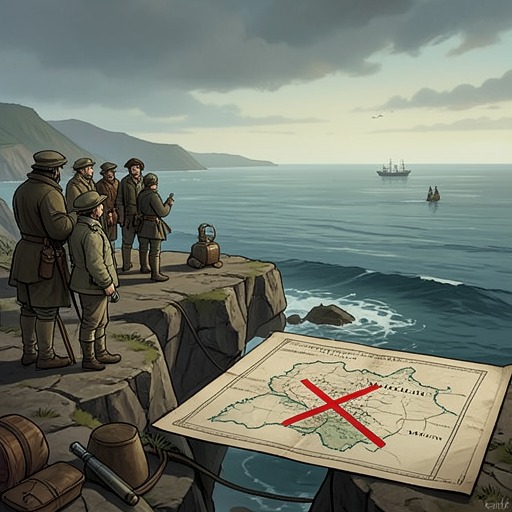
When reports indicate that coastal currents have carried the creatures east along the Gulf of Mexico, the search plan divides the response among separate routes. One third of the troops are to go to Port Arthur, where the creatures have been reported furthest west; another third are to continue west from the searchers already in Florida; the final third are to reach the Mississippi River and follow the creatures’ trail upriver. The plan treats connected waterways and separate reported locations as operational priorities, not as evidence that the whole infestation has one known point of origin.
In the New Orleans operation, a Guard unit under Sergeant Billingsly is assigned to clear the area from the city upriver along the Mississippi River, while two other infantry divisions approach from Florida and Texas. At the briefing, Billingsly warns the troops to avoid the creatures’ toxic appendages and instructs them to kill them without explosives, following Denise’s warning. Once the search begins, the New Orleans Police Department works alongside the Guard: troops cover the water’s edge while police search culverts and sheltered spaces farther from shore. Ron supplies the sergeant with information about the creatures’ tenacity and advises him on destroying bodies and collecting remains. The division of terrain and attention to carcass disposal make the operation both a hunt for hidden nests and an effort to limit further danger from the creatures.
The Guard’s work continues north after a nest is destroyed near Baton Rouge, at the edge of the Mississippi. Four days after the creatures break into a hotel room there, troops search with Ron’s team, advancing as far as St. Francisville. The sweep covers another forty miles of waterways without finding another monster. That negative result matters: the team treats it as evidence that the spread upriver has been stopped, not merely as a pause between known attacks.
Expansion of the campaign and withdrawal
The discovery of a second wave of migration broadens the threat again. The president declares a National State of Emergency and deploys Army Reserve troops to assist the National Guard in eradicating the creatures. The Guard is now part of a larger military response, while civilian participation remains possible: Molly, who has joined earlier searches near the Savannah River, learns that volunteers are still allowed to help and plans to travel to New Orleans to join hunters along the Mississippi. Her decision illustrates that the official deployment does not displace every civilian effort, although the military presence gives the campaign a new scale.
After the nest near Baton Rouge is destroyed and the upriver search finds no further creatures, Ron reports that the spread along the Mississippi has been eliminated. The broader clearance takes longer. A month passes as thousands of people spend hundreds of hours scouring the waterways along the creatures’ paths. The National Guard and Army Reserve troops then return home, while local authorities continue precautionary sweeps until they are satisfied the creatures are gone. The president has officially declared the crisis over a week before this account of the completed effort, but the continuing local searches show that formal closure and practical reassurance do not arrive at exactly the same moment.
Institutional and narrative significance
The National Guard’s role is presented through successive handoffs and partnerships rather than through a single command center: governors call it into states, the president extends deployment, local police divide search areas with troops, and the Army Reserve later joins the campaign. The story emphasizes the problems such a response must solve—covering a long coastline, tracing creatures along connected waterways, coordinating personnel across jurisdictions, and observing specific safety and disposal rules. Its numbers and assignments make mobilization visible, from troops en route to a local jurisdiction to divisions approaching the Mississippi from different directions.
The Guard also marks a shift in the scale at which the crisis is understood. Early warnings concern hidden nests and attacks that may occur before authorities can locate their source; later, troop deployments and prolonged waterway searches attempt to make the entire migration route legible and exhaustively coverable. The eventual return of the troops signals that the national campaign has reached its endpoint, but not that vigilance has instantly vanished: local authorities keep searching, and the country is left to mourn those killed and confront the questions the crisis raises.