Oscar's Guilt and Despair
Secret InvasionOscar's Guilt and Despair is the painful reckoning that follows his revenge against Brittney Nelson and Randy Miller. Oscar Brown remains convinced that the two deserved what happened to them, yet the Sliggers he brought from the East Coast are spreading and killing other people. His attempt to preserve his sense of justice cannot contain the consequences: innocent deaths, the prospect of discovery, and finally his own decision to die. The state turns on a contradiction he recognizes but cannot resolve: he did not intend every death, but his actions helped make them possible.
Revenge and Its Aftermath
Oscar's feelings are divided from the outset. His plan to get rid of Randy worked, and in his view Brittney got what she deserved as well. He still misses her a little, but not enough to take back what he did. That small admission of attachment sits beside a firm refusal to reconsider the revenge itself. The result is not simple regret: pride and a sense of justice persist even as melancholy and guilt gather around them.
The consequences extend beyond the people Oscar meant to punish. The creatures he brought from the East Coast are spreading and killing others, and he acknowledges that those deaths are on his hands too. His distinction between intended targets and later victims offers him some shelter, but not absolution. Even before the consequences become immediate, he tries to remain far from waterways, a practical effort to avoid danger that also keeps him apart from the spreading crisis. The threat he helped unleash cannot be made morally distant simply by staying away from it.
Self-Justification and Recognition
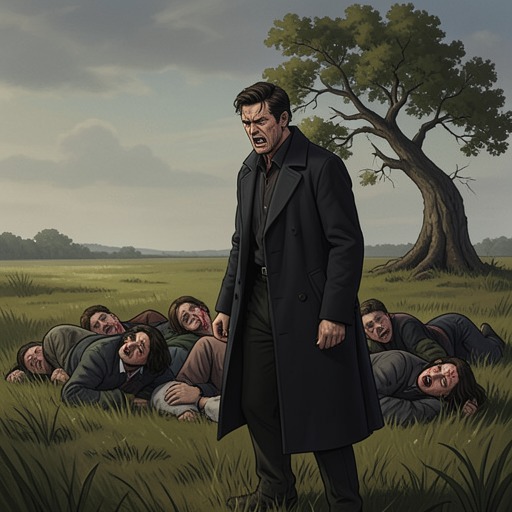
Oscar turns repeatedly to marijuana to quiet the distress, but the relief is temporary. After smoking, he studies himself in the mirror and confronts the image of a killer. He cannot settle on a single judgment: Brittney and Randy deserved to die, he thinks, yet he is now a murderer, and innocent people have also died because of his actions. The sourness of that recognition is sharpened by his defense that he did not mean for the other deaths to happen. His reasoning distinguishes intention from consequence even as the narrative makes clear that the consequences remain part of his responsibility.
The mirror becomes a place where that defense is tested rather than accepted. Oscar sees himself as someone who disregarded public safety and endangered thousands, and he identifies his conduct with terrorism despite insisting that he never intended the wider harm. The news later gives this private accusation an external name: the president has declared a National State of Emergency, troops are being sent to Port Arthur, and officials are considering bio-terrorism as a possible cause of the spread. Oscar's own description of himself as a terrorist is not a separate charge from authorities; it is his frightened moral interpretation of the news and of what he has done.
The Threat of Discovery
The broadcast changes the pressure surrounding Oscar's guilt. He learns that personnel are coming to Port Arthur to search near waterways for the Sliggers and their nests, and that officials suspect a possible origin point for the current migration. He immediately wonders whether the spread could be traced to Brittney's house and then back to him. The search of every lake, inlet, and river in the county makes the danger feel both extensive and concrete; the announcement that the animals reproduce quickly and threaten public safety and the ecosystem confirms that the crisis has grown beyond his control.
Oscar's response is fear as well as remorse. The military presence means his private act of revenge may be exposed, but the broadcast also confronts him with the public stakes he had disregarded. The movie playing after the news can no longer hold his attention. Smoking again does not quiet his thoughts; in the mirror he sees an empty person who has put thousands in danger. His reasoning that he did not intentionally kill the later victims remains available to him, but it no longer cancels the knowledge that his actions helped place them at risk. His guilt becomes unbearable, and he decides what he must do.
Return to the Shared Home
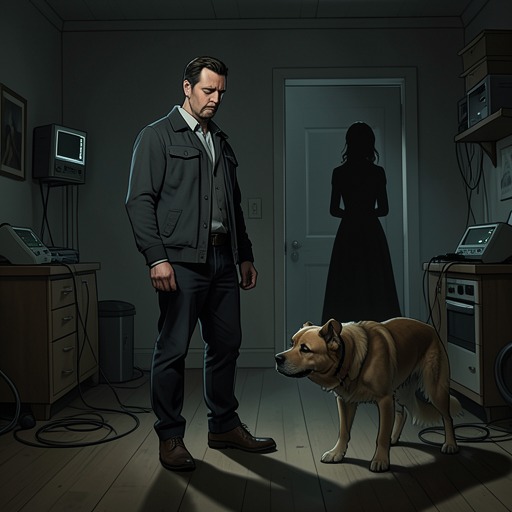
Oscar drives toward Sabine Lake and returns to the house he once shared with Brittney, the same house where he had placed the Sligger eggs beneath the back porch. He has not been back since that night. The homecoming is bittersweet: the sight of the house revives many memories, most of them good, even as the place is bound to the act that helped carry his revenge outward. The past is therefore not only something he remembers; it is materially connected to the danger he has set in motion.
Upstairs, Oscar enters the master bedroom and sits on the old bed where he and Brittney used to sleep. He picks up a stale, musty sheet, then ties one corner to the headboard and the other around his neck. He tightens the sheet and slides from the mattress. In the final moments, memories and feelings rush together—happiness, shame, despair, pride, and guilt—before his brain loses oxygen. The ending does not resolve the contradiction that has defined his state: he dies still marked by pride in his revenge and by the guilt of its wider consequences. Instead, his return to the shared bed brings those competing histories into one final scene.