Paul Fontenot
Secret InvasionPaul Fontenot is an airboat guide in Delacroix, Louisiana, whose familiarity with the bayous and easy command of a tourist excursion cannot protect him when an unknown creature erupts from the water. His introduction first establishes a practiced local guide: he finishes a public tour, goes home to eat and rest, then sets out again for a private bachelor-party trip. That return to work becomes a sharp reversal. While demonstrating how to handle an alligator for his guests, Paul is confronted by a much larger danger and dragged underwater.
Identity and Background
Paul works as an airboat operator and tour guide. After completing the last public tour of the day, he ties up at the pier, lets his passengers disembark, accepts their tips, and wishes them a good day. He turns in the key and clocks out before driving home. The sequence gives his workday a practical rhythm: the boat, the pier, the passengers, and the end-of-shift formalities are familiar parts of his routine.
His commute takes about half an hour, and he drives his pickup while singing along to the radio. He reaches his one-story house in Delacroix a little after five-thirty. At home, he reheats a pot of gumbo from the refrigerator, opens a beer, eats, and settles into his chair in front of the television. These modest details place him in a recognizable life between tours, with a meal and an evening’s rest waiting after work. But the rest is temporary: he has another booking that night.
The name he gives his guests, T-Paul, connects his professional introduction to his family background. Paul explains that his father was also named Paul and that he was named after him. Rather than use “Jr.,” as he says the guests might, Cajuns add the French word petit, meaning “little,” before a name. In his account, petit is commonly shortened to T, producing names such as T-Paul. The explanation is also a small act of hospitality: before the tour begins, he makes his nickname part of the conversation and gives the visitors a piece of the local naming custom.
The Private Tour
The second job is a private airboat trip for a group of men from nearby Texas who are in New Orleans for a bachelor party. Paul has given private tours before, but this is his first bachelor-party group, and he hopes the clients will not be too much trouble. They arrive at his house around eight in the evening. He greets them with a broad smile, then leads them around the side of the house and down a short embankment to the water, where his boat waits beside a weathered shed.
Paul retrieves flashlights from the shed and escorts the party aboard. The guests open their first beers and stow the remaining bottles in the boat’s cooler. Once they are settled, he introduces himself as their party guide and congratulates the groom-to-be. The scene shows him shifting from the routine of a commercial guide to the more informal role the private booking requires. He knows how to address a group, keep the trip moving, and turn the tour into an occasion for the clients.
His familiarity with the work is explicit: he gives a safety talk four times a day at his regular job. He tells the passengers that lifejackets are beneath the seats and that, if they have to abandon the boat, they should follow his directions. He says he knows the bayous as well as the back of his hand. That assurance is not empty bravado; when the group later spots an alligator, Paul is willing to enter the water and handle it himself. Yet the same confidence also sets up the limits of his expertise: knowing the bayou and knowing how to manage an alligator do not prepare him for the creature that takes it.
The Alligator and the Attack
When Bennie offers another hundred dollars to see Paul handle the alligator, Paul accepts. The extra payment matters to him because a boatload of young lawyers with money to spend is an unusual opportunity. He tells them they have a deal and invites them to get their cameras ready. His decision combines the practical appeal of the tip with the showmanship of a guide willing to give his customers a memorable display.
Paul sizes up the animal as roughly four to five feet long, probably four years old, and carrying about eighty teeth. He has handled larger alligators before. Positioning himself above it, he jumps into shallow water and secures it with his arms looped beneath its front legs and his hands locked below its thrashing head. The men watch from the boat, impressed; Paul finds his footing in waist-deep water and holds the adolescent alligator against his chest while they aim their phones and take pictures. For a moment, he is both an experienced handler and the central attraction of the excursion.
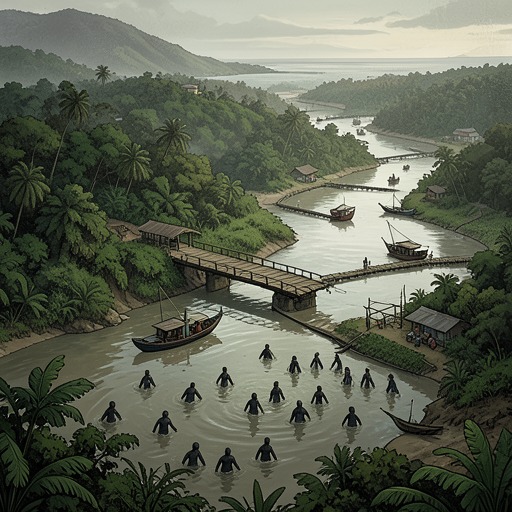
The demonstration turns without warning. Something dark and ropelike wraps around the alligator and rips it away from Paul, nearly pitching him forward. He is stunned by the sudden loss of the animal. Then the water erupts in front of him. In the beam of a flashlight, the passengers briefly see an olive-green, glistening creature with huge eyes and a long-toothed snout. It seizes Paul around the waist and pulls him beneath the surface. Bennie cries out from the boat; the water then falls quiet and settles.
Ending and Narrative Significance
Paul’s fate is left unresolved in the scene: he is taken underwater, and the water becomes silent, but the passage does not confirm what happens to him afterward. The abrupt ending makes his disappearance the decisive consequence of a routine commercial skill being turned into entertainment. His expertise is real, his confidence has been earned through repeated work, and his handling of the alligator initially appears controlled. None of those qualities can account for the predator that emerges from the bayou.
The contrast between the evening’s ordinary details and its final violence gives the attack its force. Paul has completed his public shift, driven home singing, reheated gumbo, and gone back out to accommodate a private party. The guests have beers, cameras, and an expectation of spectacle; Paul supplies it by entering the water for an extra tip. Then the spectacle is overtaken by an encounter no one aboard can explain or control. His introduction as a warm, capable local guide thus becomes a brief portrait of ordinary work at the edge of an extraordinary danger.