Port Republic
Secret InvasionPort Republic is a Chesapeake Bay community in Maryland where a quiet fishing pier becomes the site of a fatal encounter with the sliggers. The attack transforms the bay from a place of familiar summer recreation into evidence that the creatures have reached another part of the coast.
Setting and the Pier Attack
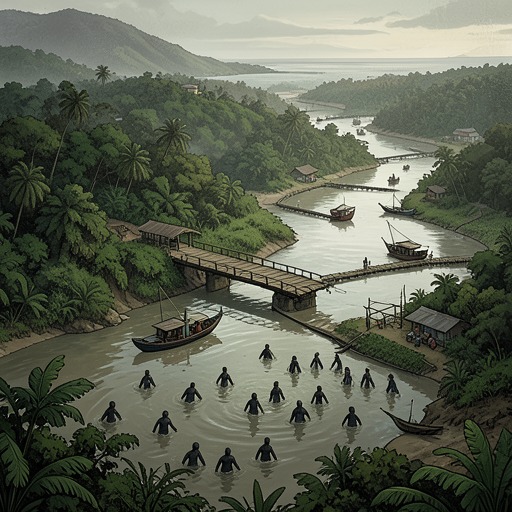
Dennis often fished late at night on the bay, where summer brought plentiful catches, including blue crabs and rockfish. On the night of the attack, powered lights illuminated the pier despite the dark sky, and a cool breeze from the north brought the temperature to around seventy degrees. Carrying his fishing pole and tackle box, Dennis crossed the small beach and walked roughly two hundred feet along the wooden pier to its end.
The encounter turned deadly in the water. As Dennis struggled back toward shore, weakened by his wet clothing and stung skin, he saw a light come on in his house and called for Claire, whose silhouette appeared at the patio door. Before he could reach her, something seized his leg and dragged him underwater. Unable to break free, Dennis was cut across the chest and belly; his last sensation was the creatures biting him as seawater filled his lungs.
Reporting and Regional Significance
The death did not remain a private loss. Andy sent Ron an interview recorded on a woman’s front porch in Port Republic: she believed her husband had been killed by sea monsters in the bay. Her account brought the attack into the investigators’ attention and made the local report part of a widening record of suspected Sligger encounters.
That record changed the meaning of Port Republic’s place on the coast. Denise contrasted the widely separated reports of a campground attack in Georgia and Sligger eggs filmed on a Florida beach at St. Augustine, concluding that the distance between them pointed to multiple coastal nests rather than one isolated outbreak. Later, Florida sheriff David Mittenfeld reported two attacks in a single night, one at St. Augustine Beach and another near Sawgrass, about twenty miles north. Port Republic thus stands among the early signs that attacks were appearing across dispersed coastal locations, while the investigators’ accumulating reports—not a confirmed local account of the creatures’ origin—began to define the scale of the threat.
From Coastal Report to Expanding Map
Port Republic’s place in the investigation became part of a much larger effort to track the creatures’ movement rather than identify a single point of origin. Later, investigators concluded that coastal currents had carried them along the Gulf of Mexico, eastward from somewhere farther west; Texas was the westernmost location reported, with sightings reaching Port Arthur near the Texas–Louisiana border. The reports therefore described a spreading range, not a route demonstrably beginning at Port Republic.
The response followed that shifting geography. Ron argued that the Mississippi River posed the greatest concern and proposed dividing troops among Port Arthur, Florida, and the river corridor. After a nest was destroyed near Baton Rouge, the search continued north with Ron’s team as far as St. Francisville. Searchers found no further nests, including across forty additional miles of waterways. Against that later record, the Port Republic attack reads as one early coastal warning within a crisis whose suspected pathways and limits had to be revised as new reports arrived.
Evidence and Uncertainty
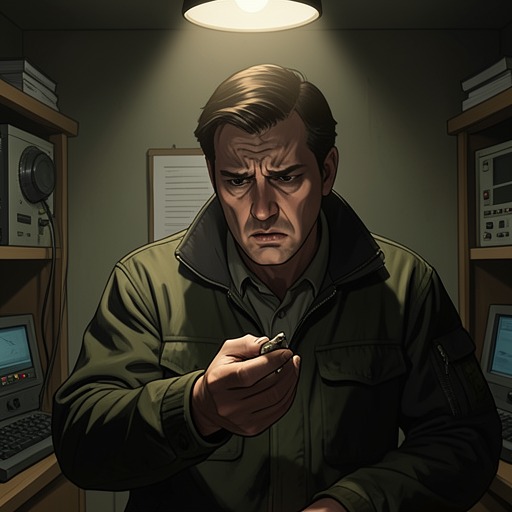
The Port Republic report established the danger of an attack in the bay, but it did not resolve what the creatures were or how they had come to exist. Denise told Ron that her tissue analysis had yielded no conclusive identification; residue samples from the Nazi U-boat beneath Wrecker Island were still awaiting test results. She suspected that the samples might reveal a substance designed to induce genetic mutation, which could explain the creatures’ mixture of marine-animal traits, but this remained a hypothesis rather than a finding tied specifically to Port Republic. The distinction matters: the attack made the creatures’ presence along the coast harder to dismiss, while their origin remained under investigation.