Rapid Evolution of Sliggers
Secret InvasionRapid Evolution of Sliggers is the observed, generation-by-generation change in the creatures’ bodies and apparent capacities. Its importance is practical as well as biological: each change suggests that methods effective against one generation may not work against the next, while further adaptation could make the infestation harder to confine. The evidence links physical changes to a suspected mutagenic origin, but the characters treat the precise mechanism as a theory rather than a confirmed explanation.
Proposed Origins and Mechanism
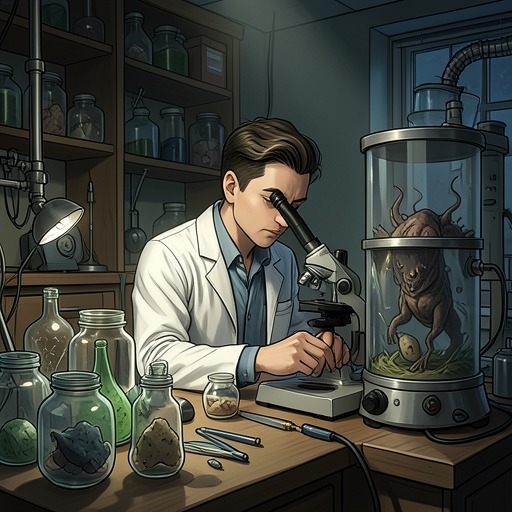
Denise’s account connects the creatures’ unusual biology to residue recovered from the old Nazi U-boat beneath Wrecker Island. Her tissue analysis had not identified what the creatures were, and test results from the residue samples were still pending. She suspected that the substance might have been created by German and Japanese scientists to induce genetic mutation when introduced into an organism’s DNA. In her explanation, successive generations could acquire traits through eating other species and mutating with the DNA of their prey. This gives the creatures’ varied marine characteristics a possible cause, while leaving the underlying science unresolved.
The distinction between explanation and evidence matters. Denise presents the substance as something she expects the tests may reveal, not as a result already established by them. The observed changes are more immediate: the creatures encountered later differ in measurable ways from those examined earlier. Their rapid evolution is therefore recognized through comparison across encounters, even while its proposed origin remains uncertain.
Physical Changes Across Generations
During an examination of carcasses, Denise noticed that the creatures’ legs were longer than those of animals from previous nests. The difference was slight, but it was visible enough for her to direct the others’ attention to it. These longer legs were not an abstract prediction about future change; they were a physical feature observed in the dead animals before the group.
Denise connected that observation to an earlier encounter in North Carolina. A creature there had been run over by a car, and examination of its body showed skin that had become tougher and denser. She treated that earlier difference and the later change in leg length as successive indications of the same process: the creatures were changing from generation to generation. The comparison matters because it makes evolution cumulative within the story. One encounter supplies evidence of altered skin; a later set of carcasses supplies evidence of altered limbs.
The changes also affect how the creatures are understood as a threat. The group had already found them harder to kill, prompting Josh to wonder whether flamethrowers alone would be sufficient. Ron’s concern goes beyond an immediate increase in resistance to human weapons. He fears that continued evolution might eventually produce creatures that no longer need water, which would make them impossible to contain. This is a feared possibility, not an established adaptation, but it gives the observed bodily differences urgent consequences: a change in anatomy may foreshadow a change in where the creatures can survive.
Spread, Adaptation, and Containment
The fear of further adaptation accompanies an infestation already spreading across distant locations. Denise reasons that attacks in Georgia and the discovery of eggs on a Florida beach are too far apart to be explained by a single local nest. She concludes that multiple nests, eggs, and creatures must be present along the coast, making it impossible to know where they are until an attack occurs. The observation does not prove that every new infestation results from a particular evolutionary change, but it establishes the larger problem in which those changes matter: the creatures are distributed across a wide area and their locations are uncertain.
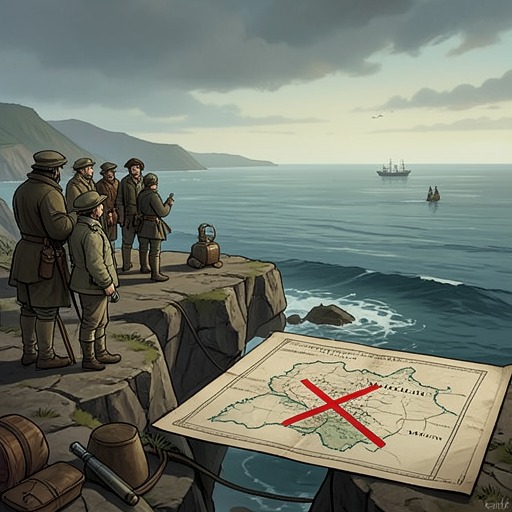
Later, the team concludes that coastal currents have carried the creatures along the Gulf of Mexico, moving east from somewhere farther west. Texas, and specifically Port Arthur on the Texas–Louisiana border, is identified as the westernmost reported point at that stage. This account makes waterways and currents part of the creatures’ spread, while Denise’s proposed mechanism suggests how their biology may change as generations encounter different prey and environments. The narrative thus joins two kinds of movement without treating them as identical: currents carry the infestation between places, while inherited changes appear across generations.
Consequences and Limits of Eradication
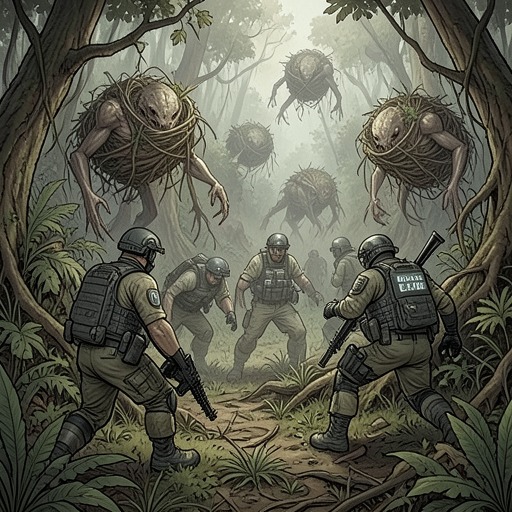
After the Baton Rouge hotel attack, Army Reserve troops found and destroyed a nest near the Mississippi River. Ron’s team continued north with the search, reaching St. Francisville before becoming convinced that the spread had been stopped. In his assessment to the U.S. Department of the Interior, Ron identifies asexual reproduction and rapid evolution to different environments among the creatures’ physical and biological attributes. The report gives evolution an operational meaning: it is one of the characteristics that must be considered in evaluating the crisis, not merely a speculation made during an examination of carcasses.
The reported containment also carries a biological precaution. Ron states that the creatures found were exterminated cleanly, without leaving remains that could contaminate the ecosystem and mutate its animals. After the nest near Baton Rouge was located, searchers covered forty more miles of waterways without finding another nest or monster, and the spread upriver was declared eliminated. That outcome marks a limit to the evidence rather than proof that evolution has ceased: the search supports the claim that this particular expansion was stopped, while the earlier anatomical comparisons and the report’s description of rapid adaptation explain why complete elimination had seemed urgent.
Rapid Evolution of Sliggers therefore functions as both a pattern of evidence and a source of strategic anxiety. Longer legs and denser skin are observed changes; reduced dependence on water remains a feared future possibility. By setting concrete differences in carcasses beside a widening, waterborne infestation, the concept makes biological change inseparable from the question of whether the creatures can still be contained.