Ron Tully
Secret InvasionRon Tully is an independent scientist whose ability to find answers makes him a federal contractor—and then a key investigator in the Sligger crisis. Recruited by the U.S. Fish and Wildlife Service to work with Andy Carlyle and other specialists, he helps connect biological evidence to practical search and disposal methods, and later recommends how troops should divide their effort across the Gulf Coast and Mississippi River. His arc moves from eager curiosity about an extraordinary specimen to the measured confidence of a scientist reporting that a major route of infestation appears contained.
Identity and recruitment
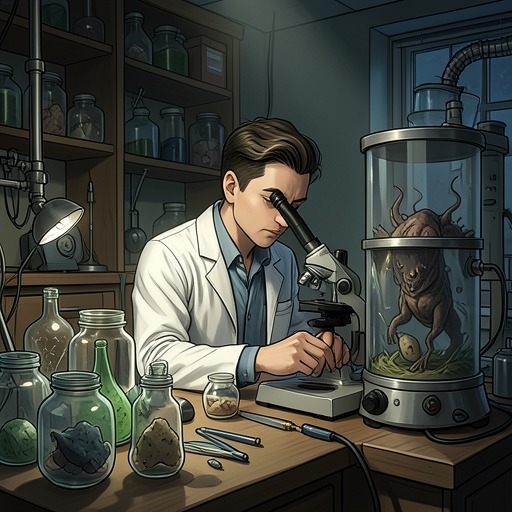
Ron is an independent scientist who has previously taken miscellaneous contracts for the federal government. His work has ranged from collecting and analyzing remote water samples and tracking wildlife migration to calculating the area occupied by a forest type, testing biological specimens, and assessing ecological change. The range of these assignments establishes a recurring feature of his professional identity: he is valued not for a narrow specialty alone, but for his habit of finding answers to unfamiliar problems.
That record brings him to the attention of the U.S. Fish and Wildlife Service. Gina Taylor calls him at home in Richmond, where the caller ID identifies the U.S. Department of the Interior. The request is urgent enough to interrupt a Saturday afternoon: the agency wants Ron and his associate, Andy Carlyle, to join Leslie Bickers at the VA Bio+Tech Park. Ron jokes about the unusual timing, but accepts the assignment. His eagerness is evident as he drives across town, calls Leslie, and waits for Andy to arrive. He anticipates that the laboratory may have living Sliggers, treating the prospect as both a scientific opportunity and a sign of the crisis’s gravity.
From specimen analysis to field investigator
Ron’s first role is to help turn separate observations into a working account of the creatures. At a meeting with Mason Parker, Denise Baddington, and Josh Moody, he introduces himself as a Fish and Wildlife scientist and identifies Andy as his partner. He asks Denise to share everything she knows. Her tissue analysis has not conclusively identified the animals, and tests on residue from the Nazi submarine found beneath Wrecker Island are still pending. Denise suspects that the residue may be a substance designed to induce genetic mutation. The creatures’ combination of traits, she proposes, could result from generations consuming other species and acquiring elements of their prey’s DNA. Ron considers the hypothesis viable, while keeping it distinct from a confirmed laboratory result.
The group’s discussion turns from origin to reproduction and urgency. Denise notes that parthenogenesis occurs in several animal groups, including sharks, crayfish, frogs, whiptails, and Komodo dragons; she proposes that the Sliggers may have acquired this capacity through consumption and genetic assimilation. Ron does not treat the possibility as a curiosity detached from events. Josh stresses that reproduction could keep pace with growth, allowing numbers to rise faster than authorities can manage. Ron agrees that the public must be warned despite the risk of panic. He proposes using his federal superiors to alert the media and contact law-enforcement agencies along the East Coast.
As the investigation advances, Ron becomes a field participant rather than a laboratory intermediary. He travels with the team to St. Augustine and meets Sheriff David Mittenfeld, offering assistance in finding the creatures and ensuring that they are disposed of safely. At another stage, he helps recruit Denise and Josh for the wider study team after learning that a family in Emerald Isle has run over a Sligger and that its body is being held at a nearby military base. The assignment therefore repeatedly joins scientific inquiry to practical work: the team needs evidence about the animals, but also people able to locate, kill, and safely remove them.
Ecological risk and search methods
Ron’s advice emphasizes that killing a creature carelessly can extend the danger beyond the immediate attack. Drawing on what the team has learned, he identifies likely nesting places as dark, wet environments near water: shaded thickets and seaside caves, particularly locations where currents are unlikely to disturb a nest. Finding the nests is the priority, because destroying individual animals without addressing their source leaves the infestation intact.
He also warns against using explosives. Scattering tissue into the water could place mutated DNA within reach of other animals; if scavengers consume contaminated remains, the biological problem may be carried farther through the food chain. This concern gives the extermination effort a demanding standard: the creatures must be killed, but their remains must also be recovered and burned so that other animals cannot feed on them. Denise stresses the same disposal requirement, and Ron promises to ensure that it is followed. The method makes containment an ecological task as much as a tactical one.
The proposed origin remains uncertain. The residue from the Nazi submarine is awaiting test results, and the suspected mutagen is not yet identified. Ron’s account preserves that uncertainty: he accepts Denise’s theory as plausible and connects it to the strange experimental material associated with the vessel, but the evidence available to the team does not establish the exact substance or prove the full sequence by which the creatures arose. That distinction between a useful working hypothesis and a confirmed result is central to his investigative role.
Coordinating the response
As the sightings multiply, Ron supports a public warning and wider interagency coordination. He recognizes that fear of public panic cannot outweigh the need to tell coastal residents what they face. The response soon involves state authorities and the National Guard; the president also orders the United States Coast Guard to participate. Ron’s scientific contribution takes place inside this expanding government effort, where field observations must inform decisions about personnel, geography, and methods.
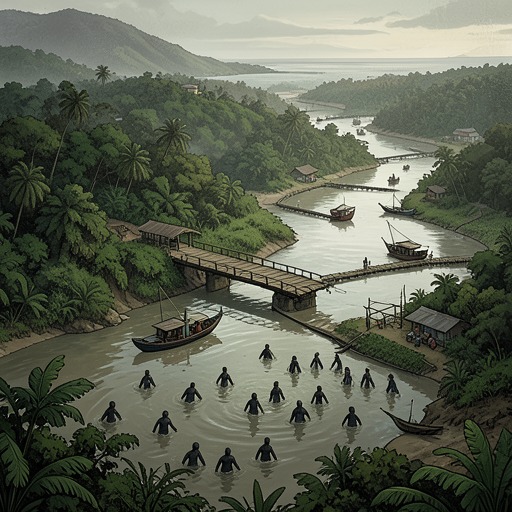
Later, reports indicate that coastal currents have carried Sliggers east along the Gulf of Mexico from somewhere farther west. Port Arthur, on the Texas-Louisiana border, is the westernmost reported location. Gina Taylor suggests that Ron’s team might go there, but he is more concerned about the Mississippi River and the possibility that the creatures will spread inland along it. He proposes dividing the available troops into three groups: one to begin at Port Arthur, another to continue westward from the search effort in Florida, and a third to reach the Mississippi and follow the creatures’ trail upriver. The plan responds to several possible routes at once rather than concentrating every force on a single presumed origin.
The deployment follows that division. At a briefing, Ron’s team sits behind the assembled troops as their commander explains the hazards, including the toxic appendages, and directs them to kill the animals without explosives. One unit is assigned to clear the route from New Orleans up the Mississippi River, while two others approach from Florida and Texas. Ron remains close to the troops as they move to the wharf and begin searching, serving as an additional set of eyes without claiming the military command role. His earlier recommendation has become an operational plan, translated into coordinated searches across multiple fronts.
Report and provisional conclusion
Ron’s final account is written in a motel room in St. Francisville, after four weeks of work. Four days have passed since Sliggers broke into a hotel room in Baton Rouge. Army Reserve troops subsequently found and destroyed a nest near the river there, then continued north with Ron’s team searching alongside them. By St. Francisville, they have found no further nests and are convinced that the upriver spread has been stopped.
In his report to his federal employers, Ron records the physical findings developed during the investigation: the Sliggers can reproduce asexually and evolve rapidly to adapt to different environments. He also records the significance of the disposal procedures. The creatures found during the operation have been exterminated without leaving remains that could contaminate the ecosystem and mutate other animals. These conclusions link the team’s understanding of the creatures to the precautions used in the field.
The search has covered forty more miles of waterways beyond the Baton Rouge nest without finding another monster. Reports from the Gulf of Mexico are also encouraging: federal and local authorities are encountering the creatures less often, and Ron judges that the situation is under control. Using the available manpower, he estimates that the remaining Sliggers can be destroyed in a short time. His conclusion is optimistic but grounded in the scope of the searches and the declining reports, not in a claim that every creature has already been eliminated. The final report completes his transition from contractor summoned to examine a possible specimen to investigator helping assess whether a regional biological emergency has been contained.