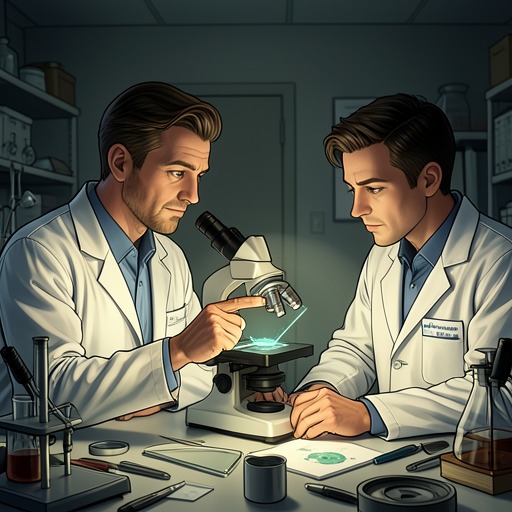
Ron Tully—Andy Carlyle
Secret InvasionRon Tully and Andy Carlyle are working partners whose collaboration links scientific investigation with the growing public response to the sligger crisis. When federal officials seek expertise on creatures believed to have appeared in more than one coastal location, Ron makes sure Andy is enlisted alongside him. Their partnership moves from an urgent call and a Richmond laboratory meeting toward field work during a coordinated effort to contain the animals.
Recruitment into the Investigation
The partnership becomes operational when Gina Taylor, a federal liaison, asks Ron to help examine animal specimens connected to reports from Leslie Bickers. Ron agrees to bring Andy into the assignment as well, explicitly treating the work as something for both of them. After ending his call with Gina, he shuts up his house, heads for his SUV, and calls his partner. Andy is at home, but Ron’s announcement that they have a major job immediately changes the evening’s plans: he asks Andy to meet him at the Bio+Tech Park, and Andy agrees to come.
Ron gives Andy the stakes as he understands them. The U.S. Fish and Wildlife Service is hiring them to study specimens thought to be the same creatures that South Carolina police had exterminated on an island weeks earlier. Ron also raises the possibility that the researchers may encounter living sliggers. The assignment is therefore not simply an examination of an unexplained carcass; it may bring the partners into contact with animals that are still alive and dangerous.
The Richmond Laboratory Meeting
The two arrive separately at the Virginia Bio+Tech Park. Ron waits in his vehicle until Andy pulls up beside him; Andy steps out of his truck with his long brown hair combed back into its usual ponytail, his matching beard framing a boyish smile. His visible excitement matches Ron’s anticipation. Ron greets him as a partner and frames what lies ahead as a chance to see a sea monster. The exchange gives their professional bond an easy familiarity while keeping its focus on the work they have come to do.
Together they walk to the designated entrance, where Leslie admits them to the building. She is still flushed with excitement and says the animals must be seen to be believed. The partners thus enter the investigation as a pair, responding to an encounter that even the person who has already seen the animals finds difficult to process. The scene establishes a practical division of labor: Gina has recruited them through Ron, Ron has brought Andy in, and Leslie provides access to the specimens.
Research Under Escalating Pressure
The scientific assignment takes place against a crisis whose scale is becoming harder to contain. Denise recognizes that attacks at widely separated locations point to multiple nests, eggs, and creatures along the coast, while Josh warns that the sliggers may reproduce almost as quickly as they grow. Ron supports warning the public and law-enforcement agencies, and says his superiors can contact the media and police departments. This broader response gives the partners’ research immediate practical stakes: understanding the animals matters because the threat is spreading faster than authorities can confidently locate it.
Later, Ron reports that an adult sligger has been killed by a vehicle and recovered as a specimen he can study. He plans to leave for the location that day, and Andy adds an invitation for Mason and his friends to join them. The work has now progressed beyond the Richmond laboratory meeting: Ron has a particular adult animal to examine, and the partners are preparing to follow evidence from one incident toward the creatures’ wider presence.
From Scientific Advice to Field Support
As government and military involvement grows, Ron’s role includes advising how forces should be directed. When Gina asks what should be done about Texas, he proposes dividing the troops among three fronts: Port Arthur, the existing advance west from Florida, and the Mississippi River, where he is most concerned about expansion. At the subsequent briefing, Ron’s team sits at the back while the Guard commander lays out the plan on a large map: one unit will search from New Orleans up the Mississippi, with other divisions advancing from Florida and Texas. Ron recognizes the deployment as the strategy he had recommended.
The military operation also shows how Ron and Andy’s partnership fits into a larger division of responsibilities. The Guard supplies armed units and a chain of command; Ron’s team stays clear of the troops’ way while following the line to provide additional eyes during the search. The briefing stresses avoiding the sliggers’ toxic appendages and killing them without explosives, reflecting the need to combine force with care in handling the animals. Ron and Andy’s work is therefore not presented as a substitute for official action: their scientific knowledge and observation accompany the organized sweep.
Across these stages, the relationship is defined less by personal disclosure than by reliable professional coordination. Ron initiates the urgent call, makes sure Andy is included, and brings him into both laboratory and field assignments. Andy answers the call, shares Ron’s evident anticipation, and helps extend the team’s work into the search. Their partnership gives the scientific response continuity as the crisis shifts from identifying specimens to tracking a rapidly spreading threat.