Savannah
Secret InvasionSavannah is both a working city and a staging ground in the Sligger crisis. Its busy riverfront remains open even as police scour the Savannah River and civilians venture into the surrounding wetlands to find nests. The contrast between historic streets, public gathering places, and nearby waterlogged search terrain gives the city a distinctive role: the danger does not replace ordinary life so much as press against it, drawing residents and newcomers from familiar civic spaces toward increasingly organized hunts.
City and River Under Threat
The crisis reaches Savannah amid mounting evidence that the creatures are appearing across a broad area. After an attack on a campground in Georgia and the discovery of Sligger eggs on a beach in St. Augustine, officials fear that distant locations point to multiple nests rather than one isolated outbreak. The concern is consequential for Savannah, whose river and coastal setting makes water a route of possible exposure as well as a place to search. National broadcasts advise people to stay indoors at night and away from the water until authorities declare areas safe.
The response along the Savannah River is conspicuous: fearful of what happened at the campground on Jekyll Island, the city concentrates police personnel on searching the riverside for signs of Sligger occupation. Yet River Street remains open for business. Its brick and cobblestone walkways continue to draw diners, visitors to confectionery shops, pub patrons, gallery-goers, people watching ships, and passengers on historic riverboats. The coexistence is not presented as proof that the threat has passed. Instead, the search and the activity on the waterfront occupy the same landscape, one watched for danger and the other still used for pleasure and commerce.
Civilian Searches and the Wetlands
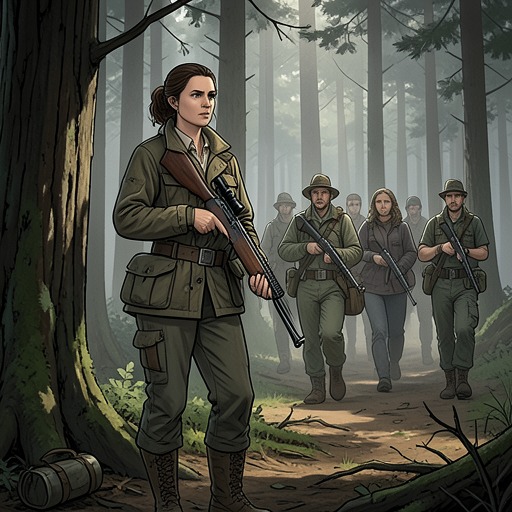
The public warning also produces a less official response. Groups of civilian hunters assemble to search for Sligger nests, but they gather outside populated areas so that they can move with firearms without interference from law enforcement. Molly Foster organizes a group of friends willing to take on the work. Her military-family upbringing has made her comfortable around guns, and her father taught the children to hunt; she brings her best shotgun to the search.
The geography around Savannah helps define the risk and method of these expeditions. One group searches wetlands between Savannah and Tybee Island, south of the Savannah River, where open, unsettled ground offers many possible places for nests. Oscar Brown reaches the meeting point after a thirteen-hour drive from Texas, stopping overnight in Mobile, Alabama. He first encounters Savannah as a visitor: parks and squares lie between the streets, Victorian houses and Gothic churches mark its historic character, and Spanish moss hangs from the oaks. He walks down the cobblestone streets toward the river to find food, later spends time in Forsyth Park, and sets out again after sunset for the hunters’ meeting place.
At the quiet roadside, Oscar finds two trucks and four people—a thin, middle-aged woman and three men—wearing waders and carrying shotguns. He has come intending to help. From his Ford Escort he takes an LED flashlight and a 9mm pistol, checks that the magazine is full, and recognizes that he does not know whether the weapon will be effective against the creatures. The moment makes Savannah’s search effort concrete: volunteer participation depends on people arriving with whatever equipment they have, while the wetland itself remains large enough to conceal the danger they are trying to find.
A Local Network of Volunteers
The civilian searches become a recurring part of Savannah’s response. Molly and her group destroy Sligger nests along the Savannah River, and Deputy Norman Linneman is among the officers who come to clean up afterward on three separate occasions. Their repeated encounters turn the aftermath of a hunt into a small relationship between volunteers and local police: the civilians search and fight, while officers respond to the resulting scenes. The deputy’s joking familiarity with Molly reflects that repetition, without making the work seem routine or safe.
Savannah’s role extends beyond the city limits as the response expands. After returning from five days volunteering in St. Augustine, Molly comes back to Georgia with her brother, Ryan, who has been missing work to join the hunts. She is disappointed that most nests found and destroyed in Florida were handled by the sheriff’s department or the National Guard, but considers searching the ground alongside other volunteers a meaningful contribution. When the president declares a National State of Emergency in response to a second wave of migration and announces Army Reserve support for the National Guard, Molly sees another opportunity to help. After calling Deputy Linneman for information, she decides to pack and head east to New Orleans to join the growing group of hunters along the Mississippi.
Narrative Significance
Savannah links several scales of the crisis without becoming a simple command center. Police concentrate on a local river corridor; civilian hunters work beyond the populated areas; national warnings and military mobilization reshape the effort; and volunteers move between Georgia, Florida, and the Mississippi. The setting’s defining contrast persists through these changes: River Street’s public life continues beside a river under search, while the surrounding wetlands offer both a landscape for recreation and concealment for Sligger nests. Through Molly’s repeated participation and eventual departure for New Orleans, Savannah also becomes a point from which local action feeds into a wider campaign.