Sligger Outbreak in Port Arthur
Secret InvasionThe Sligger Outbreak in Port Arthur carried the coastal crisis into Texas and revealed that its spread was not only a natural consequence of the creatures’ behavior. The reports traced their movement along waterways toward the Gulf, while Oscar’s private revenge had helped bring them west. What began as an expanding series of attacks thus became both an ecological emergency and a reckoning with the human act that had intensified it.
Causes and the expanding threat
The outbreak took shape against a widening pattern of discoveries. After an attack at a Georgia campground and clear video of Sligger eggs on a beach in St. Augustine, Denise concluded that the distant locations could not be explained by a single nearby nest: multiple nests, eggs, and creatures must be spread along the coast. Her warning was stark. The creatures could be anywhere, and further attacks might be the first sign that they were present. Separate attacks near St. Augustine and Sawgrass reinforced that the threat was already distributed across Florida.
Investigators had a possible explanation for the creatures’ unusual biology, but not a confirmed one. Tissue analysis had yielded no conclusive identification. Denise was awaiting results from residue taken from the Wrecker Island Nazi U-boat, where an unknown substance might have been developed to induce genetic mutation. She suspected that generations of creatures had acquired traits from marine animals they ate. The theory connected the outbreak to a substance that had leaked into the ocean many years earlier, but the test results were still pending; the proposed origin remained a hypothesis, not a settled finding.
The immediate westward pattern was described in terms of the water itself. Investigators concluded that coastal currents had carried the creatures along the Gulf of Mexico, moving east from somewhere farther west. Port Arthur, a small city on the Texas-Louisiana border, was then the westernmost reported point. Reports from the Sabine Neches Canal also placed attacks in other parts of Brittney’s neighborhood, apparently moving south toward the ocean. The pattern made waterways both a suspected route of spread and a practical guide for searching, without establishing that every attack had the same immediate source.
Oscar’s role and the human cost
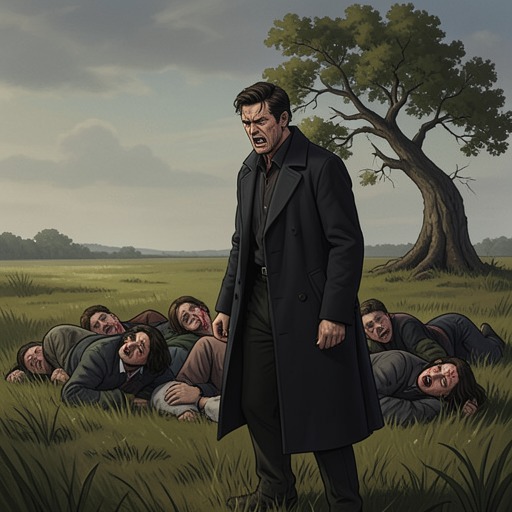
The outbreak’s personal cause emerged through Oscar’s account of what had happened and what he had done. He had brought the creatures from the East Coast. His original plan was to return to his house after Brittney and Randy were out of the picture, but he waited for the police investigation to finish and then became afraid the creatures would return to the house where they had killed before. He remained at a motel instead. His fear of another attack did not undo his part in bringing the danger to Texas.
Almost two weeks after Brittney and Randy died, Oscar watched local news report at least two more deaths along the canal. He recognized that the consequences were no longer confined to the people he had targeted: the creatures he had brought west were spreading and killing others. His feelings remained divided. He took pride in having achieved his revenge against Randy and believed Brittney had deserved what happened, yet he also understood that the later deaths were his responsibility. The same act that had seemed to him a successful personal settlement had become a wider danger, with victims beyond his original plan.
Emergency response and ecological safeguards
The scale of the Gulf-state attacks brought a federal response. A national news update reported that the president had declared a National State of Emergency and deployed the National Guard and Army Reserve to locations including Port Arthur. Troops were to assist local law enforcement in searching near waterways for creatures and nests; the stated search area in the county extended along the shorelines of lakes, inlets, and rivers. The president identified the animals’ rapid reproduction as a threat to public safety and the ecosystem, and had not ruled out bio-terrorism as a cause of the new spread. The report made clear that the authorities were treating the crisis as more than a sequence of isolated attacks.
The recommended response depended on finding nests rather than reacting only after creatures appeared. Mason advised searching dark, wet places near water, including shaded thickets and seaside caves, and destroying both nests and the creatures associated with them. He also warned against simply blasting the animals apart: scattered tissue could enter the water, be eaten by other animals, and carry mutated DNA farther through the food chain. Denise therefore insisted that all tissue be recovered and carcasses collected and burned, so scavengers could not feed on contaminated remains. These precautions made disposal part of the containment effort, not an afterthought to killing the creatures.
Containment and wider significance
The later campaign in Louisiana showed how authorities pursued the connected threat farther along the Mississippi. Four days after creatures broke into a hotel room in Baton Rouge, Army Reserve troops found and destroyed a nest near the river. Ron’s team continued north with the searchers, reaching St. Francisville without finding another nest. The teams covered another forty miles of waterways after locating the Baton Rouge nest and found no further creatures there. Reports from the Gulf of Mexico were also improving, with federal and local authorities encountering the animals less often. Ron’s assessment recorded asexual reproduction, rapid adaptation to different environments, and the clean removal of remains so they would not contaminate the ecosystem.
Those later results documented progress in the wider response; they do not establish that Port Arthur itself was the source of every Gulf Coast attack or that the outbreak there ended at the same moment. Its significance lies in how it joined several scales of consequence: an expanding route of reports along waterways, a suspected ecological mechanism that remained under investigation, a nationwide mobilization, and Oscar’s belated recognition that his revenge had endangered people he had never intended to involve. The emergency required authorities to pursue creatures and nests while also preventing their remains from becoming another means of spread.