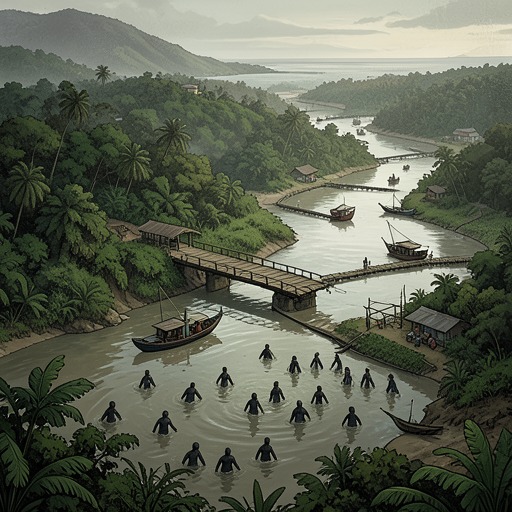
Sligger Spread Through Waterways
Secret InvasionSligger Spread Through Waterways is the developing account of how the creatures appeared across connected coastal and river environments, and of how that apparent geography repeatedly overturned the investigators’ assumptions. The water offered a plausible route for their expansion, but not a sufficient explanation: reports from widely separated places, a suspected outbreak in the Gulf of Mexico, and evidence that the creatures could survive in fresh water forced investigators to consider more than one origin and to track the threat inland. By the time the search reached the Mississippi River, waterway spread had become both an investigative hypothesis and the organizing principle for a large-scale response.
Coastal Reports and the First Pattern
The early reports made the outbreak look broader than a single local infestation. Denise reasoned that attacks at widely separated locations could not be treated as one nearby nest: if the reports from Georgia and St. Augustine, Florida, were accurate, there had to be multiple nests, eggs, and creatures along the coast. That conclusion turned distance itself into a warning. The creatures could be present somewhere unrecognized until an attack revealed them, leaving coastal communities exposed without knowing where to search.
Subsequent reports strengthened the sense of a spreading coastal emergency. Two attacks occurred on the same night: one at St. Augustine Beach and another near Sawgrass, about twenty miles to the north. In Sweetboro, South Carolina, news of appearances at multiple East Coast locations unsettled residents who still remembered the previous year’s attack. Some left for inland homes, while others fortified their houses and stocked ammunition. Mason asked residents to watch for eggs or signs of nesting near the water, but directed them to report discoveries to him and the Sheriff’s Department rather than investigate themselves. The water’s edge had become a place to monitor, not simply a backdrop to earlier attacks.
Water as Habitat and Route
The creatures’ biology complicated any attempt to map their spread. Denise’s tissue analysis had not identified what they were. Residue from the Nazi U-boat beneath Wrecker Island remained under examination, but she suspected it might reveal a substance designed to induce genetic mutation. She proposed that generations of creatures eating other species could acquire changes associated with the DNA of their prey, helping explain their mixed marine characteristics. This was a theory, not a confirmed origin or mechanism, but it offered a possible account of why the creatures did not fit neatly into one ecological category.
Later, reports west of the established coastal search area sharpened the waterway question. Andy told investigators that creatures found in the region were likely coming from somewhere farther west. A report of a possible attack at the edge of the Mississippi River raised a specific uncertainty: could they live in fresh water? Ron answered that they were adaptable, recalling that hatchlings had survived in tap water in a laboratory. Denise described them as a blend of species rather than a species of their own. The observations supported survival in salt water, on land, and in fresh water; they did not, by themselves, establish exactly how the creatures had travelled between locations. The river therefore mattered as both a possible corridor and an environment the creatures could inhabit.
The Gulf Hypothesis and Its Revision
The appearance of creatures in the Gulf of Mexico exposed a contradiction in the investigators’ first account. Ron pointed out that ocean currents did not flow in the direction needed to carry them around the southern tip of Florida and into the Gulf. Andy agreed that this made the development disturbing. Their earlier current-based explanation could no longer account for every report, so Ron proposed another possibility: a separate point of origin. The team treated that as its best current theory, not a discovery, and considered working westward to locate where this additional spread might have begun.
As reports accumulated, investigators described the Gulf movement as eastward from somewhere farther west. Texas was then the furthest-west location reported, at Port Arthur, on the Texas-Louisiana border. That mapped limit was provisional: it identified the furthest report they had at the time, not a verified origin. The difference mattered operationally. Rather than assume a single trail explained all appearances, the response divided its forces: one third was to go to Port Arthur, another third to continue west from the creatures’ known presence in Florida, and the remaining third to reach the Mississippi and follow the reported trail upriver. The plan turned uncertainty into parallel searches, with each route testing a different part of the expanding map.
Search Along the Rivers and Containment
The emphasis on waterways also shaped action at a local scale. After civilian hunters began assembling teams, Savannah concentrated police personnel along the Savannah River to look for signs of occupation. Molly Foster, raised in a military family and comfortable with firearms, led friends in searches near the river; Deputy Norman Linneman later recalled responding to the aftermath on three occasions when her group had destroyed nests there. These searches show how the water’s edge became a boundary shared by official surveillance and civilian effort, even as authorities urged residents elsewhere to leave dangerous discoveries to trained responders.
The later push up the Mississippi tested whether the reported inland expansion could be contained. Four days after the creatures broke into a hotel room in Baton Rouge, Army Reserve troops found and destroyed a nest near the Mississippi. Ron’s team continued north with the sweep, reaching St. Francisville without finding another nest. Searchers covered forty more miles of waterways after locating the Baton Rouge nest and reported no further creatures. Ron’s assessment described the spread up the Mississippi as eliminated and noted that the discovered creatures had been exterminated without leaving remains that could contaminate the ecosystem and mutate its animals.
The account does not resolve every uncertainty about how the creatures reached each waterway or whether every report shared one source. Instead, its pattern is one of revision: coastal distance suggested multiple nests; fresh-water survival widened the range of plausible habitat; the Gulf challenged a current-based explanation; and the Mississippi became the focus of a coordinated inland search. Waterways connected the crisis geographically, but they also exposed the limits of what the investigators could infer from sightings alone.