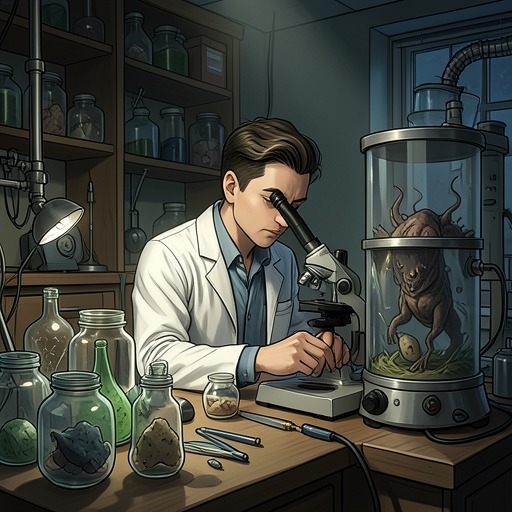
Sligger eggs
Secret InvasionSligger eggs are the large, leathery eggs found in the creatures’ nests as the outbreak spreads from coastal woods to beaches, marshes, culverts, and waterways. Their appearance makes them recognizable across separate discoveries, but each clutch also marks a dangerous breeding site: the expanding number and geographic range of nests lead investigators to conclude that the creatures cannot be contained by addressing a single outbreak location.
Appearance and Early Discoveries
One early clutch was found during a search in the woods near Virginia Beach. The boy’s parents had discovered his body and a nest in the ground; the pocket of leaves held ten eggs, each about a foot long. They were dark yellow and glistened with a sticky coating that adhered to loose earth. Their appearance offered no familiar explanation: there were no alligators that far north, and they did not resemble the eggs of any known bird.
A later television report brought the same kind of object into view on a white beach in St. Augustine, Florida. The broadcast showed half a dozen oblong, greenish-yellow eggs, roughly the size of footballs. Mason recognized them immediately and dropped his fork. The scene makes the eggs more than an isolated curiosity: an image of a clutch on the beach connects the earlier discovery to a second, distant location and signals that the threat has spread.
The Richmond laboratory received three intact eggs from the Virginia Beach crime scene. By the time authorities collected them, the original nest’s other eggs appeared to have hatched, although a brief search found no animals. Leslie Bickers described the surviving eggs as football-sized, bumpy, and greenish yellow, with a soft, thick, leathery covering rather than a hard shell. Their resemblance to giant alligator eggs was only a comparison of texture, not an identification of the animal inside.
Hatching and Scientific Uncertainty
Leslie initially limited her examination because she wanted the organism inside to finish developing. She considered taking samples from within the eggs with a syringe, but did not cut one open. A sample of viscous fluid examined under 400-times magnification yielded no clear answer about what kind of animal the yolk was nurturing; it appeared instead as a jumble of mixed proteins. The eggs therefore supplied evidence of an unknown organism without resolving what it was.
During that examination, an egg shifted on the laboratory table. Leslie saw it move again and recognized that something inside was testing the shell: the egg was hatching. The movement transforms the specimen from a puzzling object into an immediate risk. Leslie did not know what would emerge or how dangerous it might be, and her first response was to try to return the egg to its tank. The episode also gives a direct counterpart to the evidence that eggs in the Virginia Beach nest had already hatched before investigators arrived.
Nests Across Connected Habitats
Later discoveries repeat the eggs’ association with wet, concealed ground. In cut grass, Molly Foster’s light picked out a clutch tucked into tufts; the crew identified the half-dozen, foot-long eggs as belonging to Sliggers rather than alligators. Near reeds, Oscar Brown found another group of six, about a foot long and greenish yellow. Recognizing them from television, he opened his backpack and reached toward one. The scene establishes his attempt to take an egg, while the evidence of that moment does not establish what happened afterward.
Searches also locate clutches in enclosed or waterlogged settings. In a culvert, a team found large greenish eggs in a wet corner after passing two partly eaten alligator carcasses. The carcasses and the odor of rotten eggs had already heightened the team’s alertness; discovering the eggs confirmed that they had reached a nest where protective creatures might be nearby. At another search site, soldiers following trees above shallow, murky water found ten green eggs bunched in a crater of mud at the base of a tree. The soldier’s signal brought the squad to a halt, and the sergeant warned the group to expect danger. Water erupted beneath them almost at once, followed by a tentacle striking the old wood. In these scenes, a clutch is not merely a sign of reproduction: it marks the point at which searchers may encounter adult creatures defending it.
Spread, Ecological Risk, and Response
The distance between reported discoveries changes the significance of the eggs. After news of an attack at a campground in Georgia and the broadcast from St. Augustine, Denise Baddington concluded that the locations were too far apart to be explained by a single nest. She warned that there must be multiple nests, eggs, and creatures along the coast, with attacks revealing locations that authorities did not yet know. The clutches thus function as evidence of dispersed breeding, not a problem confined to the first nest near Virginia Beach.
The investigation connects the creatures’ unusual biology to a possible environmental cause, while leaving that explanation unconfirmed. Denise’s tissue analysis had yielded no conclusive identification. Residue samples from a Nazi U-boat found beneath Wrecker Island were still awaiting test results; she suspected the substance might have been created to induce genetic mutation, and proposed that generations of creatures could acquire traits from the other species they ate. Mason likewise described the suspected leak into the ocean as a possible genetic-mutation or biological-warfare experiment, not an established laboratory finding. The uncertainty matters: the eggs are visible and repeatedly recognizable, but neither their exact biological origin nor the proposed cause of their traits has yet been proved by the evidence available to the investigators.
Because nests are the source of further creatures, Mason tells responders that finding them is the priority. He recommends looking in dark, wet places near water, including shaded thickets and seaside caves, where currents are unlikely to disturb a nest, and destroying both the nests and the Sliggers associated with them. He warns against simply blowing the creatures apart: scattered tissue could be eaten by other animals and carry the mutated DNA onward through the food chain. Denise adds a related disposal rule for animals that have been killed: recover their tissue and burn the carcasses so scavengers cannot feed on contaminated remains. The egg discoveries therefore shape both the search strategy and the effort to prevent the outbreak from becoming a wider ecological contamination problem.
Significance in the Outbreak
As the reports multiply, the eggs provide a recurring, concrete measure of the infestation: clutches are found in coastal sand, ground-level vegetation, reeds, culverts, and muddy sites beside water. Their locations help explain why the response follows shorelines and connected waterways, while the attacks near nests show the danger of reaching a clutch. Later, after the Baton Rouge hotel attack, Army Reserve troops find and destroy a nest near the Mississippi River and continue searching north; no further nests are found along the next forty miles of waterways. The account does not describe the fate of every individual egg, but the contrast between repeated discoveries and an increasingly empty search marks the campaign’s progress. In the story, the eggs turn an unseen reproductive cycle into something that can be located—and, if the nest and its creatures are handled carefully, confronted at its source.