Sligger infestation
Secret InvasionThe Sligger infestation is the rapid, geographically scattered spread of predatory sea creatures along the United States coast and into connected waterways. What first appears to be a series of isolated attacks becomes a crisis of uncertain scale: distant nests suggest that no single known site can account for the outbreak, while the creatures’ capacity to reproduce and adapt makes every unsearched shoreline a potential route of further expansion. The response grows from local warnings and civilian searches into a coordinated national campaign, which eventually declares the spread stopped without resolving how the creatures originated.
Emergence and Expanding Geography
The danger becomes clear when reports place Sliggers in widely separated areas. A Florida beach yields clear video of eggs at St. Augustine, while a campground massacre on Jekyll Island, Georgia, shows that the threat is not confined to the first known area. The distance between the reports leads Denise to conclude that they cannot represent one nest moving from place to place: multiple nests, eggs, and creatures must be present along the coast. Mason, confronted with the possibility that the creatures have reached Florida, feels numbing terror at the realization that the problem is far from over. As further reports arrive, he voices the scale of the uncertainty: there could be nests anywhere, perhaps a hundred scattered along the coast.
The geography continues to widen. Mason and Ron identify earlier incidents around Virginia Beach and Chesapeake Bay, alongside reports from Florida and Georgia. In Florida, two attacks occur on the same night: one near St. Augustine and another near Sawgrass, about twenty miles to the north. The separate sites reinforce the fear that the infestation has multiple points of activity rather than a single, easily traced front. Later, the Escambia County Sheriff’s Office confirms that victims examined at Perdido Key were killed by Sliggers, extending the record of attacks westward along the Gulf Coast.
Biological Threat and Unanswered Origin
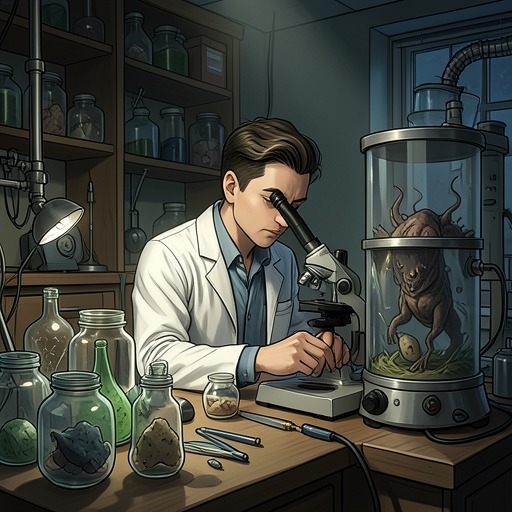
The infestation is frightening not only for its reach but for the creatures’ apparent ability to change. Denise’s tissue analysis has not identified what they are. Residue samples recovered from the Wrecker Island Nazi U-boat are still awaiting test results, but she suspects that they may reveal a substance created to induce genetic mutation in living organisms. Her theory offers a possible explanation for the Sliggers’ mixture of traits from different marine animals: successive generations may have consumed other species and incorporated characteristics of their prey. Ron considers the hypothesis plausible in light of the possibility that German and Japanese scientists experimented with genetics for biological warfare during World War II, but the compound’s identity remains unconfirmed.
The biological risks extend beyond the immediate attacks. Leslie worries that the Sliggers could establish themselves across the coast as apex predators, killing and eating whatever they encounter. If generations continue to reflect traits from their prey, she wonders whether eating humans might also affect their intelligence, defensive abilities, or capacity to strategize. Her fears remain questions, not established developments, but they capture the crisis’s central uncertainty: the creatures may not remain biologically or geographically predictable. When Ron later reports on the campaign, he identifies asexual reproduction and rapid environmental adaptation among the traits his team has uncovered. The infestation is therefore difficult to contain not simply because the animals are dangerous, but because their means of reproduction and adaptation could help them persist in new habitats.
Public Fear and Civilian Response
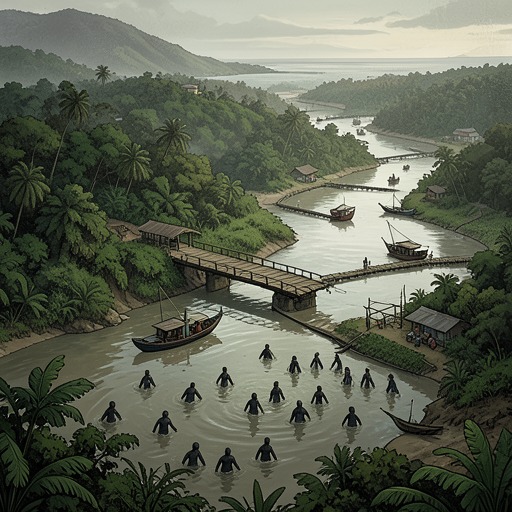
As reports multiply, the crisis changes ordinary life along the coast. National news broadcasts warn people to remain inside at night and avoid the water until authorities declare areas safe. Social media circulates the warnings, while jokes and monster-movie memes provide a dark counterpoint to the danger. Civilian groups also form to search for nests. In Savannah, police concentrate their search near the Savannah River after the Jekyll Island campground attack, even as River Street remains open to diners, pub-goers, gallery visitors, and people watching ships or taking riverboat rides. The contrast between a heavily policed waterfront and its continuing public life makes the threat visible without bringing daily activity to a complete halt.
In Sweetboro, South Carolina, the news revives memories of the previous year’s attack. Some residents lock up and drive inland to stay with family or friends; others reinforce doors, board windows, stock ammunition, and clean their guns. Mason walks the town to reassure residents that he will not allow the creatures to gain a foothold on its shores. He asks them to watch for eggs or signs of nesting near the water, but directs them to report discoveries to him and leave the danger to the Sheriff’s Department. Civilian action is thus encouraged as vigilance and reporting, while the dangerous work is meant to remain under local authority.
That distinction is tested by volunteer hunters. In Savannah, Molly Foster assembles friends for a search near Old Fort Jackson. Raised in a military family and taught to hunt, she is comfortable with firearms and carries her best shotgun. Her group is among those who find and destroy nests along the Savannah River; a deputy responds to the resulting cleanup on three occasions. Later, when a second wave of migration prompts the president to declare a National State of Emergency and deploy Army Reserve troops to support the National Guard, Molly calls the deputy again, hoping to learn how she can help. The infestation repeatedly turns public alarm into organized action, but it also exposes the risks and aftermath of civilians entering the search.
Coordinated Search and Containment
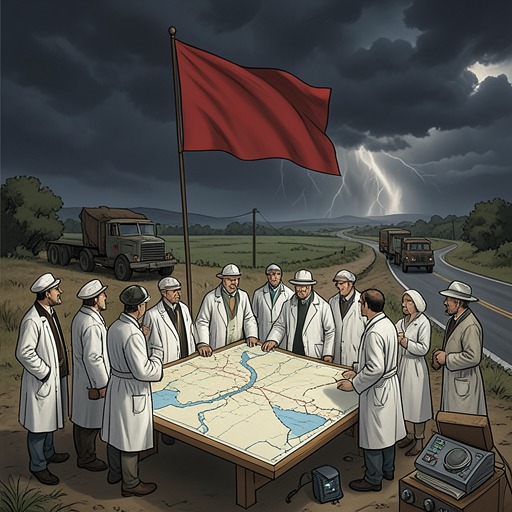
Investigators and officials revise their understanding as the reports move west. Ron’s group concludes that coastal currents have carried Sliggers along the Gulf of Mexico, moving east from somewhere farther west. At this stage, Port Arthur, Texas, near the Texas-Louisiana border, is the westernmost reported location. Ron is especially concerned about expansion up the Mississippi River, and proposes dividing the troops into three forces: one sent to Port Arthur, one continuing west from Florida, and one moving immediately to the Mississippi to follow the creatures’ trail. The plan treats the outbreak as a set of connected but geographically distinct search problems rather than a single front.
At a National Guard briefing, the divisions of labor become concrete. The unit led by Sergeant Billingsly is assigned to clear the area from New Orleans up the Mississippi River, while two other infantry divisions advance from Florida and Texas. Troops are warned to avoid the creatures’ toxic appendages and to kill them without explosives, following Denise’s warning. Ron’s team accompanies the operation, supplying its observations while staying out of the troops’ way. The campaign’s approach combines local knowledge of nests and creature behavior with a broad, coordinated sweep across jurisdictions and waterways.
Four days after Sliggers break into a hotel room in Baton Rouge, Army Reserve troops locate and destroy a nest near the Mississippi. Ron’s team continues north with the searchers. They reach St. Francisville without finding another nest, and after searching forty more miles of waterways, the teams report no further monsters. Ron’s assessment records both the creatures’ asexual reproduction and rapid evolution, and the clean disposal of those found, intended to leave no remains that could contaminate the ecosystem and mutate other animals. The account presents eradication as a matter of biological containment as well as killing the visible creatures.
Declared End and Lingering Questions
The final sweep is immense: over the course of a month, thousands of people spend hundreds of hours searching waterways along the Sliggers’ paths. National Guard and Army Reserve troops return home, while local authorities continue searching until they are satisfied that the creatures are gone. A week after the president officially declares the crisis over, public life begins to return to normal. The immediate threat has been defeated, but mourning for those killed remains part of the aftermath.
The ending does not settle the infestation’s origins. The story leaves open how it spread so quickly from different points and how the creatures came to exist; the mysterious substance associated with the Wrecker Island Nazi U-boat is still being analyzed. The victory is therefore operational rather than explanatory: the spread has been stopped, but its cause is not yet known. That distinction gives the resolution its uneasy edge. The searches can end and the threat can be declared over, while the biological event that produced the Sliggers remains an unanswered question.