Sliggers
Secret InvasionSliggers are mutated sea creatures whose venomous claws, unusual reproductive capacity, and movement through coastal waters turn them into a spreading ecological and public-safety crisis. Their bodies combine traits associated with many different animals, while their ability to reproduce before adulthood raises the possibility that even a small surviving population could establish new colonies. The story offers a strong but unconfirmed explanation for their origin: generations of marine animals may have been changed by an unknown substance released from a Nazi U-boat near Wrecker Island.
Physical Form and Behavior
An adult Sligger stands about five feet tall, with olive-green skin, a reptilian tail, and thick amphibious legs ending in webbed feet. Its most distinctive features are three pairs of tentacle-like appendages, each about four feet long and equipped with a venomous claw. The combination makes it both a land-moving predator and an animal adapted to wet environments; observers are warned that Sliggers move quickly and can take many bullets to kill.
Their heads are dark and shiny, with enormous black eyes and broad, fishlike mouths. A hatchling emerging from an egg has a piranha-like jaw and teeth that are longer and thinner than that comparison might suggest. The tentacles pull it out of the egg first, followed by its amphibious legs and reptilian tail. The creatures’ disturbing appearance is therefore not simply a single familiar animal enlarged: it is a body assembled from visibly different kinds of animal traits.
A Sligger reacts to illumination with shaking and hissing before charging. In one encounter, a creature burst from grass toward a couple while several other heads appeared from the brush to join the attack. The scene conveys the danger of mistaking a quiet, overgrown place for an empty one: multiple animals can be concealed together, and a first sighting may already be the beginning of an assault.
Origin and Evolution
The creatures’ precise origin is unresolved. Investigators discovered an old Nazi U-boat stranded on an island off the coast, with residue and evidence of scientific experiments inside. Mason Parker described the material as possible genetic mutation or biological warfare research, and said that something from the vessel had leaked into the ocean many years earlier. The suggestion is that marine organisms ingested the substance and that its effects passed through generations; the identity and makeup of the compound, however, remain unknown.
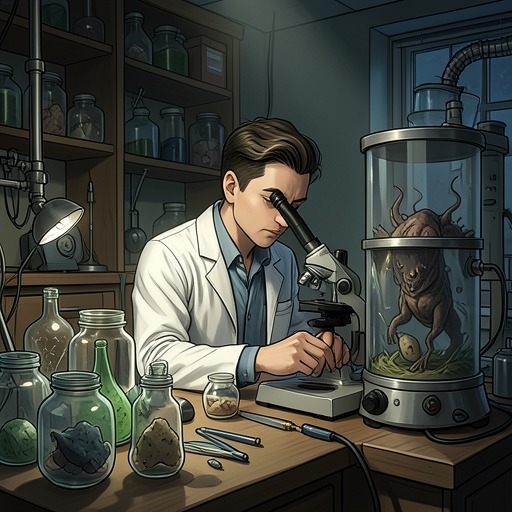
Laboratory analysis has not yet supplied a definitive biological explanation either. Denise Baddington reports that tissue analysis yielded no conclusive identification. She suspects that the residue from the U-boat may have induced genetic mutation, helping to explain why Sliggers display traits associated with several marine and land animals. She further proposes that generations of creatures eating other species could have absorbed prey DNA. These are working explanations rather than established findings, and the unresolved chemistry leaves a gap between the suspected source and the animals’ present form.
The proposed evolutionary history also connects their reproduction to other species. Denise points to parthenogenesis in blacktip sharks, crayfish, frogs, whiptails, and Komodo dragons, and suggests that Sliggers may have acquired the relevant capacity after consuming one of these animals. The hypothesis links their strange anatomy and reproductive biology to the same broader process of mutation and dietary adaptation, without identifying a single confirmed ancestor or pathway.
Reproduction and Habitat
Sliggers lay eggs in nests, and the young begin developing inside their shells before hatching. During an examination of dead hatchlings, Denise found small eggs inside them that were already beginning to develop. Mason Parker recognized the implication: a creature could carry the next generation before it had grown up, making a single survivor a potential starting point for a colony. The discovery turns an individual kill into an incomplete measure of success; eggs and nests must also be found and destroyed.
Their preferred nesting conditions are dark, cool, and wet, usually close to water. Shaded thickets and seaside caves are identified as likely search sites, particularly places where water currents would not disturb a nest. Yet their environmental tolerance may be broader than that preference suggests. Ron Tully recalls that hatchlings in the laboratory survived in tap water poured in by Leslie Bickers. The evidence does not establish how long they can live in freshwater or how far they can travel from the coast, but it warns against treating salt water as an absolute limit.
Water also offers a possible route for the infestation’s movement. Investigators conclude that coastal currents carried Sliggers along the Gulf of Mexico, eastward from somewhere farther west. At the same time, the crisis appears at locations too far apart to be explained by a single nearby nest, leading Denise to anticipate multiple nests, eggs, and creatures along the coast. The route of spread is therefore only partly understood: currents offer an explanation for movement between places, while the creatures’ original points of arrival remain uncertain.
Expansion and Human Response
The Sliggers’ emergence is presented as a recurring coastal danger, not a threat confined to one nest or town. Witness descriptions and photographs of recovered body parts from attacks in South Carolina match the creatures encountered elsewhere. Sweetboro residents, still shaken by the previous year’s attack, respond to news of multiple East Coast appearances by leaving coastal homes, reinforcing doors and windows, stocking ammunition, and cleaning their guns. The return of apparent safety in Sweetboro after the Wrecker Island mission is consequently fragile: the town had believed its Sliggers obliterated, but similar creatures are emerging in other locations.
As reports spread nationally, people are advised to remain indoors at night and away from the water until authorities declare areas safe. Social media carries both warnings and jokes, while informal groups organize searches for nests. Molly Foster assembles friends for a hunt, drawing on her comfort with firearms, a military-family upbringing, and experience as a hunter. Her group later destroys nests along the Savannah River; the repeated cleanup visits by a deputy mark the hunters’ work as part of a developing, if dangerous, civilian response rather than an isolated excursion.
The search strategy focuses on locating nests and eliminating both the eggs and the associated adults. Even a shoreline section that looks promising—one with partially submerged trees—can yield no nest, underscoring the uncertainty of searching by habitat alone. Meanwhile, Sliggers are reported in a Baton Rouge hotel, and Army Reserve troops locate and destroy a nest near the Mississippi River. The troops continue north with Ron Tully’s team; by the time they reach St. Francisville without finding another nest, the team is persuaded that the spread has been stopped. This is a provisional assessment of the search, not an answer to how the infestation began or spread so quickly.
Ecological Risk and the Limits of Control
The danger posed by Sliggers continues beyond their direct attacks. Denise Baddington insists that the tissue of killed animals must be recovered and the carcasses burned cleanly, so scavengers cannot feed on remains containing mutated DNA. The warning makes disposal part of eradication: leaving a carcass behind could, in theory, carry the same contamination into other animals and extend the crisis through the food chain. Ron Tully’s final assessment likewise emphasizes that exterminated creatures were removed without leaving remains that could contaminate the ecosystem.
The animals’ capacity to reproduce asexually and their reported rapid evolution add a further uncertainty to control efforts. Denise observes that carcasses show some change, but the evidence does not specify what changed or establish the mechanism. The combination of variation, reproduction, and movement through connected waterways makes the Sliggers difficult to treat as a fixed population with a single predictable habitat. Even after searches in Louisiana suggest that the spread has stopped, scientists are still analyzing the unknown compound, and the origin of the infestation remains an open question. Their apparent defeat therefore does not erase the ecological problem that produced them: the suspected contamination has not yet been identified, and its full consequences are not known.