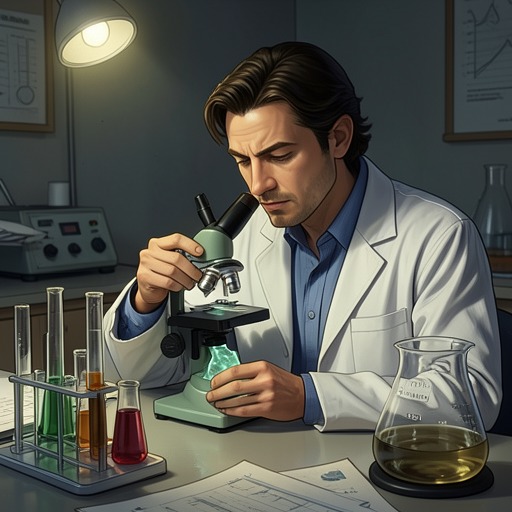
U-boat mutagenic substance
Secret InvasionThe U-boat mutagenic substance is an unidentified material associated with the Wrecker Island Nazi U-boat and suspected of entering the ocean decades before the Sligger crisis. Investigators connect it to the creatures’ mutations, but the available tissue analysis does not establish what the substance is. Its importance lies not only in the monsters it may have helped create: contaminated remains could pass mutated DNA back into the food chain, making careful eradication part of the effort to protect the wider ecosystem.
Origin and Uncertainty
The suspected source is an old Nazi U-boat found beneath Wrecker Island, where strange experimental material was discovered. Mason Parker describes the material as having leaked into the ocean many years earlier and says investigators suspect a genetic-mutation or biological-warfare purpose. The compound itself, however, has not been identified: the story presents its origin and function as a working theory, not a laboratory-confirmed result.
Denise Baddington, the marine biologist stationed in Sweetboro by the U.S. Fish and Wildlife Service, has both samples of the tainted water in which the creatures lived and residue recovered from the submarine. Her tissue analysis of the Sliggers has yielded no conclusive explanation of what they are, and she is still waiting for tests on the submarine residue. She suspects that the substance may have been created by German and Japanese scientists to induce genetic mutation when introduced into an organism’s DNA. The pending results matter because they could test that proposed link; until then, the compound remains an explanation under investigation rather than a solved scientific mystery.
Proposed Role in Sligger Mutation
Denise’s theory links the contaminant to the Sliggers through generations of feeding. In her account, marine animals consumed waste from the experiments; the resulting mutations, together with the DNA of prey animals eaten by later generations, could explain why the creatures display traits associated with multiple marine species. The text therefore presents mutation not as a single observed transformation but as a suspected, cumulative process whose precise chemistry is still unknown.
The creatures’ spread makes this uncertainty consequential. Denise reasons that attacks reported at widely separated locations, including St. Augustine and a campground in Georgia, indicate multiple nests and populations rather than one isolated group. Later, officials conclude that coastal currents carried Sliggers eastward through the Gulf of Mexico from somewhere farther west; Texas, with Port Arthur near the Texas-Louisiana border, is the westernmost reported point. The narrative thus connects the submarine’s old leak to a crisis that moves through water and coastal habitats, while stopping short of proving the contaminant’s exact route or concentration at each site.
Contamination and Eradication
The suspected mutagen changes how authorities must kill the creatures. Mason warns that simply blowing them apart could scatter mutated DNA through the water. If other animals ate the tissue, he fears, the cycle could begin again. Denise accordingly urges responders to recover all tissue and cleanly collect and burn carcasses, preventing scavengers from feeding on remains that might carry mutated DNA. Destroying the creatures without controlling their remains would, on this account, risk extending the ecological consequences of the original leak.
This protocol accompanies nest destruction and broader cleanup. After the Wrecker Island battle, the creatures and their eggs were destroyed, their carcasses properly disposed of, and the EPA cleaned up the toxic element that had leaked from the submarine in order to restore the island’s ecosystem. In the later response, Ron Tully records that exterminated creatures were handled cleanly, leaving no remains that could contaminate the ecosystem and mutate its animals. The source material distinguishes these practical containment measures from chemical certainty: the cleanup proceeds even though the substance’s identity is still unresolved.
Continuing Consequences
The compound’s narrative role persists after its suspected release. It connects a concealed wartime experiment to present-day mutations, turns the disposal of dead creatures into a biosecurity concern, and gives investigators a reason to collect water, residue, and tissue samples. The evidence does not disclose a final test result or a definitive chemical name. Instead, the substance remains an unresolved cause whose suspected effects are visible in the Sliggers and whose possible return through contaminated food chains informs the rules of the extermination campaign.
The response eventually reports that a nest near Baton Rouge was destroyed and that searchers moved north along the Mississippi River to St. Francisville without finding another nest over forty more miles of waterways. Ron Tully’s assessment also describes the creatures’ asexual reproduction and rapid environmental adaptation, while reporting that their remains had been disposed of to prevent contamination. Those findings indicate progress in containing the infestation; they do not establish that the submarine residue has been chemically identified or that the original leak’s full environmental effects are known.