United States Coast Guard
Secret InvasionThe United States Coast Guard is assigned a central role in the federal response to the Sligger crisis: working around the clock with local law enforcement to find the creatures’ nests. Its deployment signals that the threat has outgrown isolated coastal attacks and state-by-state action. The Coast Guard joins a wider network of police, volunteers, and National Guard forces, with the task of helping search a coastline where the creatures’ spread remains uncertain.
From scattered reports to federal action
The need for a response beyond local jurisdictions becomes clear as reports emerge from widely separated places. Mason tells the group about an attack at a Georgia campground and video showing Sligger eggs on a beach in St. Augustine. Denise concludes that the distance between the sites points to multiple nests and creatures along the coast, making further attacks likely and their locations difficult to predict. The crisis is therefore not simply a matter of pursuing a known group from one site; searchers may not know where a nest is until an attack occurs.
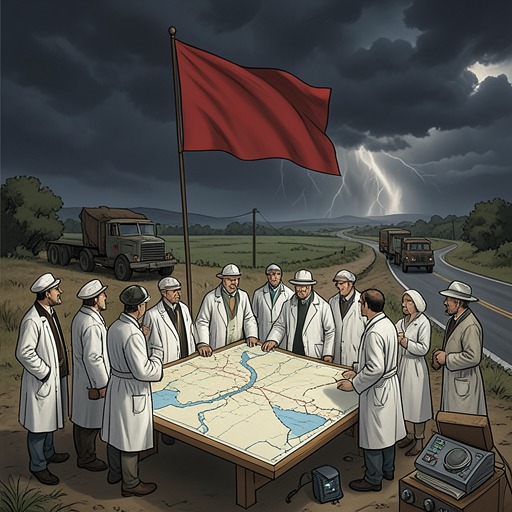
That geographic uncertainty gives urgency to calls for public warning and wider coordination. Eaver asks whether someone in government can issue a national warning. Denise identifies a contact at the U.S. Fish and Wildlife Service, while Ron later says he will have his superiors notify the media and contact law-enforcement agencies along the coast. These steps establish an information and coordination chain before the Coast Guard enters the response directly.
Presidential order and assigned task
The federal escalation is announced after several governors have already called in the National Guard. Virginia, New York, South Carolina, Georgia, and Florida have taken that step when a news report says the president has met with the secretary of defense and ordered the United States Coast Guard to join the effort. The president’s stated plan gives the service a specific operational role: it is to work continuously with local law enforcement to find every Sligger nest.
The same announcement expands the National Guard deployment, sending the remaining forces to states that have not yet called them in. The distinction matters: the Coast Guard’s stated assignment is joint nest-searching with local police, while the additional Guard deployment broadens the pool of forces available across the affected states. The book presents these as connected parts of the federal response, not as interchangeable organizations or a single undifferentiated command.
Part of a wider search effort
The Coast Guard is one component in a response that depends on many kinds of personnel. Andy counts local police, volunteers, the Coast Guard, and the National Guard together as enough people to cover the coast, while also fearing that the creatures may already have spread too far. His assessment frames the service’s contribution in terms of manpower and coverage: the problem is extensive shoreline and waterways, and even a large combined force may be racing against the Sliggers’ movement.
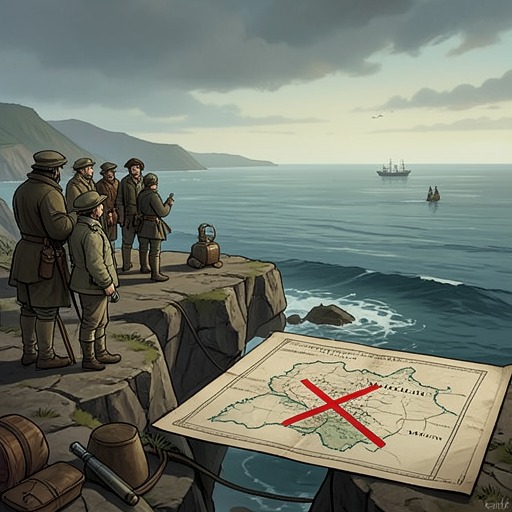
The scale of the search is made concrete by the civilian hunters’ experience along the Savannah River. After a confrontation, Molly calls the police and gives them the location of bodies that need disposal; her group waits rather than continuing its hunt. She recognizes that from their position another ten miles of river remain before the Atlantic, not counting inlets and island shores, and that searching the waterways could take months. The episode gives context to the Coast Guard’s round-the-clock assignment: finding nests requires sustained work across a connected, difficult-to-cover coastal landscape, not merely a response at individual attack sites.
Limits and narrative significance
The book establishes the Coast Guard’s mandate and its place in the mobilization, but does not make it the sole search force or attribute the crisis’s eventual containment to the service alone. Later plans describe National Guard infantry divisions searching from different directions, while local deputies conduct methodical shoreline sweeps. The Coast Guard belongs to this broader, overlapping effort, whose effectiveness depends on cooperation across agencies and jurisdictions.
Its introduction marks a shift in the crisis’s scale. Earlier, the characters are trying to alert officials that distant discoveries imply nests across the coast; now the president has authorized a federal service to join local law enforcement in a continuous search. The deployment offers a visible sign of national commitment, but the uncertainty about how far the infestation has spread remains. In that tension between organized response and incomplete knowledge, the Coast Guard represents both the reach of federal mobilization and the enormity of the task it has been ordered to undertake.