VA Bio+Tech Park
Secret InvasionVA Bio+Tech Park is a research site in Richmond that becomes an early scientific focal point in the investigation of the coastal creatures. In Leslie Bickers’s laboratory, eggs recovered near Virginia Beach are examined, and the site brings her into contact with scientists Ron Tully and Andy Carlyle as the unexplained threat begins to spread.
Setting and laboratory
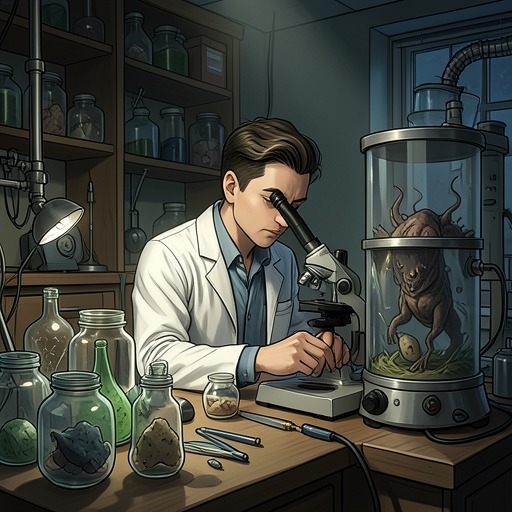
On a Saturday, Leslie arrived after an unusually quick drive and entered a quiet building where the sound of her shoes echoed along the hallway. In the laboratory, she put on her coat and went directly to the specimen tank. Its clear Plexiglas walls held three eggs nestled on sterile gauze, protected by a steel mesh cover.
The eggs had come from a nest found in the woods near Virginia Beach, after a young boy was killed there. His parents had discovered as many as ten eggs in the ground, but only three remained intact by the time authorities arrived; the rest appeared to have hatched. A brief search found no animals, so the eggs were the only specimens brought to the laboratory.
Leslie Bickers’s examination
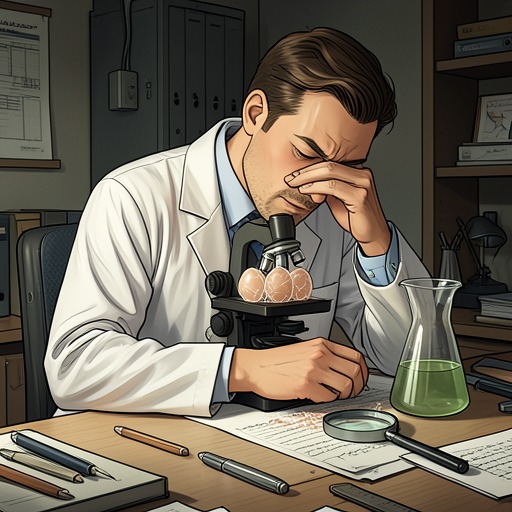
Leslie removed one egg and studied it under the examining table’s white light. About the size of a football, it was oblong, greenish yellow, and bumpy, with a soft, thick, leathery covering rather than a hard shell. She wondered what organism it contained, but, as a responsible biologist, resisted cutting it open before it had finished developing. For the time being, she limited her examination to its exterior and the possibility of taking samples with a syringe.
The specimen unsettled the limits of her experience: in fifteen years as a biologist, Leslie had never seen anything like it. The lab’s initial task was therefore both practical and provisional—to preserve the eggs while investigating an organism that had not yet been identified.
A meeting place for investigators
The park also became a point of contact between Leslie and outside specialists. Gina Taylor asked Ron and Andy to come to Richmond and join Leslie, explaining that an unidentified animal had been found near Virginia Beach. When the two scientists arrived, Leslie met them at the building entrance, still flushed with excitement, and led them through the hallways to her laboratory. Ron and Andy were eager to see the animals for themselves.
The visit placed the preserved specimens within a growing effort to understand the threat. In the wider investigation, Denise Baddington reported that tissue analysis had produced no conclusive identification. Residue recovered from the Nazi U-boat beneath Wrecker Island was still awaiting test results, but she suspected it might reveal a substance created to induce genetic mutation. Her hypothesis was that generations of creatures feeding on other species could acquire traits from their prey. This explanation remained a theory, not a confirmed finding.
Significance in the expanding crisis
The laboratory’s specimens represented only a fraction of a problem already appearing across distant coastal locations. Reports from Georgia and St. Augustine led Denise to conclude that multiple nests and creatures must be present along the coast, rather than the incidents being connected to a single nest. That wider pattern made the eggs at the park more than an unusual biological curiosity: they were evidence of a reproducing, geographically dispersed danger.
Later, investigators described coastal currents carrying the creatures along the Gulf of Mexico and reported Port Arthur as the furthest-west location then known. After a nest near Baton Rouge was destroyed, searchers moved north toward St. Francisville, covering another forty miles of waterways without finding further monsters. Those developments belong to the broader response rather than to a confirmed operation based at VA Bio+Tech Park. The park’s specific importance is as the place where anomalous eggs were carefully preserved and examined, and where scientific collaboration began to take shape around a threat whose range was growing faster than its explanation.