Virginia Beach
Secret InvasionVirginia Beach is where the novel’s first major evidence of the Sligger threat emerges: a boy is killed in nearby woods, and a nest containing as many as ten eggs is found at the scene. The discovery links a local tragedy to a danger that cannot be contained within one town, because several eggs have already hatched and the creatures themselves remain unaccounted for.
Setting and First Discovery
The opening places Matty outdoors in Virginia Beach as evening approaches; his mother, concerned by the growing darkness, asks Darren to go and call him home. The later account of the crime scene establishes the stakes of that ordinary setting: the boy was killed in woods near the city, where his parents also found a nest in the ground. The juxtaposition makes the surrounding landscape more than a backdrop. The woods conceal both the fatal encounter and the first tangible sign of a population that has escaped detection.
The nest held as many as ten eggs. By the time authorities arrived, only three remained intact, while the others appeared to have hatched. A search of the area yielded no animals. The gap between the missing eggs and the absent creatures makes the discovery ominous: investigators have evidence of reproduction without knowing where the hatchlings have gone.
From Crime Scene to Laboratory
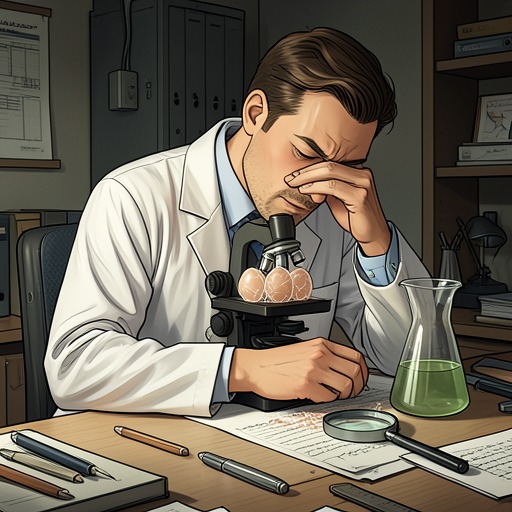
The three intact eggs were taken from the Virginia Beach-area crime scene to Leslie Bickers’s laboratory at the VA Bio+Tech Park in Richmond. Two days after the boy’s death, Leslie examined eggs about the size of footballs, greenish yellow and bumpy, with a soft, thick, leathery covering rather than a hard shell. She was tempted to open one, but chose to let the organism develop and limited her initial investigation to the exterior and possible samples drawn with a syringe.
The transfer carries the local discovery into a scientific investigation, but it does not immediately resolve the mystery. Denise Baddington later reports that tissue analysis has produced no conclusive identification of the creatures. Her proposed explanation instead connects them to residue from an old Nazi U-boat found beneath Wrecker Island: she suspects a substance designed to induce genetic mutation, with the creatures’ varied marine characteristics arising over generations as they consume other species. The link remains a theory pending laboratory results, not a confirmed account of the eggs’ origin.
A Local Incident Becomes a Coastal Warning
Virginia Beach matters to the wider crisis because its evidence changes how investigators interpret subsequent reports. When attacks are reported in Georgia and eggs are seen on a Florida beach, Denise reasons that the locations are too far apart to be explained by a single nest. She warns that multiple nests, eggs, and creatures must be distributed along the coast, making further attacks likely and their locations difficult to predict before they happen. The Virginia Beach discovery is thus part of the evidence behind a shift from treating the creatures as a contained local danger to anticipating a regional emergency.
Later, two attacks are reported in Florida: one near the eggs found on St. Augustine Beach and another near Sawgrass, about twenty miles farther north. Those incidents reinforce the pattern of separate coastal sites, rather than establishing that the creatures have returned to Virginia Beach. The narrative uses the city as an early point of discovery against which the expanding geography of the threat becomes legible.
Ecological Stakes and Narrative Significance
The response to the Virginia Beach evidence also develops the crisis’s environmental dimension. Mason Parker advises that nests are most likely in dark, wet places near water, including shaded thickets and seaside caves, and that both nests and their creatures must be destroyed. He warns against simply blowing them apart: scattered tissue could enter the water, be eaten by other animals, and restart the cycle through mutated DNA. Denise later insists that every carcass be recovered and burned so scavengers cannot carry the material into the food chain.
These precautions connect the nest found near Virginia Beach to a larger causal chain that the investigators are still trying to establish: a suspected historical release into the ocean, creatures with unexplained traits, and the risk that their remains could spread genetic contamination further. The city’s importance is therefore not only that a killing occurs nearby. It is the first clear hinge between a hidden nest, an unresolved scientific question, and the recognition that coastal waterways may carry consequences well beyond the original crime scene.