Botola nascosta di Mato Rujo
Senza sangueBotola nascosta di Mato Rujo is a carefully concealed compartment dug into the earth beneath the floor of a room at Manuel Roca’s farm. Manuel uses it to hide Nina from approaching armed men, telling her to wait until danger has passed or her brother comes for her. Its first function is protection; its lasting meaning comes from the moment Tito finds Nina inside, lowers the hatch, and leaves without rescuing her. The small refuge becomes a chamber of suspended time, and later a focal point for both Nina’s enduring terror and Tito’s unspeakable wartime memory.
Construction and Concealment
Manuel moves baskets full of fruit to uncover a hidden lid and look inside. The space below is little more than a large hole dug in the ground, likened to an animal’s den. It is not presented as a finished room: its defining features are its earth floor, a lid level with the floor above, and the ordinary objects that conceal its entrance. The baskets make the hatch disappear into the working disorder of the room, while the bare hole offers only enough space for Nina to lie down.
The concealment depends on the room’s familiar contents. When Tito later searches it, he finds overturned chairs, trunks, tools, and baskets of half-rotten fruit. Damp and decay fill the room, and dust on the floor appears disturbed, as though feet—or something else—had dragged across it. The hidden compartment is thus marked first by absence and inference: its entrance is not obvious, but the traces around it suggest that the room has been used in an unusual way.
Manuel Hides Nina
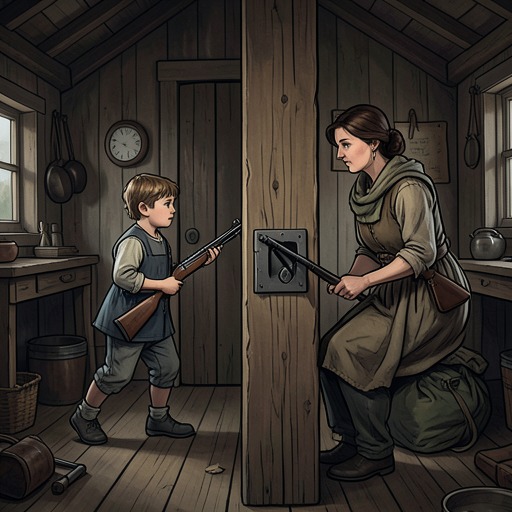
Manuel tells Nina that people are coming and that she must hide below until they leave. He reassures her, but also makes clear that he might have to go away with the men. In that case, she must stay inside until her brother comes or she can tell that nobody remains and everything is over. The instructions turn the hatch into a place of waiting: Nina is not given a definite rescue time, only conditions she must learn to recognize from underground.
At Manuel’s urging, Nina drops into the hole and lies on the hard, dry earth. He gives her a blanket, which she spreads on the ground before lying down again. Once the lid is lowered, narrow blades of light enter between the floorboards. Nina hears Manuel speaking to her, the baskets scraping across the floor overhead, and then the room grows darker. She curls on her side, knees bent, as if settling into her bed, while her father continues speaking softly from above. That familiar posture briefly makes the unfamiliar hiding place resemble a place to sleep, but the sounds outside it soon rupture the illusion of safety.
A shot and the crash of a window breaking interrupt Manuel’s quiet words; a man then calls for Roca to come out. The contrast between the father’s tenderness and the violence reaching the house makes the hatch both shelter and boundary. Nina can hear the danger without seeing it, while those above can conceal the opening by replacing the baskets. Protection therefore requires her to remain still and cut off from the events that will determine whether anyone returns for her.
Tito Finds the Hatch
During the attack, Tito enters the cluttered room while el Gurre searches elsewhere, striking the walls with a machine gun to find hidden doors. Tito moves a basket and recognizes the outline of a hatch in the floor. He tests the sound beneath it with his boot, shifts two more baskets, and kneels to lift the carefully cut lid. Nina is inside, curled on her side with her hands tucked between her thighs and her head angled toward her knees; her eyes are open.
Tito points his pistol at her and calls for Salinas, but no one answers from beyond the curtain. The stillness of Nina’s curled posture strikes him with an almost overwhelming sense of recognition and beauty. He recalls the bodily position as one he has found in himself many times, in the warmth of bedclothes or beneath an afternoon sun as a child. For a moment he sees her as complete and orderly, an image sharply at odds with the surrounding room’s dampness, disorder, and violence.
The scene does not lead Tito to bring Nina out. She turns her head back to its former position, and he realizes that time has passed while el Gurre continues battering the walls. He lowers the hatch slowly, remains on his knees watching the floor’s cracks for a while, then replaces the baskets. His heart beats at his temples. The hatch has revealed Nina to him, but he leaves her in the same enclosure, restoring the concealment rather than ending it.
Abandonment and the Burning Farm
Tito leaves the farm with el Gurre and Salinas. As they walk away in the night, he has decided to tell Salinas that a child is still inside, but the words do not come. The silence around them, his exhaustion, and Salinas’s trembling, labored progress accompany the failure to speak. Tito looks back toward the farm; when el Gurre returns, the building is already being consumed by fire, flames breaking out everywhere as black smoke rises into the night.
The fire makes the hatch’s earlier promise of temporary safety radically uncertain. Nina had been told to wait for her brother or for the moment when all danger had ended, but the reader sees the farm burn before there is any assurance that she has been found. Tito’s decision to lower the lid and his silence on the path connect the hidden space to a concrete consequence: the possible rescue he might have enabled is delayed while the place that contains Nina is destroyed by fire. The episode establishes the hatch not as a secure refuge but as a shelter whose protection depends on people outside it choosing to return.
Recalled Space and Wartime Memory
Years later, Nina recounts what it was like when the hatch opened. She says she felt no fear at first: she turned to look at the boy’s face, and what was happening seemed natural, even obvious. In some way, she liked it. Fear came when he lowered the lid again. Darkness returned, baskets scraped back over her head, and the boy’s footsteps receded. She felt lost, and says that terror never left her. Her recollection distinguishes the discovery of the hidden child from the abandonment that followed it; the hatch becomes frightening not simply because it is dark, but because it closes after the possibility of rescue has appeared.
Nina also remembers wishing that the boy would take her with him. She frames this desire through the strangeness of a child’s mind, without making the moment less consequential: the space that Manuel intended as a hiding place becomes, in her memory, the scene where escape seemed briefly possible and then vanished. Its physical boundaries—earth, lid, floorboards, baskets—persist in the remembered sounds and darkness of that loss.
Tito, listening to Nina years later, cannot tell her what seeing her in the hole meant to him. He remembers her curled there, clean and orderly, and the peace he felt, an experience he says he rarely found again except before a landscape or in an animal’s gaze. Yet he cannot find a word adequate to what seemed infinitely complete. His difficulty becomes part of the compartment’s significance: Nina can narrate the fear that followed the lid’s closing, while Tito remains unable to shape his own wartime experience into a telling. He listens without interrupting, lost in thought, and eventually cries openly. The concealed hole holds the two memories together without reconciling them: the child’s lasting terror of being left and the soldier’s inexpressible glimpse of peace.