Count of Torrelavid
Senza sangueThe Count of Torrelavid is at once a powerful landowner, a gambler who turns a child into the stake of a card game, and a political operator entrusted with eliminating Nina. His story makes the novel’s exchanges of property and protection inseparable from coercion: he takes Nina from Ricardo Uribe after wagering for her, later makes her his wife, and ultimately receives a visitor who returns to him with the buried history of the Mato Rujo raid and massacre.
Belsito and the Gambler
Belsito, the Count’s estate, is described as the finest fazenda in the area. An avenue of orange trees climbs the hill to the house, from which the ocean can be seen. Its beauty gives the property a vivid presence in the gambling scene: Belsito is not merely a large sum of money but a place with a landscape and a home, the prize the Count chooses to put at risk.
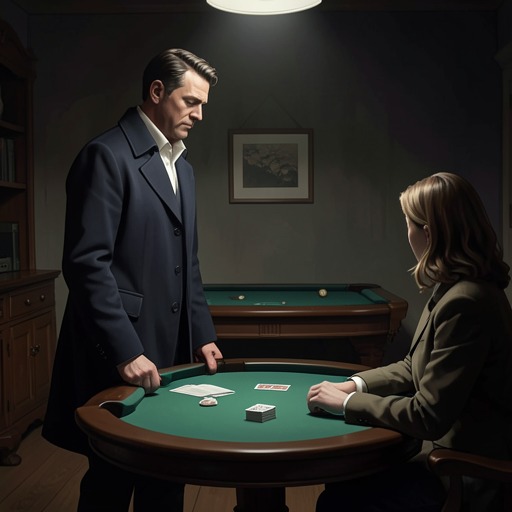
The Count plays at the Riviera, a gambling tavern where Uribe goes every Friday. On the winter night that changes Nina’s life, the game continues late. Uribe holds four jacks and faces a pot worth more money than he would see in a year. The other players have contributed and folded; the Count alone keeps raising, and both men press on as the game carries them beyond ordinary judgment. The Count stakes Belsito. When Uribe says he has nothing of comparable value to wager, the Count suggests Uribe’s pharmacy, laughing at first. Then he becomes serious and turns the exchange toward Uribe’s daughter.
The Wager for Nina
The Count presents Belsito against Uribe’s child as an honest proposal. The tavern’s stillness and the attention fixed on Uribe sharpen the cruelty of the transaction: Nina is made to stand in for property, although she is not a consenting player. The Count places his five face-down cards on the table. Uribe stares at them without touching them, murmurs something no one later reports, and slides his own cards toward the Count. The account does not disclose either hand, but the Count takes Nina to his home that very night.
The wager is also a reversal in the Count’s relation to Nina. Before that night, he had seen her only once, as she crossed a plaza while he sat at a café. That single glimpse precedes the decision to make her the price of a game and then to incorporate her into his household. The narrative gives no explanation of what the Count felt about her; instead, it emphasizes the distance between his brief prior acquaintance with the child and the lasting claim he acquires over her.
Marriage and Household
The Count does not marry Nina immediately. He waits sixteen months, until she is fourteen, and then marries her. Nina later says that she bore him three children. The sequence links the tavern wager to a family life, but it does not turn the original exchange into a free choice: the Count first takes her as the consequence of a gamble, and the marriage follows while she is still a child. His household becomes part of Nina’s later history, without erasing the circumstances under which she entered it.
Political Role and Nina’s Survival
The Count’s private power is joined to a concealed political role. In the account of a former wartime associate, he had played both sides throughout the war: he worked for the opposing group while also being one of the narrator’s people. After Salinas is found dead, suspicion eventually reaches Uribe, and people become convinced that Nina may know something. The postwar world, the narrator says, has moved on, but for those still shaped by the conflict nothing is finished; Nina is regarded as a danger, and a decision is made to eliminate her. The Count is assigned to carry it out.
Instead, he confronts Uribe with a choice. Uribe can face a lifetime in prison for Salinas’s murder, or disappear and leave Nina to the Count. The narrator judges Uribe a coward and says a court would not have been able to convict him, but fear determines his response: he leaves Nina with the Count and goes away. He dies about ten years later in a remote village beyond the border, leaving a statement that he had done nothing and that God would pursue his enemies to hell. The Count’s intervention therefore does not amount to a simple rescue. He becomes Nina’s keeper through an ultimatum backed by political danger, after having already taken her through the wager.
The suspicion surrounding Uribe has its own tangled background. Salinas was found dead in bed, officially from a heart condition; rumors later accused his doctor, Astarte, of poisoning him gradually over several months, but an investigation produced no conclusion. During the war, Astarte had made money from Botran, a remedy for fevers and infections that he developed with a pharmacist: Uribe. After the war, Uribe’s name appeared among the suppliers to a hospital, and someone claimed to have seen him working there. He submitted to questioning, was released, and withdrew to a rural town, where he bought a pharmacy and lived with the little girl he called Dulce, claiming her mother had died years earlier. The narrator identifies this concealed child as Nina, Manuel Roca’s surviving daughter. The Count is thus placed at the junction of Nina’s hidden identity, the unresolved death, and the decision to remove her.
The Return to Belsito
Years later, a former wartime associate takes the train to Belsito. He has begun sleeping at night and is among people who no longer call him Tito; believing the war truly over, he decides there is one remaining matter to settle. He intends to tell the Count about the trapdoor, the child, and everything connected to them. The Count recognizes him and receives him courteously in the library, offers him a drink, and asks what he needs. The visitor begins by asking whether the Count remembers the night at the Mato Rujo raid and massacre. The account supplied here ends before the Count’s answer, leaving this meeting poised between the Count’s composed hospitality and the history the visitor has come to disclose.
Across these episodes, the Count’s defining position is that of a man who can make private arrangements carry public consequences. He wagers land, claims a child, and is entrusted with a political killing; when the past returns, the visitor’s journey brings the unresolved story back to Belsito, the place that first figured in the exchange.