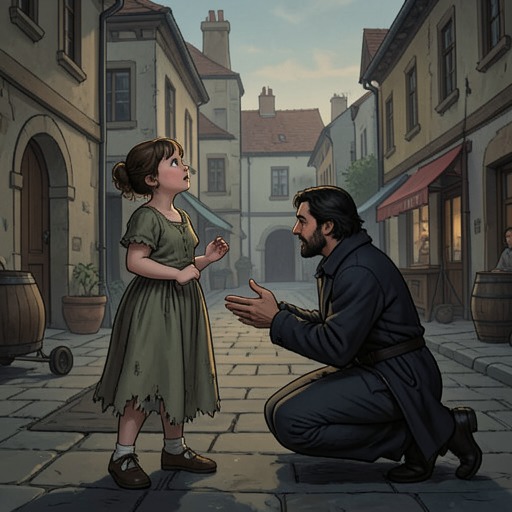
Il ritrovamento e il salvataggio di Nina
Senza sangueThe discovery and rescue of Nina is the turning point from the burned farm’s desolation toward survival. Three days after the fire, an unnamed, ragged traveler finds her amid the ruins; without demanding words or explanation, he offers his hand, takes her onto his horse, and rides away with her. The scene makes rescue an act of quiet physical care, set against a landscape still marked by destruction.
Arrival at the Ruins
Three days after the fire, a man arrived at the Mato Rujo farm on horseback. He was dressed in rags and dirty all over, and his mount was an old, emaciated horse. The animal’s eyes were diseased: flies circled the yellow fluid running down its muzzle. The arrival offers no account of the rider’s identity or purpose. He enters the scene not as a named rescuer with an explained plan, but as a stranger whose first presence is defined by poverty, hardship, and the damaged animal carrying him.
The farm’s remains make the scale of the fire visible before Nina appears. Its walls stood blackened and useless in the middle of what seemed like an enormous extinguished brazier, compared to the surviving teeth in an old man’s mouth. The blaze had also consumed the great oak that had shaded the house for years. Now it stood like a black claw, marked by an atmosphere of ill omen. The setting is not simply a shelter in need of repair: the home and its long-standing shade have been burned away, leaving a landscape of aftermath.
Finding Nina
The traveler remained on horseback and made a slow half-circle around the farm. At the well, he lowered the bucket without dismounting. He heard the metal strike the water, then looked up toward the ruin and saw a girl sitting on the ground, leaning against what remained of a wall. She was watching him. Soot darkened her face, but her eyes were still and bright; she wore a little red skirt and was covered in scratches or wounds. The narrative identifies her as the child at the center of the rescue, while her posture and injuries register what the fire has left her to endure.
The encounter begins without speech. The girl has nothing to say, and the man studies her eyes, lips, and hair before offering a hand. This pause makes the recognition bodily rather than explanatory: she is first seen as a silent child amid the ruins, and the next step is not interrogation but an invitation to stand. When she takes his hand, he helps her up and lifts her onto the horse behind him. Her movement from the ground beside the broken wall to the saddle marks the scene’s decisive change—from abandonment in the burned farm to the possibility of being carried away.
The Well and the Departure
Before approaching Nina, the man draws up water from the well. It is blackish. He stirs it with a tin spoon, but the darkness does not clear; he fills the spoon, drinks a long swallow, looks into the bucket again, and spits into it. He then leaves the bucket on the well’s rim and urges the horse onward. The water’s visible contamination belongs to the scene’s material aftermath: even this source at the farm is darkened, and the traveler’s brief attempt to stir it changes nothing. His decision to ride on carries the action away from the ruin rather than restoring what the fire has spoiled.
Once Nina is behind him, the old horse adjusts its legs and lifts its muzzle twice. The man makes a strange sound with his mouth, and the horse calms. The small exchange matters to the rescue’s practical shape: the child and the traveler leave together on an exhausted animal that must itself be steadied. As they ride away at a walk beneath a fierce sun, Nina lets her head fall forward and rests her forehead against the man’s dirty back. She falls asleep. After the watchful stillness of her first appearance, sleep is the scene’s quietest sign of change: carried from the ruins, she can at last stop looking at the stranger and rest against him.
Significance
The rescue follows the fire by three days, a delay that places Nina not at the instant of destruction but in its aftermath. The blackened walls, lost oak, injured child, and dark water make the wreckage tangible; the unnamed rider does not undo any of it. What he can do is offer a hand, provide transport, and take Nina away from the ruined farm. The scene’s reversal is therefore limited but consequential: devastation gives way to movement, and exposure to the possibility of shelter and continued life.
The contrast between the farm’s scorched stillness and the slow departure gives the rescue its emotional force. Nina does not explain what happened or announce what she needs. The account remains with observable acts—the offered hand, the lifted child, the horse calmed, the forehead resting against a dirty back. In a narrative framed by a burned home and a child who has nothing to say, care is conveyed through contact and transportation rather than promises. The ending leaves the destination and the traveler’s identity unstated, but makes the immediate outcome clear: Nina has been found and is no longer alone among the ruins.