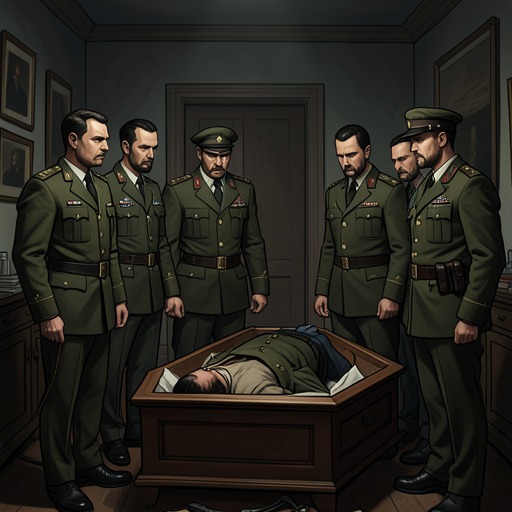
Mato Rujo raid and massacre
Senza sangueThe Mato Rujo raid and massacre is the violent destruction of Manuel Roca’s household by Salinas, el Gurre, and their men. Its decisive horror is not only the killing of Roca and his son: the raid also leaves Nina alive beneath the farmhouse, unseen by the attackers and abandoned to the fire. The escape of the perpetrators, the concealment of what happened, and the later decision to eliminate Nina show how the violence of war persists when public life declares the conflict over.
Background and Stakes
The assault unfolds as the men insist that the war has ended, while Salinas rejects that conclusion: for him and Roca, it has not. Roca warns that they will all be arrested and spend their lives in prison, but Salinas treats the threatened killing as a favor to others. He says Roca will disappear, that his friends have abandoned him, and that no one will ever know what happened. The threat of private execution and deliberate concealment is present before the shooting begins: the attackers are not simply pursuing a military objective but preparing to erase the crime and its victim.
The Shootings and the Hidden Child
Salinas’s threat becomes immediate when he presses his pistol to Manuel Roca’s knee and fires. The wound drops Roca to the floor, where he curls up, screaming; Salinas stands over him, still shouting that he will kill him. El Gurre moves forward, while the boy watches silently from the doorway. Then a child appears across the room with a rifle aimed at the attackers. Nina, listening from below, recognizes the voice as her brother’s and imagines telling him later that it was beautiful: in that instant, its clear, unmistakably childish sound stands against the men’s violence.
Asked who Roca is to him, the boy answers that he is his father, then fires a single shot that goes nowhere. El Gurre responds instinctively with a machine-gun burst, lifting the boy from the ground and hurling him against the wall. Salinas falls beside Roca; the two men meet each other’s eyes as Roca cries out. Salinas backs away, shaking, and stares at the child’s broken body, the rifle flung into a corner. The boy’s small, orderly white teeth remain visible in his open mouth. The killing leaves Salinas trembling and unable to steady his hands or legs, but his horror does not stop the attack.
At Salinas’s order, El Gurre puts the machine-gun barrel into Roca’s throat. Roca continues to scream against the hot metal; El Gurre fires a short burst, the last of his war. Below the floor, Nina hears the silence that follows and folds herself tighter, hands between her legs and knees drawn toward her head. She believes her father will come for her and take her to dinner, and that the family will soon forget the night. The child’s hope is set against what the reader knows: her father has been killed, and the violence above her has not ended.
Discovery, Abandonment, and the Burning Farmhouse
Earlier, Manuel Roca had covered the entrance to the concealed hatch with baskets and told Nina to stay hidden. The attackers’ search reaches the room above her: as El Gurre beats the walls with his machine gun, Tito notices disturbed dust and discovers the carefully cut hatch beneath baskets of partly rotten fruit. He opens it to find Nina curled on her side, hands hidden between her thighs and eyes open. For a moment he points his pistol at her and calls for Salinas, but no one answers from beyond the curtain. The beating continues elsewhere in the house; Tito lowers the hatch, replaces the baskets, and leaves without telling the others that Nina is there.
Outside, the men walk into the dark in silence. Salinas leans on Tito, while El Gurre goes back toward the farmhouse and then runs to catch up. Tito sees the building behind them torn open by flames, black smoke rising into the night. He had meant to tell Salinas that a child remained inside, but the silence and his exhaustion have kept the words from him. Now he freezes at the sight of the fire and turns on El Gurre, demanding to know what he has done. Nina’s survival is therefore also an abandonment: the hatch has hidden her from the killers, but leaving her beneath a burning house converts concealment into a new danger.
Aftermath, Impunity, and the Event’s Later Meaning
The farmhouse massacre outlives the night as a problem of accountability. Years later, a participant recounts that suspicion gathered around Nina because she might know something about Salinas’s death. The country had moved on from the war with startling speed, he says, while those who had not escaped it remained a world apart; within that unreconciled world, Nina came to be treated as a danger. The decision was made to eliminate her, and the Count of Torrelavid was charged with doing so. Thus the child who survived the attack became, in its aftermath, a target of a further conspiracy—not because the narrative establishes that she had acted against anyone, but because the former combatants feared what she might know.
The account also links the massacre to the absence of a credible public remedy. The Count had spent the war playing both sides, working for the opposing forces while remaining one of the group’s own. He confronted Ricardo Uribe with a choice between spending his life in prison for Salinas’s murder and disappearing while leaving Nina behind. Uribe, described as a coward, fled and left the child to the Count; he died about ten years later in a remote village beyond the border, still claiming in a written statement that he had done nothing and that God would pursue his enemies to hell. The episode makes the law present chiefly as a threat wielded in private, not as a process that secures a hearing or establishes responsibility: fear and exile replace trial, while the people who know the story continue to carry it.
Nina’s own later recollection exposes another break in the chain of knowledge. She says she knows everything about that night yet remembers almost none of it: trapped below the floor, unable to see, she heard events that seemed so absurd they felt like a dream, and the fire erased what little remained. Her fuller account came from what others later told her, but she cannot know whether they lied. She describes the sequence she has been given—entry into the house, her father being shot, Salinas shooting him, and El Gurre killing him with a short burst from the machine gun—and says that El Gurre liked to tell it. The massacre is therefore both a witnessed catastrophe and a story assembled after the fact, with Nina’s sensory absence and the perpetrators’ versions separating remembered knowledge from direct memory.
When Nina confronts Tito, the issue is no longer only the accuracy of that account. She points to his worn overcoat, the neat way he puts his glasses into their gray case, the clean windows of his kiosk, and his careful look both ways before crossing the street. Such ordinary habits make him appear normal, yet he had stood there at twenty while her brother was killed and had done nothing. Tito answers that they were soldiers. His brief explanation does not resolve her challenge; it sharpens the contradiction between everyday respectability and participation in wartime violence. The raid’s legacy is not contained in the burned farmhouse or in the deaths there. It survives in concealment, conflicting recollection, impunity, and Nina’s demand that an apparently ordinary survivor explain how an atrocity could happen.