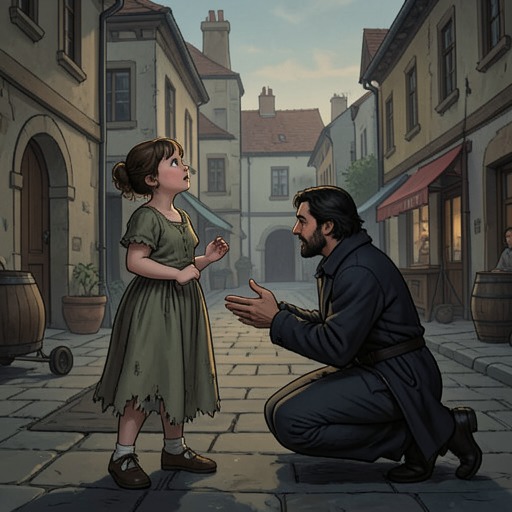
Nina's Silence and Traumatic Withdrawal
Senza sangueNina’s silence and traumatic withdrawal are shaped by a childhood in which hiding offers brief protection but leaves fear attached to the act of being left alone. At Mato Rujo, she waits beneath the floor while violence unfolds above her; years later, she describes how the terror of that hiding place never left her. Her return to the same tightly curled posture beside Pedro Cantos makes the body’s memory visible even when the past itself remains fragmented.
Childhood Hiding and the Shelter of the Body
At Mato Rujo, Manuel Roca tells Nina that people are coming and orders her to hide in a concealed hole beneath the floor until they leave. She answers that she understands. He gives her a blanket, which she spreads on the earth before lying down again. As the cover closes, light enters through gaps between the floorboards; she hears her father speaking, the baskets dragged into place, and then a gunshot and a window breaking. Her refuge is therefore not an escape from the violence but a place in which she must experience it through sound, darkness, and uncertainty.
When gunfire sweeps through the house, Nina presses herself against the blanket and draws her knees to her chest. The cool earth seems trustworthy in a way the people above her are not: it protects her without betraying her. She imagines her curled body as both shell and creature, a shelter she can make for herself, and thinks that nothing can hurt her while she remains in that position. The thought is a child’s improvised assurance, not proof that danger has passed; its force lies in how completely she makes stillness into protection.
After the violence, she tries to organize waiting into a small, repeatable task. She recalls a counting song about clouds and an eagle, then plans to finish it before getting up to see who the men are and what they want. If she cannot open the hatch, she imagines calling for her father. Instead, she remains on her side, knees drawn close, cheek against the rough wool, singing softly. The song gives time a sequence, while her posture holds her inside the only safety she can control.
Memory, Silence, and Retelling
Nina later says she remembers little of that night directly. From beneath the floor she could not see, and what she heard seemed so impossible that it felt like a dream; the fire erased what remained. She says that children are particularly able to forget, and that she knows the fuller account because others told it to her. She is unsure whether they lied, and says she never had the chance to ask. Her knowledge of the event is thus split between an incomplete sensory memory and a story assembled afterward, leaving certainty and recollection out of alignment.
Her later account gives the opening and closing of the hatch a particular emotional reversal. Seeing the boy’s face when the cover lifted did not frighten her; she says the moment felt natural, even obvious, and that she liked what was happening. Fear came when the cover descended again: darkness returned, baskets scraped overhead, and the boy’s steps receded. She describes that as the greatest fear of her life and says it never left her. In the same recollection she imagines that, at that moment, she wanted the boy to take her away. The episode makes abandonment, rather than the sight of the boy, the decisive wound in her memory.
Adult Life and the Reported Silence
After an indistinct memory of an orphanage, Ricardo Uribe takes Nina into his home when she is eleven. A pharmacist in a rural village with no wife or relatives, he presents her to the community as his daughter. He keeps her in the back of the pharmacy, teaches her between customers, and discourages her from going out alone. In the evenings she listens beside him to stories of war while he strokes her hair. She senses his sexual arousal beneath his trousers, though the account describes her then as a child receiving this attention without understanding its full meaning.
One evening Uribe kisses her on the mouth and touches her beneath her skirt and elsewhere. Nina does nothing; he then breaks away, cries, and asks her to forgive him. A few days later he tells her he has found her a future husband, a young bricklayer from a nearby village. Nina sees the young man in the square the following Sunday. The narrative presents the arrangement after Uribe’s assault without explaining Uribe’s reasons or describing the marriage that follows from it.
In the account Nina gives of her later life, the Count of Torrelavid keeps her hidden at home despite pressure to make her disappear, and eventually marries her. She has three children with him. People rarely see her outside and call her Donna Sol, the name he gives her. They say that she does not speak and has never spoken—not, according to the story, since her time with Uribe. This reported reputation should not be mistaken for an unbroken absence of speech in the frame narrative: Nina speaks at length in the later conversation, recounting experiences that the community’s story has turned into a mystery.
Return and the Meaning of Repetition
In the final scene, Nina thinks of Pedro Cantos crying with his hands in his coat pockets and remembers him touching her without daring to breathe. She turns toward him and deliberately arranges her body as she once did beneath the floor: knees drawn up, feet aligned, thighs together, hands joined between her legs. Looking at herself, she sees an old child and smiles. The posture is no longer only a child’s attempt to withstand an unseen threat; as an adult action, it also becomes a chosen return to a bodily form that holds her history.
Nina reflects that people may spend their lives wishing to return to the hell that made them and to live beside the person who once saved them from it. She cannot explain the impulse to return to the place where they were broken, or the urge to repeat that instant in the hope that the rescuer can make it safe. The thought does not cancel the terror: the old refuge and the old wound remain joined. She rests her forehead against Pedro Cantos’s back, closes her eyes, and falls asleep. Her ending gives the repeated posture a small change in circumstance: she is no longer alone beneath the floor, and the darkness of the remembered hiding place gives way to sleep beside another person.