Ricardo Uribe
Senza sangueRicardo Uribe is a pharmacist who gives Nina shelter by passing her off as his daughter, but the protection he offers is inseparable from concealment and, eventually, abandonment. His wartime pharmaceutical work, the unresolved suspicion surrounding Salinas’s death, and his flight after being confronted make him both Nina’s rescuer and a compromised figure who cannot remain in her life.
Background and wartime work
During the war, Uribe worked with the physician Astarte on Botran, a preparation used to treat fevers and infections. The invention brought them money, and Uribe was then working in the capital. His professional history later became entangled with accusations surrounding the hospital of the Hyena: his name appeared on a supplier list, and someone claimed to have seen him working there. The evidence did not produce a clear public judgment. Some people associated him with the hospital, while others remembered him as a good man.
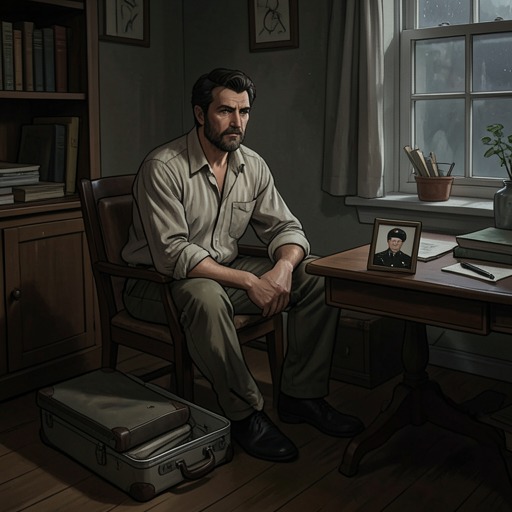
After the war, Uribe encountered trouble with the police. He appeared for questioning and explained his part in events; when he was released, he gathered his belongings and left. He moved to a small, secluded town in the southern countryside, bought a pharmacy, and resumed his trade. The move began a second life built around an apparently ordinary role, but the account later makes clear that his quiet provincial identity also served to hide Nina.
Nina in the pharmacy
Nina recalls that her earliest memory was of something like an orphanage. Uribe then arrived and took her with him. He had been in the village only a few months, had no wife or relatives, and told the townspeople that Nina was his daughter. They accepted the story. In the later account, the name he used for the child was Dulce; in fact, the girl was Nina, the surviving daughter of Manuel Roca. Uribe’s claim of fatherhood thus provided her with a place in the community while concealing who she was.
The pharmacy organized their daily life. Uribe kept Nina in the back room, teaching her between customers, and discouraged her from going out alone. He presented himself as the person from whom she could learn what she needed to know. Nina was eleven. This arrangement gave her instruction and shelter, but also kept her dependent on him and apart from the wider village. The same separation that helped hide her identity narrowed her freedom.
Nina’s recollection of their evenings complicates the protective father figure Uribe had constructed. He sat on the sofa and had her lie beside him while he told stories about the war, sometimes stroking her hair. She describes the closeness as troubling and inappropriate. The account does not present his claim that she was his daughter as proof of a safe or uncomplicated bond: his care, control, and boundary-crossing behavior coexist. That tension matters to his role in her life, even though the evidence does not establish what he intended beyond the actions Nina recounts.
Salinas and suspicion
Salinas was found dead in his bed, and the death was initially attributed to a heart problem. A later rumor accused Astarte of poisoning him gradually over a period of months. The matter was investigated, but the inquiry yielded no conclusive result. Uribe’s connection to Astarte was professional and substantial: he had helped develop Botran. The account places that collaboration beside the suspicion surrounding Salinas without establishing that Uribe took part in the poisoning.
A later confrontation nevertheless presents Uribe with the prospect of prison for Salinas’s murder. The unnamed man who approached him had played a double game during the war, working for the opposing side while also being one of the resistance’s own. He told Uribe that he could spend his life in prison or disappear and leave the child. The threat transforms Uribe’s departure from a simple continuation of his postwar move into a decision made under pressure. It does not resolve the truth of the murder allegation; the investigation had failed to do so, and Uribe’s own account remained a denial.
Departure and legacy
Uribe was afraid, left Nina with the Count of Torrelavid, and went away. In doing so, he abandoned the child he had taken in and claimed as his own. His earlier concealment had kept Nina hidden as Manuel Roca’s surviving daughter; his final act transferred her to someone else rather than allowing the household he had built around her to continue. He died roughly a decade later in a remote town beyond the border.
The statement he left behind insisted that he had done nothing and that God would pursue his enemies to hell. It preserves his self-defense, not an independent resolution of the charges against him. Uribe’s story therefore ends with two competing accounts still in view: the man who sheltered Nina and made a life for her in a pharmacy, and the frightened fugitive who left her when his own safety was threatened. His protection mattered, but it did not become lasting responsibility.