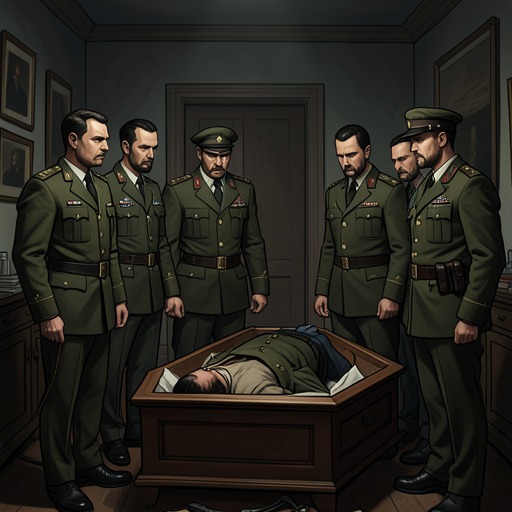
Salinas's Death
Senza sangueSalinas’s death, discovered in his bed two years after Manuel Roca’s story, became more than an unexplained loss: conflicting accounts of its cause reopened the buried suspicions of the war. Though officially attributed to a heart problem, the death was rumored to be a slow poisoning, and the belief that Nina might know something about the past helped turn suspicion into a decision to eliminate her.
Background and Discovery
One morning, Salinas was found dead in his bed. The explanation given was that something had happened to his heart. His death came two years after the events surrounding Manuel Roca, but its timing and the circumstances quickly made the official account only one version of the story.
A rumor spread that Salinas’s doctor, Astarte, had poisoned him little by little, every day for months. The alleged method was a drawn-out, agonizing one. Authorities investigated, but the inquiry produced no conclusive result: the suspicion persisted without being established as fact.
A Wartime Connection
Astarte had made money during the war with Botran, a preparation used to treat fevers and infections. He had devised it with the help of a pharmacist, Ricardo Uribe, who was then working in the capital. The account connects Uribe to the medicine and its wartime origins; it does not establish that either man was responsible for Salinas’s death.
After the war, Uribe encountered trouble with the police. His name appeared on a supplier list for the hospital of the Hyena, and someone later claimed to have seen him working there. Others described him as a good man. Uribe appeared for questioning and explained himself; once released, he left with his belongings for a secluded town in the south, bought a pharmacy, and resumed his trade.
Suspicion and Its Consequences
The death did not sit well with the former wartime circle. When Uribe became implicated in the matter, the coincidence struck people as strange, and they gradually came to believe that Nina, the surviving daughter of Manuel Roca, knew something. Their reasoning joined the disputed death to an older fear: the child might have seen or heard something during the events at the farm.
A man later recalled that Nina’s rumored survival made it impossible for him and the others to put the past behind them. He had kept silent for years, first from fear and then because he thought the war had been buried and people wanted to look forward. News that Roca’s daughter was alive revived the question of what she remembered; Salinas’s death intensified it. The man wondered whether Nina could remember his face, and the group ultimately decided she was a danger and should be eliminated.
The Death as a Turning Point
The accusation against Uribe became leverage. The Count of Torrelavid, described as having played both sides during the war, went to him and presented a choice: risk spending his life in prison for Salinas’s murder, or disappear and leave Nina behind. The account does not resolve whether Uribe had any part in the death; it shows how the unresolved accusation could be used against him.
Uribe was frightened and left Nina with the count before going away. About a decade later, he died in a remote village beyond the border. In the account of Salinas’s death, uncertainty is itself consequential: the investigation settles nothing, yet the rumor and the suspicions it nourishes help propel Nina from concealment into danger.