Uribe Bets Nina in a Poker Game
Senza sangueUribe Bets Nina in a Poker Game is the wager through which Ricardo Uribe surrendered his daughter to Count of Torrelavid in exchange for Belsito. A game that begins with money and a farm escalates into a claim over a child: Nina is made the stake without any indication that she can consent. The exchange determines her immediate fate, and its consequences return later in the account of Uribe’s disappearance and death.
The Game and Its Stakes
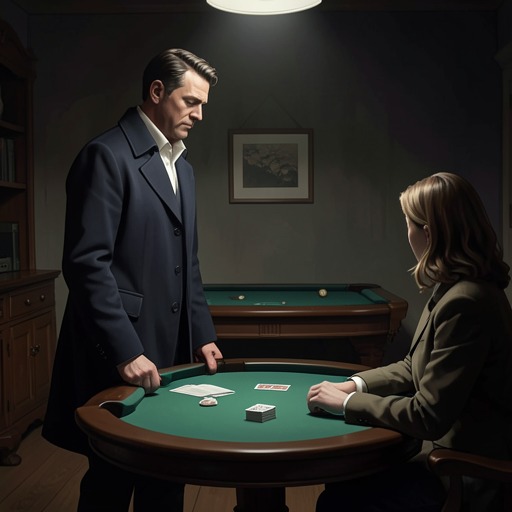
The wager takes place on a winter evening, months after the events involving Manuel Roca. Uribe has left home for the Riviera, a tavern where he gambles every Friday. He plays late into the night and holds four jacks, facing a pot larger than the amount of money he sees in a year. The other players have put in some money and withdrawn, leaving the contest between him and the Count, who keeps raising. Uribe trusts his hand and continues; as the stakes mount, the game reaches the point at which, in Nina’s telling, the players lose their sense of reality.
The Count first puts his Belsito farm on the table. The room falls still. Nina later explains what makes that property worth so much: an avenue of orange trees climbs to the crest of a hill, where the house looks out over the ocean. Belsito is not an abstract sum of money but a beautiful estate, made vivid by its approach and its view. Against that offered prize, the Count names what Uribe has that could match it: his little girl.
From Property to Person
Uribe initially says that he has nothing to wager that is worth Belsito, and lays down his cards. The Count answers by suggesting that Uribe could wager his pharmacy instead, then laughs; some of the people gathered around join him. Uribe smiles, one hand still resting on his cards, as if bidding them farewell. The exchange turns abruptly when the Count becomes serious, leans across the table, and proposes Belsito against Nina. He lays down his five cards, face down, directly in front of Uribe.
Uribe does not touch them. He stares at the cards, says something too quietly for anyone to report later, and then pushes his own hand across the table toward the Count. The account gives no explanation of his whispered words or of what, if anything, he understands about the Count’s hand. What it does establish is his action: he transfers the cards and accepts the wager, while Nina’s future is decided in her absence. The formal shape of a game of chance makes the exchange look like a contest between men, but the thing placed at risk is a child, not a possession capable of making its own bargain.
Nina’s Fate
The Count takes Nina to himself that very night. In her account, he does not marry her immediately: he waits sixteen months, until she turns fourteen, and then marries her. She says that she gives him three children. These later facts reveal the wager’s consequence beyond the night at the tavern. It is not merely a threat made to unsettle Uribe or a symbolic stake in an extravagant game; the Count’s claim over Nina becomes her marriage and shapes the family she has afterward.
The interval and Nina’s age make the cost of the wager concrete. Uribe’s decision takes effect immediately in the Count’s possession of her, while the marriage follows after a period of waiting. Nina recounts the arrangement in the plain terms of what happened, not as a choice she made at the table. The game has allocated her between men before she is old enough to be married, and the account supplies no evidence that her wishes entered the bargain.
Later Consequences
The story of the wager is set beside the history of Salinas’s death and Uribe’s later flight. Two years after the affair involving Roca, Salinas is found dead in bed; the stated explanation is a heart problem, but a rumor later alleges that his doctor, Astarte, poisoned him slowly over several months. An investigation produces no resolution. Astarte had made money during the war from Botran, a treatment for fevers and infections that he devised with the help of a pharmacist: Ricardo Uribe.
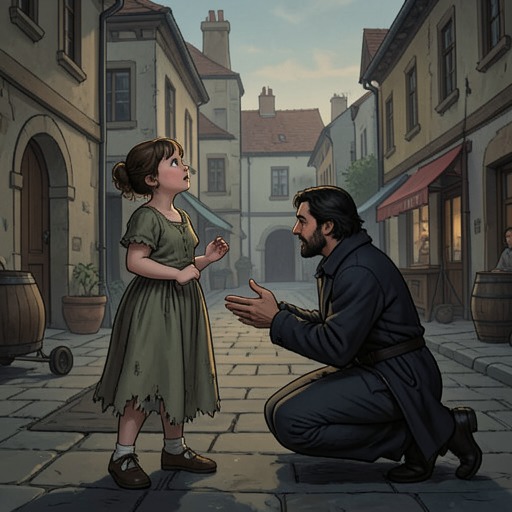
After the war, Uribe faces police trouble. His name appears on a list of suppliers to the hospital of the Hyena, and someone claims to have seen him working there, although others describe him as a good man. He answers questions, is released, and moves to an isolated town in the south, where he buys a pharmacy and lives with Nina, whom he presents as his daughter Dulce, saying that her mother died years earlier. The account identifies this as how he hides Nina, the surviving daughter of Manuel Roca. Later, the narrator says that the Count, who had worked as a double agent during the war, confronts Uribe with a choice: face life in prison for Salinas’s murder or disappear and leave the girl behind. Uribe leaves Nina with the Count, departs, and dies about ten years later in a remote village beyond the border. This later history does not establish that Uribe was guilty of Salinas’s death; it shows how the wager belongs to a larger web of concealment, fear, and coercion in which Nina is repeatedly transferred between men who control her fate.