el Gurre
Senza sangueel Gurre is a small, wiry gunman whose casual manner and sudden violence define his role in the attack on Mato Rujo. During the assault, he fires the burst that kills Manuel Roca’s son and later executes Roca at Salinas’s command; afterward, he returns to the farm as it burns, while Nina remains concealed beneath its floor. His violence is presented not as a detached spectacle but as part of a war whose participants try to justify the killing of children in the name of a better world.
Appearance and Introduction
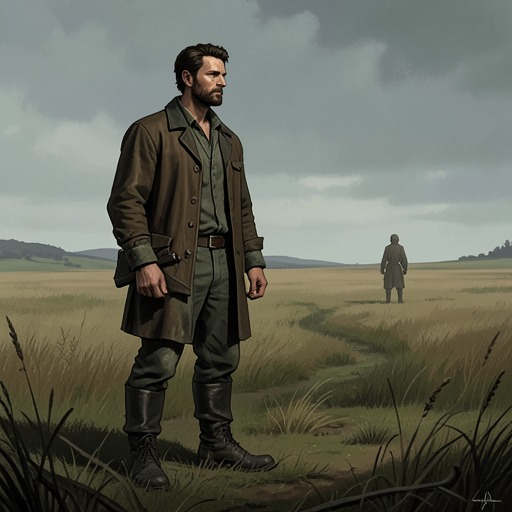
Behind a stack of lumber, el Gurre grins as Salinas gestures for him to shoot. He holds a small submachine gun in his right hand and searches for a cigarette with his left. He is described as small and thin, wearing a filthy hat and enormous mountain shoes. The details make his stillness almost comic: he finds the cigarette, puts it between his lips, and only then stands to fire. The pause does not soften the violence that follows; it makes his unhurried readiness part of the scene’s menace.
Violence at Mato Rujo
During the attack, Manuel Roca’s young son identifies himself as Roca’s child and fires a single shot into the empty space. el Gurre responds instinctively with a burst from his submachine gun. The bullets lift the boy from the ground and throw him against the wall, killing him. The narrative momentarily filters the image through Tito’s thought, comparing the child to a bird struck in flight. The boy’s solitary shot and el Gurre’s overwhelming response establish the disproportion at the heart of the massacre.
Later, Roca continues to scream while the barrel of el Gurre’s gun is pressed into his throat. At Salinas’s order to make him stop, el Gurre fires a short, dry burst—the last burst of his war. Nina, hidden below the floor, hears the gunfire and then a frightening silence. She folds herself tighter into the hiding place and imagines that her father will come for her so they can go to dinner; she cannot yet know what has happened. The juxtaposition makes el Gurre’s violence reach beyond its immediate victims: even unseen beneath the house, the child experiences its sounds and their aftermath.
The Burning Farm and Tito’s Confrontation
After leaving the farm, el Gurre returns when Salinas sends him back. Tito and Salinas have gone some distance along a field path, and Tito has not managed to say that a girl is still hidden inside the house. In the darkness, el Gurre runs toward them with the farm ablaze behind him, flames tearing through the building as black smoke rises into the night. He urges them to keep moving, but Tito freezes at the sight and demands to know what el Gurre has done. As el Gurre tries to drag Salinas onward and repeats that they must leave, Tito grabs him by the neck and shouts the accusation again. The fire turns the unspoken fact of Nina’s presence into an immediate, visible catastrophe: el Gurre has gone back, and the farmhouse is being consumed while she remains concealed below its floor.
Guilt, Self-Justification, and the Meaning of the Killing
el Gurre’s actions belong to a war that its participants later struggle to explain. Salinas recalls that he had fired only twice during four years of war before the final day, when he shot his dying brother at the brother’s plea. In the hospital chapel, Salinas could not bring himself to smother his brother with a pillow; after el Blanco handed him a pistol, he pressed it to his brother’s forehead and fired. He tells Manuel Roca that he will shoot once more, making the execution at Mato Rujo part of a repeated history of violence rather than an isolated act. The account does not establish what el Gurre himself thought or felt about either shooting, but places his gunfire amid other men’s attempts to survive unbearable choices and their consequences.
The political defense offered for wartime brutality sharpens the moral contradiction surrounding el Gurre’s violence. Salinas argues that a better world required destroying what stood in its way, enduring and inflicting suffering, and treating old people, children, friends, and enemies alike as part of the same struggle. He reduces the deaths of one, ten, or a hundred children to a cost supposedly justified by the lives of millions. Against this abstract arithmetic, the narrative gives the child’s body, Roca’s scream, and Nina’s frightened silence particular weight. el Gurre’s role is therefore not merely that of a gunman in a massacre: his actions expose the human price hidden by the ideal of a future world, while the evidence offers no indication that he personally articulates or resolves that conflict.
The Political Logic Behind the Violence
The moral contradiction surrounding el Gurre’s violence comes into focus in Salinas’s later defense of the war. Salinas argues that building a better world required destroying what stood in its way, both enduring suffering and inflicting it, and making no distinction between old people and children, friends and enemies. He describes the struggle as breaking open the earth so that millions might gain a decent life, happiness, and the dignity to live and die without being trampled or mocked. In that calculation, he asks what the death of one child—or ten or a hundred—could mean beside the millions who supposedly awaited the promised future. The narrative sets this political abstraction against the boy killed by el Gurre’s burst, Manuel Roca’s scream, and Nina’s frightened silence. el Gurre’s part in the massacre thus exposes the human cost concealed by Salinas’s arithmetic, although the account gives no evidence that el Gurre himself voices or resolves the conflict.