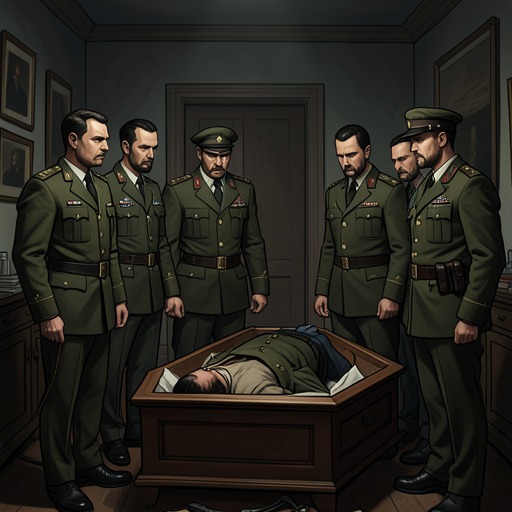
el Gurre's Death
Senza sangueel Gurre’s death is recounted not as a solved killing but as the beginning of an uneasy wait. Four years after the speaker had heard that Nina escaped from a clinic and might be dead, el Gurre was found shot in the back outside his stable. A woman’s name in his pocket—written in el Gurre’s own hand—made the death seem connected to her, while the speaker’s memory of closing a trapdoor tied him personally to what he expected would follow.
Discovery at the Stable
The speaker places the death four years after he was told about Nina, the clinic, and her escape. At the time he was still working in a factory in the north. Others had told him that she was probably at the bottom of a river or down some slope, where a vagrant might eventually find her. He remembers accepting the news without forming a conclusion, though he wondered what people meant when they said she had gone mad. That earlier uncertainty supplies the emotional setting for his account of el Gurre: the possibility that Nina had vanished permanently had once seemed plausible, but it did not settle what had happened or what might yet happen.
The report of el Gurre’s death comes after a long pause in the present conversation. The speaker says that el Gurre died; after another silence, he describes how he was found, face down in manure in front of his stable, with a bullet in his back. The location and position make the discovery starkly physical, but the account gives no shooter, motive, or circumstances of the shooting. It does not establish whether the name subsequently found on the body explains the death. The story preserves that gap rather than converting suspicion into a solution.
The Name in the Pocket
A note in el Gurre’s pocket bears a woman’s name. The speaker looks toward the woman listening to him and identifies the name as hers, then traces a slight mark in the air as he says it: Donna Sol. He lets his hand fall back onto the table. He stresses that the handwriting was el Gurre’s own, making the note more than a name reported by someone else: el Gurre himself had written it.
That small piece of paper becomes the account’s hinge. The bullet establishes that el Gurre is dead; the handwritten name links his death, in the speaker’s telling, to the woman before him. But the evidence remains limited to the note and the speaker’s interpretation of it. He does not explain why el Gurre wrote the name, when he wrote it, or what relation it bears to the shooting. The uncertainty is part of the scene’s force: the name offers a connection without supplying a complete account of what occurred.
A Death Told Through Silence
The event reaches the reader as a recollection spoken across a table, not as a witnessed scene at the stable. Before naming the death, the speaker pauses for a long time; after describing the discovery, he falls silent again. He appears suddenly to find the telling difficult. His look toward the woman, the gesture that accompanies Donna Sol, and the hand returning to the table give the disclosure a present-tense audience and consequence. The memory is not detached background: he is telling it to the person he believes the name concerns.
Behind them, three musicians begin a kind of waltz, playing softly and bending the tempo. The subdued music does not clarify the circumstances of the death; instead, it accompanies a story whose crucial links remain unresolved. A name is spoken, a hand makes a small gesture, and then the music continues while the account turns from the dead man to the speaker’s own future. The scene’s movement is therefore less from mystery to answer than from report to expectation.
The Wait That Follows
The speaker says that from the day of el Gurre’s death he began waiting for the woman. He believes nothing can stop her and that she will eventually arrive. His expectation is specific: he does not imagine that she will shoot him in the back or send a stranger who does not know him. He expects her to come herself, look him in the face, and speak to him first. These are his beliefs, not a confirmed account of what she will do; the narrative ends this recollection with anticipation rather than showing her arrival.
He explains why he thinks he cannot escape that encounter. That evening, he had opened the trapdoor and then closed it. He expects the woman to remember his action. The detail turns his wait into more than generalized fear of revenge: he understands himself as someone implicated in a particular act and imagines that she will confront him directly about it. In his account, el Gurre’s death does not end the danger associated with Nina’s disappearance. It marks the point when the speaker begins to regard the past as an approaching face-to-face reckoning.