Acharya Research-Fraud Scandal and Internal Inquiry
Serious MenThe Acharya Research-Fraud Scandal and Internal Inquiry turns a disputed claim about life high above Earth into a crisis over scientific credibility and control of the Institute of Theory and Research. Oparna Goshmaulik’s letter alleges that Arvind Acharya ordered her to contaminate a sampler and falsify a report; the ensuing inquiry ends not only in public condemnation and Acharya’s suspension but also in Jana Nambodri’s elevation as acting Director. The official account of a confession is later contested, so the scandal’s outcome rests as much on competing claims and public perception as on the sampler itself.
Scientific Dispute and Institutional Tension
The crisis follows an existing conflict over what research the Institute should pursue. Acharya refuses to let the Giant Ear be used to search for extraterrestrial signals, dismissing the search as a narrow projection of human expectations rather than a sound scientific programme. He argues that the universe is too vast and too little is known about consciousness to justify a search that assumes distant life would communicate in recognizably human ways. Nambodri, by contrast, insists that even a very small mathematical possibility can justify a search for truth. Their disagreement is about scientific standards, but also about who has authority to define legitimate research and direct the Institute’s resources.
Nambodri eventually brings wider discontent into the open. He says the Balloon Mission is not the Institute’s only important work and that radio astronomers are disturbed by Acharya’s refusal to permit the Search for Extraterrestrial Intelligence (SETI). He accuses Acharya of acting autocratically and unfairly. The confrontation provides the political setting for the later inquiry: Acharya’s authority is already being challenged, while Nambodri is seeking a different balance of power. Earlier, when Acharya enters a meeting about a new SETI department, a scientist rises involuntarily, disrupting the aggressive posture Nambodri had urged. Acharya’s calm unsettles his opponents; his command of the room has not yet disappeared.
The Letter and the Public Allegation
The scandal takes a concrete form in a letter from Bhaskar Basu to Acharya. Basu says the Institute has independently verified that Oparna, head of the Astrobiology lab and Balloon Mission project coordinator, wrote the letter. According to her account, she first told Acharya that the sampler had yielded no life. She then alleges that he instructed her to contaminate it and produce a false report so that the mission could claim microscopic life had been detected at the improbable altitude of 41 kilometres. She further alleges that he threatened serious professional consequences if she refused. Oparna takes moral responsibility for her own actions and offers to resign; Basu calls the accusation extraordinary and schedules an internal inquiry for Wednesday at noon, with an empowered committee and senior faculty available for questioning.
The scientific claim had previously been presented more cautiously. At a press conference, Acharya says he has not concluded that the living material came from space, describing that origin instead as a reasonable guess supported by several facts. He points to the then-prevailing belief that bacteria and fungi did not exist at such heights and says the chance of material reaching the sampler through debris from defunct satellites is very small. Asked whether the sampler might have been contaminated in the laboratory, he replies that precautions were taken and that the organisms discovered were rare and difficult to culture. The later allegation therefore strikes directly at the distinction between a tentative interpretation of unusual results and the fabrication of those results.
Inquiry and Shift in Focus
The letter’s reach quickly exceeds the Institute. Copies mysteriously arrive in journalists’ and scientists’ inboxes under the subject line India’s Woo-Suk, invoking the disgraced South Korean scientist Hwang Woo-Suk and his fabricated stem-cell breakthroughs. Online responses range from denunciations of fraud to explanations for why a celebrated scientist might have fallen, alongside defences from people unwilling to believe Acharya capable of deceit. Some readers suspect that Oparna’s accusation is revenge by an enraged woman. Yet the story that spreads most powerfully is that Acharya has fallen, and reporters gather outside the Institute’s fortified gates.
The inquiry’s proceedings do not remain centred on the sampler. The trial lasts only a day. After Oparna leaves, postdoctoral students involved in the Balloon Mission enter nervously and leave without taking the case forward. The jury sets the sampler scandal aside and hears complaints from thirteen scientists who say Acharya mentally tortured them. This change gives the inquiry a broader institutional basis: even where evidence concerning the sampler is described as thin, accumulated grievances can be brought to bear against a powerful Director. Nambodri regards the shift as his masterstroke. The inquiry thus becomes a contest over both the alleged research fraud and the conduct of a leader whose manner has left colleagues ready to testify against him.
Announcement, Disputed Confession, and Aftermath
Outside the gates, Basu announces that the inquiry is over and says Acharya confessed to ordering Oparna to falsify research in an attempt to prove fraudulently that he had discovered life forty-one kilometres above Earth. Basu adds findings of other unacceptable conduct: misuse of Institute funds to sustain the ambitious Balloon Mission, long-standing humiliation of colleagues, and activities in the basement that the Institute is too ashamed to disclose. He declares Acharya suspended until further notice and names Nambodri, described as one of the country’s founding fathers of radio astronomy, acting Director.
The announcement does not settle what Acharya admitted. In the days that follow, he fervently denies confessing to contamination of the sampler. His denial, however, is overshadowed by his silence about what Oparna meant to him and whether the basement had served as a private refuge for their relationship. Public inference fuses the allegations: suspicion about personal conduct makes other accusations seem more plausible, whether or not each has been independently established. Friends and professional bodies that once sought Acharya’s association distance themselves; some refuse his calls, while others tell him to fight his battles in court. Letters of support arrive from around the world, but even these do not restore the public conviction that he is innocent.
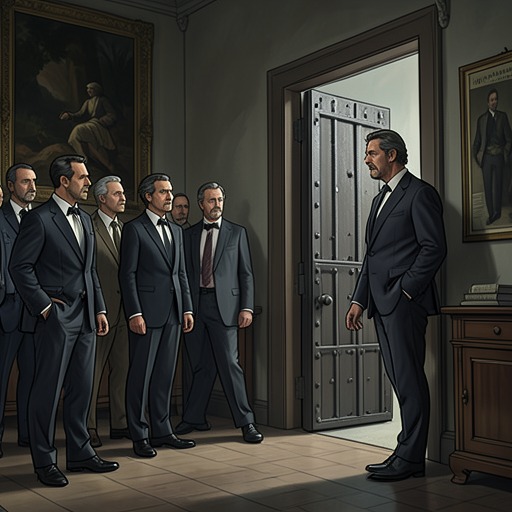
Nambodri’s change in status is made visible inside the Institute. After the announcement, he and Basu walk to the third floor as doors open and scientists follow them. Some acknowledge the change approvingly; others watch bleakly, and an old Number Theory scholar hands Nambodri an envelope while announcing his resignation. The growing crowd gathers outside the Director’s office. Basu invites Nambodri to enter first, and applause accompanies the transfer of authority. Seated in the large black leather chair, Nambodri jokes that there was no Big Bang, drawing laughter from the assembled scientists. The moment marks a sharp institutional reversal: the Director who had resisted challenges to his scientific priorities is suspended, and his rival occupies the office amid a display of collective recognition. Yet the contested confession and unresolved allegations leave the scandal’s truth more complicated than the official announcement suggests.