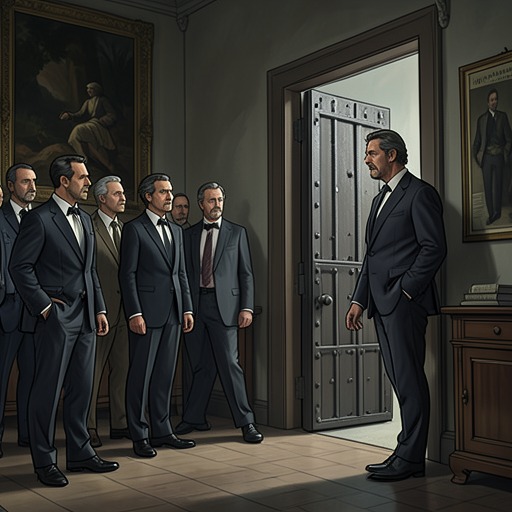
Acharya’s fall from favor and humiliation
Serious MenArvind Acharya’s fall from favor and humiliation is not simply the punishment of a scientist accused of fraud: it is the collapse of an authority built from scientific prestige, personal conviction, and institutional control. A dispute over the Giant Ear and the search for extraterrestrial intelligence precedes the Balloon Mission scandal, but the inquiry turns Acharya’s position into a public disgrace. Suspended and abandoned by former allies, he initially experiences the aftermath as an inner blankness. Only later does he recognize that what has been destroyed is his stature—and that its destruction releases him from the identity that had constrained him.
Conviction and Institutional Conflict
Before the scandal, Acharya’s certainty already makes him a formidable and divisive director. Jana Nambodri urges him to let radio astronomers use the Giant Ear to search for alien signals, citing requests from astronomers around the world and discontent within the Institute of Theory and Research. Acharya refuses, dismissing the proposed search as a narrow projection of human ideas about life rather than a sound scientific pursuit. Nambodri counters that even a remote mathematical possibility can justify searching for truth. Their disagreement is about research priorities, but also about who has the authority to decide what counts as science and how the Institute’s resources should be used.
The conflict becomes an open challenge at a meeting attended by senior scientists. Nambodri places the radio astronomers’ dissatisfaction on the table, accusing Acharya of repeatedly blocking the Giant Ear’s use for the search for advanced civilizations and of acting autocratically. Acharya’s position is not merely an abstract objection: as director, he can prevent a rival research program from proceeding. Yet his insistence that scientific work must not be pursued for money or publicity, and his suspicion of the motives behind the search, also help make him seem unwilling to share institutional authority.
The balance of power begins to shift before the inquiry. When Nambodri and Bhaskar Basu arrange a meeting to discuss a new SETI department, they expect Acharya to encounter an organized challenge. Acharya arrives with striking calm, and his composure unsettles Nambodri; one scientist even stands reflexively, undermining the aggressive posture Nambodri had sought. The scene shows how much Acharya’s authority still depends on the force of his presence, even as opposition gathers around him. The conflict is therefore not a simple contest between an unquestioned director and a united institution: his opponents must find leverage beyond the research dispute itself.
The Balloon Mission Allegations and Inquiry
That leverage comes through the Balloon Mission. A letter from Oparna Goshmaulik, head of the Astrobiology lab and project coordinator, alleges that Acharya pressured her to contaminate a sampler after she reported that it contained no life. According to the letter, he wanted a fabricated report claiming microscopic life at an altitude of 41 kilometres and threatened professional consequences if she refused. Oparna accepts moral responsibility for her own actions and offers to resign, while the Ministry of Defence informs Acharya that an empowered committee will conduct an internal inquiry and requires him to appear before it.
The inquiry does not proceed as a straightforward examination of the sampler allegation. It lasts only a day. After Oparna leaves, postdoctoral students connected with the Balloon Mission enter and depart without advancing the case. The jury sets the sampler scandal aside and hears complaints from thirteen scientists who say Acharya mentally tortured them. Nambodri has shifted the contest from a disputed research claim to a broader account of how Acharya treated his colleagues. The evidence against him is described as thin, but his opponents can draw on accumulated resentment as well as the immediate allegations.
At the Institute gates, Basu announces that the inquiry is over and says Acharya confessed to ordering Oparna to falsify the research in an attempt to prove that life existed at 41 kilometres. Basu also reports misuse of Institute funds for the ambitious Balloon Mission and says Acharya’s conduct had long humiliated the scientists working there. He refers to activities in the basement that the Institute is too ashamed to disclose. Acharya is suspended until further notice, and Nambodri becomes acting director. The announcement turns an internal power struggle into a public institutional verdict, delivered before reporters gathered outside the gates.
Public Disgrace and Personal Isolation
The announcement carries consequences beyond Acharya’s formal suspension. In the days that follow, he vehemently denies having confessed to contaminating the sampler, but his denial cannot undo the force of the public account. The unanswered questions surrounding his relationship with Oparna and the basement feed the perception that he may have engaged in other misconduct. Formerly powerful friends distance themselves: some refuse his calls, while others tell him to fight his battles in court. Scientific organizations that had once sought the prestige of his endorsement inform him that his association is no longer necessary. Letters from friends and admirers arrive from around the world, but even their support does not restore his confidence that he is believed innocent.
The institutional change is visible in the Institute’s corridors. Scientists follow Basu and Nambodri to the director’s office, and applause accompanies Nambodri’s entry. Not everyone celebrates: an eminent number theorist hands Nambodri an envelope announcing his resignation, while others watch bleakly. The mixed response makes the transfer of authority feel less like a settled restoration of order than the public culmination of a conflict that has damaged the Institute. Acharya’s humiliation is complete not only when he loses his office, but when the organization that once gathered around his prestige performs its allegiance to someone else.
At home, the disgrace strains Acharya’s relationship with Lavanya Acharya. He wanders around the lawns and sits on the sea rocks before returning to the Professors’ Quarters, but he appears to feel neither pain, shame, nor anger. Lavanya tries to reach him and cannot find a way through his detachment. His suspension has also diminished her standing among the residents, while the affair has made her feel that her own defeat has been publicly advertised. Their daughter, Shruti Acharya, stops speaking to her father after learning about the affair online, despite having previously urged him to be brave. Acharya’s professional collapse thus enters the household as silence and estrangement, not merely as news from the Institute.
The Loss of Stature and Its Aftermath
The depth of Acharya’s crisis becomes clearest when he considers ending his life. Perched on a railing high above the ground, he thinks less about a final peace than about unfinished questions in physics and cosmology. After slipping and recovering his balance, he understands the numbness that has followed the inquiry. The committee and the blacklist of fraudulent scientists have not killed his mind or spirit, he realizes; they have killed his stature: the celebrated identity of a Nobel laureate in all but the prize, opponent of the Big Bang, and discoverer of extraterrestrial life. What felt like death is also relief from the burden of defending that identity.
Acharya recognizes that the image of the grand scientist had helped conceal the torment of a paranormal experience in his boyhood. His reputation had gathered around his mathematical ability, while fear of losing that reputation had held him back from openly investigating determinism and the purpose of life. Stripped of public standing, he imagines a different kind of science, one concerned not only with particles and forces but with the possibility that ordinary choices, like the birth and death of a star, may be predetermined. The scandal does not establish the truth of these ideas; it changes the conditions under which Acharya feels able to pursue them.
His fall therefore has two sharply contrasting outcomes. Institutionally, he loses his directorship, colleagues’ trust, and the protective influence of former friends. Personally, the loss of fame loosens his attachment to a public identity that had narrowed his intellectual life. The novel leaves his transformation unresolved, but the humiliation that appears to reduce him to a disgraced scientist also becomes the opening through which he can imagine a less conventional vocation.