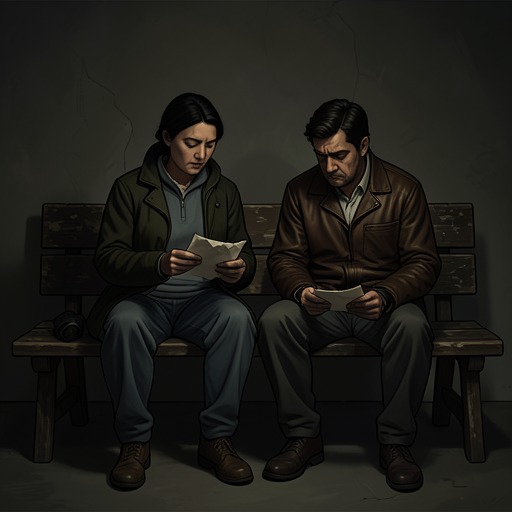
Acharya’s psychological crisis and transformation
Serious MenArvind Acharya’s psychological crisis and transformation follow his disgrace and suspension from the Institute of Theory and Research. At first, he appears to have lost not merely his position but his capacity to feel. A sudden return of happiness then overturns that emptiness: he decides that the self destroyed by the scandal was his public stature, not his mind or spirit. The recognition frees him to pursue ideas he had previously feared would cost him his reputation, but the freedom also carries him into a form of happiness that unsettles his family and changes the place he occupies in the Institute.
Disgrace and Emotional Numbness
After the trial and his suspension, Acharya moves through the Institute as if cut off from his former life. Others see a fallen man, but the account describes something more vacant than ordinary shame or grief: he feels no pain, anger, or humiliation, and his fixed gaze seems unable to settle even on his memories. The disgrace has deprived him of the identity through which he understood himself, leaving him unable to recognize what remains.
He continues to come to the Institute every day, wandering across its grounds and sometimes stopping to stare at his feet. Old friends greet him; he answers with a weak look and a nod. Young postdoctoral researchers insult him, and he nods to them too. Their different responses meet the same blankness. His wife, Lavanya Acharya, tries to console him, but she cannot find a way to reach someone the narrative compares to a man separated from life. His suspension also diminishes her standing among the wives in the Professors’ Quarters, making his professional fall a change in her social circumstances as well as his.
The damage reaches his daughter, Shruti Acharya. She had urged her father to be brave, but after reading about his affair online, she asked her mother whether it was true and stopped speaking to him. Acharya is not affected by her anger; he is grateful to anyone who offers silence. The estrangement thus deepens the crisis without breaking through it. His emotional vacancy makes even the reactions of people closest to him seem distant.
The Turn from Despair to Liberation
The change comes suddenly one Monday. Sitting beneath a solitary palm in the Institute’s backyard, Acharya finds himself happy, and with that feeling his life and memories seem to return. The scene does not present a new achievement or reconciliation as the cause. Instead, his shift follows a change in how he understands what has happened to him: the trial did not kill his mind or spirit, he concludes, but his stature.
His former identity had been built around extraordinary public claims: the great Arvind Acharya, a scientist associated with opposition to the Big Bang, and the supposed discoverer of alien life. He had imagined that the numbness was a kind of death. He now interprets it as relief from the burden of maintaining that grand identity. The reversal is therefore both psychological and intellectual. What first looked like the extinction of the self becomes, in his account, release from the reputation that had confined it.
The narrative sets this insight beside his earlier contemplation of suicide at home. From the balcony, nine floors above the driveway, Acharya considers the practicalities of the act and finds the process unaesthetic. Yet his attention keeps returning to questions he still wants to pursue: gravity, the nature of time, life, and infinity. Even while considering an end, his mind remains attached to unresolved problems. His fear also turns toward Lavanya’s possible future as a widow, and toward the possibility that she might be happier with his memory than with him alive. The episode exposes the bitterness and jealousy beneath his scholarly detachment, while the realization beneath the palm gives that despair a different meaning: he can relinquish the public figure without relinquishing inquiry.
A New Science of Predestination
Acharya’s freedom is not a return to his earlier scientific program. He believes that his boyhood experience had tormented him for years, and that he concealed its implications behind the authority and apparent solidity of science. His reputation as a genius, he thinks, made it easier to pursue mathematical truth while making it harder to speak openly about his belief that every action is predetermined or to investigate the purpose of life. Once stripped of his standing, he feels able to become a prophet of a different science—one organized not around particles and forces but around what he calls the great game of life.
He begins to imagine ordinary choices and natural events as part of the same pattern as cosmic events. A shopper choosing cabbage rather than brinjal, or a traveler turning left rather than right, might be as preordained as the birth and death of a star. Even a butterfly’s movement or a flower’s shudder in the breeze may, in his hypothesis, have been determined aeons earlier. His examples bring the vast question of determinism down to everyday decisions, while also making the theory difficult to separate from the personal crisis that gives it urgency. Acharya decides that the world has power to shame him only if he grants it that power; abandoning his former reputation allows him to pursue these ideas without the same fear of public judgment.
Family Estrangement and the Basement Following
At home, Acharya tries to explain himself to Lavanya through a confession about a remark he once made at a Cosmic Ancestry seminar, but she laughs and offers him coffee rather than solving the mystery of his sudden change. Her response is warm, yet it cannot restore their former understanding. Her mother’s old prediction—that Acharya would one day go mad—returns to Lavanya’s mind. Lavanya had once answered that he seemed happy; the remembered exchange holds together the two states that define the transformation, happiness and apparent madness, without making either a simple cure for the other.
Later, Lavanya tells him that she had managed to live with him because he had tried not to appear mad. Now she cannot bear his unaccountable joy or his habit of speaking to objects as if they had asked him questions. She says his constant happiness makes her feel unnecessary, while also telling him that her difficulty is not embarrassment but an inability to handle what he has become. She leaves for Chennai to be with her family. Acharya’s intense love for her persists; in the basement, he experiences it as more frightening than the love he had felt for Oparna Goshmaulik. The change that liberates his thinking therefore costs him the everyday closeness of his marriage.
After Lavanya leaves, Acharya spends his time in the Institute basement, where lamps let him multiply his shadow across walls and floor. He imagines these shadow-figures as beings with the same memories, theories, and wife as himself, and grants them reality because perception is, to him, an uncertain basis for deciding what exists. The shadows offer an imagined company of figures who understand and love him. In time, scientists and students gather around him to discuss the philosophical future of physics, extraterrestrial life, and questions about why life exists in the universe. His crisis has not returned him to his old authority; it has transformed him into an isolated, increasingly eccentric thinker whose loss of public stature opens a new intellectual direction even as his altered happiness drives his wife away.