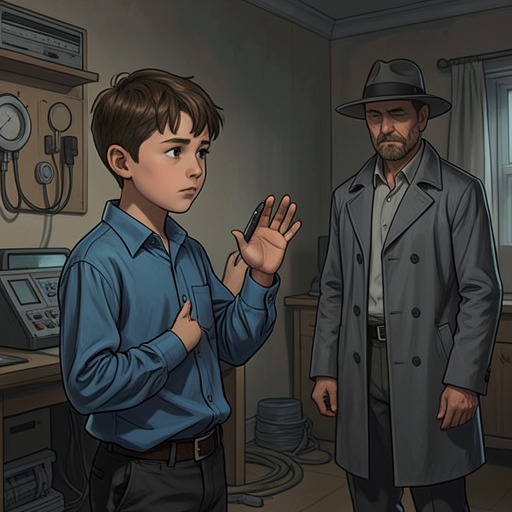
Adi's hearing aid
Serious MenAdi's hearing aid begins as an ordinary but visible part of Adi Mani’s life, its white wire running from his left ear into his shirt. It becomes something more complicated when Ayyan Mani turns it into part of the apparatus behind Adi’s staged brilliance. The device records both a real bodily difference and the family’s struggle over how that difference will be seen: at home it is handled with care, while in public Ayyan tries to hide it, then uses its appearance to support a performance that nearly betrays him.
Appearance and Everyday Use
The aid is present from Adi’s first appearance on the terrace. Among children running beneath a starless sky, he stands apart, quiet and observant, with a hearing-aid strung to his left ear and its white wire disappearing into his T-shirt. The detail makes his hearing impairment visible before the narrative explains its extent. As he grows, the family learns that he is almost entirely deaf in that ear. The aid is therefore not simply an emblem: it belongs to the practical circumstances of a boy whose hearing is uneven.
Its use is not effortless. In the heat of September, sweat runs from Adi’s oiled hair into his ears. He repeatedly removes the hearing-aid to wipe it, then replaces it, tolerating the discomfort without appearing to recognize it as such. The moment gives the device a material presence: it needs attention, is affected by weather, and interrupts the ease of wearing it. It is part of an ordinary routine, not an invisible cure that makes the impairment disappear.
A more intimate routine takes place after Adi comes out of the bathroom in a towel. Ayyan dries him and helps him put the aid on, binding its small white box around the boy’s stomach. A wire runs from the box; Ayyan blows into Adi’s left ear to dry it, making him giggle, and then fits the earpiece into place. The scene contrasts the device’s public visibility with the patient, physical care it requires at home. Ayyan’s attention is gentle and specific: the aid must be fitted, the ear dried, the wire arranged.
A Family Disagreement Made Visible
The impairment also becomes part of a dispute between Adi’s parents about religion and misfortune. When Oja Mani cries, she connects Adi’s ear to the absence of gods, wondering whether this would not have happened if they had had them. Ayyan responds sharply, while Oja insists that the Hindu gods are hers too. The hearing-aid is not the cause of their disagreement, but Adi’s hearing difference gives their incompatible explanations a painful focus. For Oja, it is a possible sign of divine anger; Ayyan resists that interpretation rather than accepting the impairment as evidence against their family’s beliefs.
The device also gives Adi a small means of refusing demands. When Ayyan asks him what happens at the end of a story, Adi takes off the aid and closes his good ear with a finger. During the later argument about the household’s Ganesha idol, he again removes it, this time shutting his right ear. These gestures are not explanations of what Adi thinks; they are concrete acts that change what he can hear. In a noisy family exchange, the aid can be taken off, and his body can withdraw from the argument even while his parents continue it.
The Aid in Ayyan’s Performance
The object changes function when Ayyan presents Adi’s supposed ability to recite prime numbers. After Adi makes a mistake during the recital, he removes the earpiece and glances quickly at his father. Ayyan steps between his son and the photographer, removes the earpiece, and asks that Adi be photographed without it so he will not appear handicapped. The request exposes a tension in Ayyan’s project: the device is part of his son’s everyday life, but Ayyan fears that it will alter the public image he is building. Rather than let the photograph show Adi as he is, he tries to control which evidence of difference reaches the newspaper.
The arrangement used for the interview is more elaborate. Ayyan puts the earpiece back in Adi’s good ear. It is a Walkman earpiece fixed to the shell of the hearing-aid, with the Walkman taped beneath Adi’s shirt to his stomach. The aid’s familiar form thus conceals a second function: it is incorporated into the equipment through which Ayyan guides the performance. The device remains recognizable, but what it does in this scene cannot be read from its appearance alone.
The newspaper photograph preserves the contradiction. The article announces that the boy can recite the first thousand primes and shows Adi beaming, apparently wearing a hearing-aid. Ayyan had wanted the aid excluded from the picture, yet the photograph includes what looks like one. Its apparent position on Adi’s right ear, the good ear, is the detail that makes the image misleading and potentially revealing. The printed photograph is not a transparent record: it presents an image that Ayyan’s staged arrangement has already complicated.
Misplacement and Near Exposure
When Arvind Acharya sees Adi, he notices the discrepancy between the photograph and the boy in front of him: in the paper the hearing-aid appears on the right, while Adi now wears it on the left. Ayyan answers that the photograph was accidentally flipped. Acharya accepts the explanation and does not pursue the anomaly, being more interested in the boy. The device has therefore come close to exposing the construction of Adi’s public identity, but its misleading appearance gives Ayyan a ready excuse.
Across these scenes, the hearing-aid’s significance lies in the distance between use and display. At home, it is a small piece of equipment that Ayyan dries, fits, and adjusts for his son; in the taxi, sweat makes it irritating to wear; during arguments, Adi can remove it; in the interview, Ayyan folds it into a deception; and in print, its apparent placement produces a discrepancy sharp enough for Acharya to notice. The same visible object can register care, bodily discomfort, refusal, concealment, and risk. It does not erase Adi’s hearing impairment; instead, the choices made around it reveal how Ayyan’s ambition depends on managing what others are allowed to see.