Adi’s Performance at St Andrew’s School Inter-School Science Competition
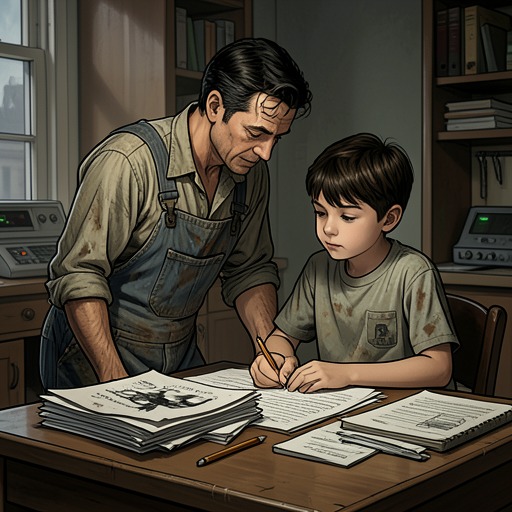
Serious MenAdi Mani’s performance at St Andrew’s School’s interschool science quiz turns a staged display of precocious knowledge into a public spectacle—and brings Ayyan Mani’s invention of his son’s genius to a limit. From the audience, Adi calls out correct answers during the contest; Ayyan’s whispered encouragement makes clear that he is managing the display, even as its growing success frightens him. The final interruption sends father and son out of the auditorium together, leaving the acclaim behind and the game close to its end.
The occasion and its opening
The quiz finals were the culmination of written elimination rounds involving five hundred tenth-standard students from fifty schools. Six teams had qualified. St Andrew’s was hosting the finals, but its own teams had been disqualified in the preliminaries. Sister Chastity stressed that the school had accepted this outcome rather than unfairly favouring its own contestants. She also told Ayyan that a special participant from the school could take part for honour, without competing for the prize. The arrangement gave Adi a place in the event outside the ordinary team competition.
The auditorium was full. Six tables stood in a semicircle on the stage beneath a board identifying the event as St Andrew’s School’s First Interschool Science Quiz. Students crowded onto wooden benches along the red-carpeted aisle, while parents and teachers sat farther back. Adi was in the sixth row. Some of the older-looking students had faint moustaches; to Ayyan, the boys and girls around his son seemed strikingly grown. Oja Mani, seated among the adults, toyed with her thin gold-chain pendant and watched the other mothers. The audience and the formal stage gave Adi’s appearance the scale of a public examination, though he was not competing for the prize.
The quizmaster, the school’s senior mathematics teacher, introduced the rules and invited the contestants to introduce themselves. The first round was physics. Its opening question concerned the Michelson–Morley experiment: the scientists had set out to demonstrate the existence of ether, but their work instead established that light travels at the same speed regardless of the observer’s motion. The grim members of Team A did not nod when asked whether they were ready. The formal, team-by-team structure was already in place when Adi’s voice first broke into it.
Answers from the audience
The next question asked what Sir James Chadwick was known for discovering. Before the contestants answered, a small voice from the hall supplied neutron. The response left the people onstage confused and the members of Team B angry. Adi’s answer had landed outside the rules of the contest: he was not at the team table, yet his knowledge had made him impossible to ignore.
The interruptions continued. Three further questions followed a similar pattern: contestants glanced anxiously toward Adi, the audience waited for his response, and someone onstage eventually supplied an answer. That sequence eased the tension in the hall, but it also shifted attention away from the teams and toward the boy in the sixth row. Adi was not simply demonstrating what he knew; his presence was changing the rhythm of the quiz and turning the audience into witnesses to his apparent brilliance.
For the final question of the first round, the quizmaster described a scientist who had spent his last days trying to turn ordinary metals into gold. Adi called out Isaac Newton. The hall fell silent again, then began to murmur. Sister Chastity stood in the aisle with her arms akimbo. Oja covered her mouth with quivering fingers, frightened as the parents around her turned with smiles of regard and envy.
Ayyan rose, apologized loudly to the Principal, and made his way down the aisle. The children on the benches lifted their legs to let him pass. Reaching Adi, he bent toward the boy’s good ear and pointed a stern finger as though reprimanding him. Instead, he whispered, “Excellent, my son. Just one more time.” The gesture exposed the private coordination beneath the public display: Ayyan appeared to correct Adi while urging him to continue. He then returned to his seat, embarrassed by the many eyes on him, and apologized again to Sister Chastity. She graciously acknowledged him, then called for Adi to behave. The quizmaster confirmed Newton as the answer, and the hall applauded at length, though no one stood.
The interruption and the exit
The quizmaster warned that Adi must stop answering unless a question was passed to the audience; otherwise, he could be asked to leave. The warning marked a limit the earlier questions had blurred. The teams still had their turns, the quizmaster still controlled what counted as an answer, and Adi’s uninvited brilliance threatened to overwhelm the contest’s structure. Team F looked nervously toward him as the quizmaster presented the next question: Who was the second man on the Moon?
Adi shouted an incorrect pronunciation of Buzz Aldrin’s name. The quizmaster looked down at the floor, and Sister Chastity stood. Ayyan jogged down the aisle again, while the children lifted their legs to make way. This time he led Adi out of the row by the hand and through the narrow aisle. The audience, which had watched the earlier passage with astonishment, was now enjoying the repeated spectacle of Ayyan crossing the hall. Behind them, the quizmaster supplied the correct name. A standing ovation followed as father and son headed for the exit.
The contrast between the applause and Adi’s removal makes the scene’s turn especially sharp. His answers have won recognition, but his interruptions have also made him a problem for the event. Ayyan tries to look embarrassed as he leads him away, while Adi beams. The exit is at once a comic retreat and a boundary: the performance can no longer continue in the auditorium on the same terms.
The game reaches its limit
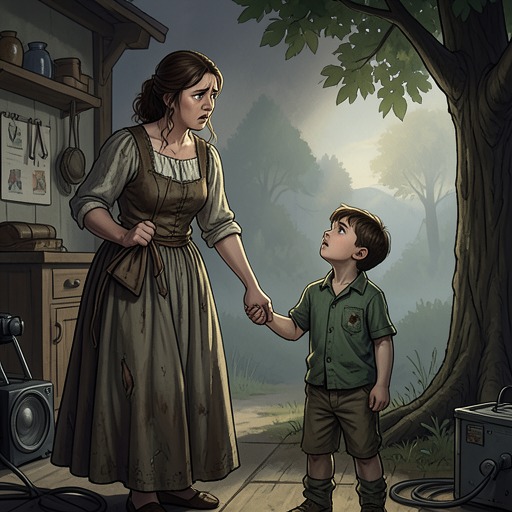
In the corridor, Ayyan and Adi laughed together. Oja appeared at the far end, crying as she ran toward them; she stopped to adjust her hair and look around, then hurried on before running again. Ayyan understood that the day had given her a life-changing glimpse of public admiration for her son. He recalled the distance between this moment and her earlier circumstances: she had grown up as a waiter’s daughter, entered a humid one-room home as a new bride, and learned that Adi could not hear well in one ear. The public triumph brought pride, but it also sharpened Ayyan’s unease. He felt both excitement and fear because he knew he was stretching the limits of the game and that it had to end.
Oja dropped to her knees beside Adi, held him by the hair, hugged him, and then held his arms as she asked how he knew so much. She called him bright and weird, kissed his nose, and said she would put an evil eye on his cheek. Her affectionate amazement captures the success of the illusion from within the family: she sees a remarkable son, while Ayyan knows how deliberately the public image has been managed. He dismissed the idea of using the protective mark, but the gesture of Oja’s concern remained part of the scene’s emotional aftermath.
The decision to stop the performance became explicit the following day at the Institute. Ayyan had already told Adi the night before that the game was over, and Adi had accepted this with some sadness. At the Institute, while people gathered to see the boy whose brilliance they had read about, Ayyan resolved that there would be no more clever lines supplied in class, quiz questions made to fall conveniently into Adi’s path, or newspaper articles about him. The quiz had therefore been more than a moment of successful display: it was the point at which acclaim and risk became inseparable. Adi’s answers brought his parents admiration, but the spectacle also showed how far Ayyan had taken the fiction—and why, after the corridor’s laughter and applause, he believed it was time to end.