Adi’s partial deafness
Serious MenAdi Mani’s partial deafness is both a practical condition and a point of tension in the story’s account of how a child is seen. He can hear through his right ear but not his left, and uses a hearing aid; at school, the distinction between being regarded as extraordinary and being treated as a child with a disability becomes bound up with Ayyan Mani’s fabricated genius persona. The device helps make his impairment visible, yet a staged newspaper photograph turns it into a misleading sign of exceptional achievement.
Identity and everyday experience
Adi Mani is described as partially deaf, and the narrative makes the condition specific rather than leaving it as a general label: he can hear without the hearing aid, but only in his right ear. The left ear is the one for which the aid is fitted. This asymmetry matters to how he moves through the story, because the device is not merely an abstract marker of disability; it is part of the practical arrangement through which he hears.
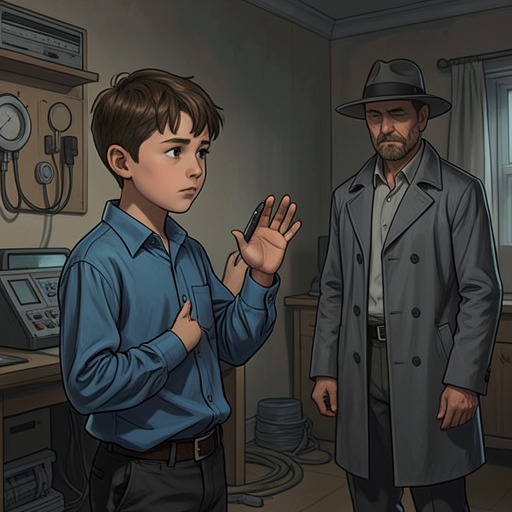
At school, adults initially interpret Adi Mani’s unusual questions as signs of a bright, curious child. His comments can sound strikingly precise, but when teachers try to extend the discussion, he falls silent. He knows only what his father has taught him about the subjects he raises. The staff accept this reserve as consistent with a little boy who is odd and laconic, and partly deaf. The account therefore separates his hearing impairment from the limits of his knowledge: the silence following a question does not establish an inability to think, but exposes the narrow preparation behind the appearance of broad expertise.
The hearing aid and its care
A scene of ordinary care presents the device in detail. After drying Adi Mani, Ayyan Mani helps him put on the hearing aid: a small white box is bound around the boy’s stomach, a white wire runs from it, and the earpiece is fitted into his left ear. Ayyan Mani first blows into that ear to dry it, and Adi Mani giggles; his father repeats the gesture before placing the earpiece. The moment shows the aid as an everyday necessity handled within the family, not simply as a prop in the public story of the boy’s supposed talent.
The same domestic scene holds affection and awareness of impairment together. Ayyan Mani playfully touches his son’s oiled hair and thinks of him as beautiful and healthy, then feels the hearing aid’s hard form at the other ear. The juxtaposition does not make the device disappear into a general account of parental tenderness. Instead, the physical aid interrupts that impression, keeping Adi Mani’s particular hearing needs present within his father’s loving attention.
School status and the constructed image
The school’s response to Adi Mani changes as his questions become more elaborate. At first, teachers find them endearing; later, they try to engage him in conversation about light, sound, and the ocean. When he cannot continue beyond what Ayyan Mani has taught him, he clamps up. His partial deafness helps explain how the staff frame his quietness, but the narrative also shows that the public impression of unusual knowledge has been deliberately cultivated at home.
Adi Mani begins to enjoy the attention. He understands that people consider him extraordinary, a status he values over being called special, a term associated in his mind with children regarded as handicapped. He does not believe that he is really handicapped, although he knows he can hear only with his right ear unless he uses the aid. His response makes the labels socially consequential: the same child and the same hearing condition can be read through different categories, and one category brings him a recognition he fears losing.
A newspaper photograph sharpens that conflict. An article presents Adi Mani as a boy genius who can recite the first thousand primes, and the accompanying image shows him wearing what appears to be a hearing aid. In fact, the earpiece is on his right, good ear. The placement is easy to miss, and even Oja Mani does not notice it. The photograph thus makes the device part of the public image while concealing the detail that would identify how his hearing actually works. It does not erase the impairment; it turns the aid into a carefully managed visual sign within the family’s deception.
Family, future, and significance
Ayyan Mani’s role is central to the way Adi Mani’s condition intersects with his manufactured reputation. Ayyan Mani has taught him the material behind his questions and presents himself as the father of a genius, while another adult presses him to consider how he will support that son’s future. The prospect of a future for the supposed prodigy sits beside the practical reality of a child whose needs include a hearing aid. The available scenes do not show the device as the cause of the deception, but they do show how the deception alters the meaning attached to Adi Mani’s difference.
Adi Mani’s attachment to the secret pact with his father grows as he recognizes that his mother might oppose their game and that its end could cost him his standing at school. He fears that without the genius identity, people will return to calling him special. His anxiety is therefore not simply about losing attention: it concerns losing a valued social identity and being returned to a category he rejects. The hearing impairment remains real while the interpretation of it shifts according to how adults and classmates respond to him.
The novel also places this child’s imagined future against a broader account of educational competition. Ayyan Mani foresees the pressure on his son to pursue engineering and compete in entrance examinations, while the account of that future includes the stigma attached to Dalit reservation. These projections do not establish that Adi Mani’s hearing loss determines his later prospects. Rather, they underline how many labels and expectations may be imposed on him before he can define what he wants. His hearing aid offers a concrete counterweight to the genius performance: it records an everyday bodily fact that neither the newspaper image nor the school’s preferred story can fully explain.