Arvind Acharya
Serious MenArvind Acharya is a distinguished but combative scientist whose authority at the Institute of Theory and Research rests on an uncompromising faith in his own scientific convictions. He fights to define what research deserves institutional support, rejects the Big Bang and the search for extraterrestrial signals, and pursues the possibility that life arrived on Earth from space. The Balloon Mission makes that conviction consequential: it brings him close to a historic discovery, then collapses into scandal when he confesses to ordering research falsified. His fall destroys not his curiosity but the public stature that had enclosed it, leaving him to imagine a new way of investigating the universe.
Identity and Scientific Convictions
As director, Acharya occupies a room at the end of a corridor in the Institute, behind the anteroom where his secretary, Ayyan Mani, receives callers and manages access. The setting makes his authority tangible: Acharya is at once a scientist with a private intellectual world and the institutional gatekeeper whose decisions determine what work can proceed. He is known for forceful judgments and a manner that leaves colleagues uncertain whether he is joking, inviting debate, or delivering a final verdict.
Acharya’s opposition to the Big Bang theory reaches back to the height of his intellectual powers, about three decades before the events surrounding the Balloon Mission. He regards the theory as a religiously inflected account of beginnings and argues instead for a universe without beginning or end. His resistance is not a passing provocation: he spends years attacking the theory, and his reputation as its old foe becomes part of his public identity. Work on gravitational collapse had led many to think that he might win a Nobel Prize if he moderated his opposition, but he does not temper it to improve his prospects.
A childhood experience, disclosed much later to Oparna Goshmaulik, helps explain why Acharya’s public life is shadowed by a private mystery. When he was about nine, while walking with his family to a circus, he experienced a vivid premonition of a dwarf’s fatal accident during the show. The events then unfolded as he had foreseen them. The episode became a secret he carried into adulthood, hidden behind the authority and rational prestige of science. In his later reckoning, his early talent for mathematical truth-seeking had helped cloak an experience he could not readily explain.
Defining Science and Contesting SETI
Acharya’s most sustained institutional conflict is with Jana Nambodri over the use of the Giant Ear. Nambodri presses him to let radio astronomers search for signals from intelligent extraterrestrial civilizations, citing worldwide requests to use the instrument, discontent among the Institute’s astronomers, and potential usage fees. Acharya refuses. He dismisses the search as a form of human self-projection: in his view, scientists are imagining beings sufficiently like humanity to build radio transmitters, rather than confronting the possible diversity of life. He also argues that publicity, not scientific seriousness, drives the quest.
The disagreement exposes two different standards for deciding what constitutes worthwhile science. Acharya insists that researchers should pursue what he considers real science, rather than use the Giant Ear for what he sees as an ungrounded search. Nambodri answers that even a remote mathematical possibility can justify a search for truth, and that hope has a place in scientific inquiry. Their conflict is not simply about equipment or funding. It concerns who has the authority to classify a research question as science, whose curiosity an institution should serve, and whether uncertainty is a reason to investigate or a reason to refuse.
At a public challenge to Acharya’s position, Nambodri raises the wider complaint: Acharya has repeatedly denied the Giant Ear to SETI researchers and publicly rejected their work. Acharya’s opposition has become an exercise of institutional power, not merely a private theoretical preference. Yet he is not a skeptic about every extraordinary possibility. He believes that microscopic organisms arrive from space and that spores carried by comets or meteorites may seed life on worlds unlike Earth. He even allows that life elsewhere might take forms beyond human imagination. His boundary is therefore not between conventional and extraordinary claims, but between questions he considers intellectually serious and those he believes merely reproduce human expectations.
The Balloon Mission and Oparna
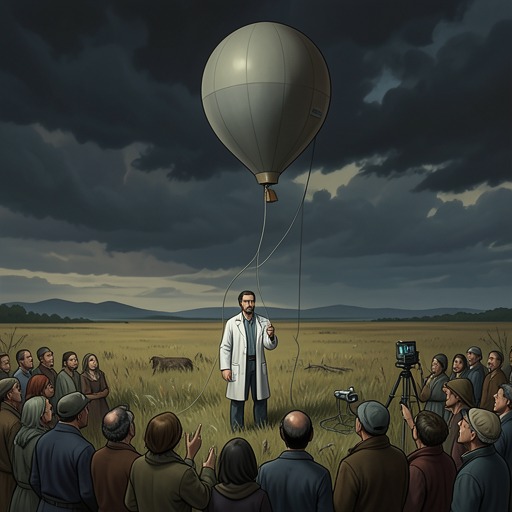
The Balloon Mission gives Acharya’s belief a concrete experimental form. A high-altitude balloon is to carry sterilized containers to 41 kilometres, where they will capture air; the containers will then be examined in Oparna’s laboratory. Acharya expects the experiment to test whether living matter can be found at that altitude and support his view that life reaches Earth from space. The plan binds his cosmological conviction to a specific instrument, a series of samples, and the work of a research team.
Two days after Acharya speaks at the Institute’s annual Talks, the basement laboratory becomes a centre of activity. Acharya begins arriving before nine, accompanied by research assistants, while old friends from around the world return temporarily to help. Their visits soften his isolation: they embrace, recall their earlier scientific battles, and make the project into a fellowship as well as an experiment. When they discuss a name for the mission, Acharya joins in and suggests Superman before the group settles on Balloon Project. The scene shows him animated by shared work, not only by the fight to defend his theories.
Oparna’s place in the project grows alongside her personal connection with Acharya. She coordinates the work and studies the material in the basement laboratory; after the visiting colleagues depart, she can enter Acharya’s office freely, and the two often work together late into the night. She also sees the intensity behind his convictions. At the Institute’s Talks, he warns the departing research scholars that many may never make discoveries of their own, but should not obstruct people of exceptional intelligence. He then turns to the Balloon Mission, communicating his certainty that microscopic life is falling to Earth. The speech and the subsequent laboratory activity make his belief both an intellectual position and a source of collective momentum.
Discovery, Scandal, and Suspension
When the balloon flies over Hyderabad in the first week of November, it carries four samplers. Three go to laboratories in Boston and Cardiff; the remaining sampler is delivered to the Institute. Oparna’s team and two American scientists examine it in isolation from the rest of the Institute. Their findings initially appear to vindicate Acharya: living matter is reported at an altitude where bacteria and fungi were not believed to exist. Acharya receives the news in silence, then tells the press that humanity has been living with aliens. His claim that life may have come from space gains an apparent experimental foundation.
At the press conference, however, Acharya describes the extraterrestrial origin as a reasonable guess supported by several facts, not a conclusion. He points to the difficulty of explaining how the material reached such an altitude and the very small likelihood of contamination from defunct satellites. Asked whether the sample could have been contaminated in the laboratory, he replies that precautions were taken and that the organisms are rare and difficult to culture. The qualifications matter: the discovery is presented as evidence for a hypothesis, while the reliability of the sample remains central to whether that evidence can bear the weight placed on it.
That reliability becomes the basis of the Institute’s internal inquiry. In a letter to the Ministry of Defence, Oparna states that Acharya pressured her to contaminate a sampler after the first results showed no life, and to produce a report supporting the claimed discovery. She says that he threatened professional consequences if she refused, and takes moral responsibility for her own part by offering to resign. The allegation turns the project’s central object—the sampler—from a possible trace of extraterrestrial life into the focus of a dispute over the integrity of the experiment.
The inquiry’s public outcome is decisive. Acharya confesses that he ordered Oparna to falsify the research in an attempt to prove that life had been found at 41 kilometres. The Institute also reports misuse of its funds for the Balloon Mission and a long-running pattern of conduct that humiliated colleagues; it cites other activities in the basement without specifying them. Acharya is suspended, and Nambodri becomes acting director. The project that had briefly made Acharya the apparent discoverer of alien life instead establishes the grounds for his professional disgrace.
Fall, Reassessment, and an Uncertain Future
Acharya’s crisis is bound up with the loss of his reputation. After the trial, he understands his numbness not as the death of his mind or spirit, but as the destruction of his stature: the celebrated scientist, the Nobel laureate who never received the prize, the opponent of the Big Bang, and the discoverer of aliens. Those identities had made him formidable, but they had also trapped him. He recognizes that his reputation had helped conceal the childhood premonition he could not explain and had made him fear that an inquiry into life’s purpose or predestination would cost him the standing he had earned.
Once that standing is gone, Acharya imagines himself free to pursue a different science. Instead of explaining the universe only through particles and forces, he considers investigating what he calls the great game of life. His questions turn toward ordinary choices: whether the decision to buy one vegetable rather than another, or to turn left instead of right, might be as predetermined as the birth and death of a star. He does not present this new direction as an established theory or completed research programme. It is an opening made possible, paradoxically, by the collapse of the identity he had spent his life protecting.
His relationships remain entangled with this change. In a bleak moment, he thinks about his wife, Lavanya Acharya, and whether she might find happiness after his death; later, Ayyan urges him to go and get her, behave more normally, and consider a future. Oparna, once his closest collaborator on the Balloon Mission, becomes inseparable from the discovery’s falsification and the inquiry that follows. The evidence thus places private attachment beside professional collapse without allowing either to undo the consequences of his confession.
Ayyan offers Acharya a practical possibility rather than an answer to his scientific crisis. He says he has come with a future and asks where the Joint Entrance Test papers are stored, adding that he knows about Aryabhata Tutorials and the three printers. The exchange points toward a scheme involving examination papers, but it does not establish what Acharya will do next. His ending is therefore deliberately unsettled: the director stripped of office and scientific prestige has begun to imagine a life beyond the authority that once defined him, while an unorthodox offer opens a new course whose outcome remains unknown.
Narrative Role and Significance
Acharya’s trajectory connects the novel’s scientific arguments to questions of authority, belief, and self-invention. His conflict with Nambodri demonstrates how institutions police the boundary between credible research and purported nonsense, while the Balloon Mission shows how conviction can produce genuine experimental effort and also become the rationale for misconduct. The confirmation of fraud does not retroactively settle every scientific question Acharya raises; instead, it forces a distinction between the possible truth of a hypothesis and the integrity of the means used to claim it.
His downfall also reverses the meaning of his eccentric certainty. For much of his career, confidence appears to be the source of his power: he can bar the Giant Ear from SETI, rally a team around the Balloon Mission, and command a room with his theories. After the inquiry, that same public stature is revealed as a burden he had feared losing. The novel leaves him not vindicated but newly exposed to questions he had postponed. His possible turn toward predestination and the patterns of ordinary life emerges from that exposure, preserving the central tension of his character: a passionate search for truth repeatedly complicated by the stories he tells about what he knows.