Arvind Acharya and Lavanya Acharya’s marriage through the affair crisis
Serious MenArvind Acharya and Lavanya Acharya’s marriage is a decades-long bond whose intimacy is expressed less through declarations than through remembered jokes, practical care, and habits of living together. Arvind’s affair with Oparna Goshmaulik forces that quiet attachment into the open, but does not erase it: Lavanya is shaken by what he tells her, yet remains capable of compassion for him and affection for the life they have shared.
A young marriage formed in public view
Arvind and Lavanya married when he was still a student. After their wedding in Sivagangai, he prepared to take her to Madras, accompanied to the station by relatives whose tears concealed laughter. An aunt joked about whether he was taking his new bride to his hostel room, turning the newlyweds’ departure into a teasing public spectacle. The episode establishes a tone that recurs in their early life: embarrassment and amusement mingle, while the couple faces the world as an object of other people’s attention.
In Madras, Lavanya felt isolated enough to write long, melancholy letters to her mother. Arvind secretly read one. Its account of his work on gravity showed that she found his research absurdly specialized, yet also saw him as useful and amusing in the domestic world. He could lift rice sacks into the loft without a stool; his calm obedience tempted her to invent errands for him; and when she tried to bow at his feet in a temple, his startled jump made her laugh. These recollections do not present their early marriage as solemn or idealized. Its affection appears through teasing, everyday observation, and the delight Lavanya took in Arvind’s peculiarities.
Their affection also existed within a society that made their bodies conspicuous. They were both unusually tall for the time and place, and could not hold hands in the street. Shopkeepers, drivers, pedestrians, and children mocked or pointed at them; even crying babies were silenced when their mothers directed them toward the couple. The recollection gives their marriage a shared, exposed quality: they had wanted the comfort of holding hands, but public scrutiny made even that small gesture difficult. The narration says they wanted the contact not only out of love, but also as a way to heal.
Shared life, work, and practical care
Lavanya’s memories preserve a form of closeness that neither spouse had needed to name. On long flights over the Atlantic, her thick hair tickled Arvind’s nose as she slept with her head on his shoulder. Remembering those first beautiful months, Arvind recognizes the intimacy of their life before either of them called it love. The physical details matter because they make the marriage legible through repeated proximity rather than through formal declarations.
Their partnership also changed alongside Arvind’s career. Influenced by an uncle, he left his studies to join India’s early space programme at Thumba. When he became disillusioned with its limited means and ambitions, he went to Princeton to study cosmology and took Lavanya with him. His later absorption in gravitation became one of the defining features of his life; their shared history includes the choices and relocations that made that work possible. The account does not reduce Lavanya to a supporting role, but shows her life intersecting with the turns of Arvind’s scientific vocation.
Care remains visible in the marriage long after its early years. When Lavanya tells Arvind that Anju is dead, she is in tears. They take a taxi to the airport in heavy rain because Lavanya says he should not drive. Arvind insists that he can, but she prevails, as she often does in such matters. The small disagreement conveys familiarity as well as concern: even amid grief, they move through a practiced pattern in which she judges what is safe and he resists her assessment.
The affair enters the marriage
Arvind’s attraction to Oparna develops at the Institute, where she is his colleague and the head of Astrobiology. On one occasion he reaches the door of her laboratory, imagines the life and love he has shared with Lavanya, and turns away without entering. His recollection of Lavanya is not an abstract appeal to duty: it arrives as images of her as a bride, walking beside him, sleeping against his shoulder, and sharing the early years when their love did not require a name. The retreat marks a moment when the remembered marriage still has the force to interrupt his movement toward an affair.
That restraint does not settle the matter. After Lavanya returns from an absence of two weeks, she notices that Arvind has used deodorant and jokes that he has become strange while she was away. While drying his chest, she teases him about the absence of lint in his navel and asks if he is having an affair. He answers yes. The confession begins in the language of domestic play, but its directness changes the room: Lavanya turns back to him only after the word has had time to register.
Arvind identifies Oparna as a woman who works with him. When Lavanya asks whether he loves her, he says he does not know. He also explains that the relationship is taking place in the basement of the Institute. The exchange is strikingly spare: Lavanya asks for the facts that might give the betrayal shape, while Arvind cannot offer certainty about the emotion behind it. His uncertainty does not make the disclosure harmless; it leaves Lavanya to confront both the affair and the destabilizing question of what it means for their marriage.
Lavanya’s response and the bond’s unresolved state
Lavanya leaves the bedroom and spends the night awake on the couch. She first experiences the revelation through an unsettling absence: she is shocked that Arvind has had an affair, but frightened that she does not feel sad. Her fear turns backward as well as forward. She wonders whether she ever loved him enough and what their life of more than four decades had been, even as she recognizes that she does love him. The contradiction is central to the scene: the marriage cannot be summed up either as unbroken devotion or as an arrangement emptied of feeling.
Lavanya’s memories restore a more complicated picture. She remembers Arvind as a stranger in the present and as someone she loves when she thinks of him through their past. She wants to touch his bald head, reassure him, and see him happy, recalling the young groom who eagerly told her how fast the Earth moves. Her compassion is not presented as approval of his affair. Instead, it coexists with the wound, revealing an attachment that can hold affection and injury at once.
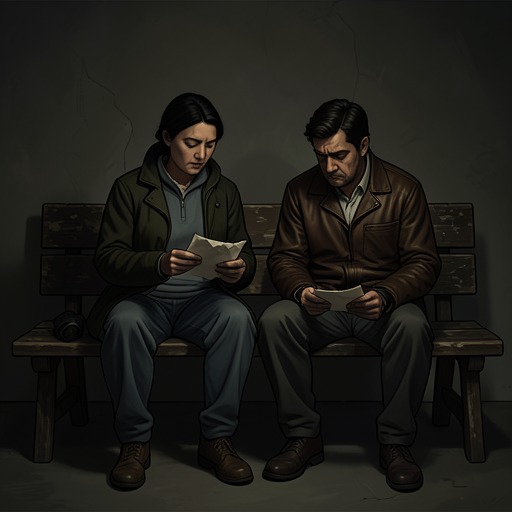
The morning after the confession, the couple shares the house without resolving the breach. Arvind sits in the hall, handling a spoon and the edges of a newspaper, and remains there while the maid cleans around him. Lavanya goes to the kitchen, and the cook brings him coffee and breakfast; later, he finds and heats food in the refrigerator because Lavanya does not cook that evening. They occupy the same home but do not resume their former ease. The passage leaves the marriage in suspension rather than declaring either reconciliation or separation: its accumulated history remains present, while the affair has made their shared life newly uncertain.